



Apple Growers Of The Year Reflect On The State Of The Industry
 April 1, 2008
 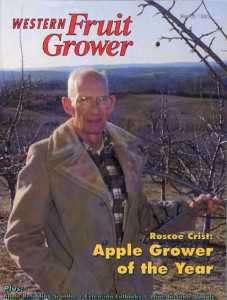 Roscoe Crist (1993)
Adapting to change was always a key element to the way J. Roscoe Crist, American Fruit Grower’s 1993 Apple Grower of the Year, did business. Crist’s willingness to break new ground and work on behalf of the apple industry earned him the award in its fifth year, not to mention a great deal of respect throughout the industry. Crist Brothers Orchards Inc. was founded in 1882 by Roscoe’s grandfather as a small general farm and transformed into an apple orchard by his father. Roscoe and his brother Edward took over in the 1950s. Today, Crist says staying in business for more than 50 years was his most important accomplishment, and credits his “ability to adopt new practices as they came along.” Quoting Alexander Pope, he says, “Be not the first by whom the new are tried, nor yet the last to lay the old aside.”
Crist was honored for the key role he played in helping to resolve apple industry pesticide issues through his role as a member and chairman of the International Apple Institute’s Environmental Affairs Committee. The committee succeeded in surveying apple growers and packers to determine actual pesticide use in order to replace then inaccurate pesticide estimates, which has helped bolster the industry’s image as an environmentally responsible one. Crist was also recognized for his support of industry research and work to unite the nation’s apple industry to work together, as well as his involvement in the formation of Storm King, a grower-owned marketing corporation, and early adoption of new technology like controlled atmosphere storage into his operation.
Now eight years retired from the apple business, Roscoe Crist still stays involved by “keeping his eyes open” out in the orchards that his nephew Jeff Crist, winner of the 2007 Apple Grower of the Year award, currently oversees. From all of his years as an apple grower, Roscoe Crist says the most valuable thing he took away was the goodness of his fellow growers. “The people you meet, the people in the industry, tend to be very intelligent, hardworking people.”
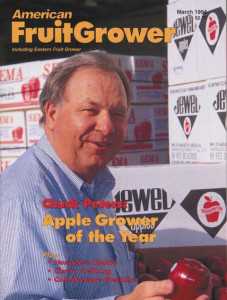 Chuck Peters (1994)
The look of an apple orchard has changed significantly over the years, but one thing sure hasn’t, says Chuck Peters: Good growers stay on their toes and aren’t afraid to make changes. For that very reason, Peters says his greatest accomplishment in the apple industry was being an innovator and early adapter of V-trellises in the late 1960s and early 1970s.
But followed close behind that accomplishment, says Peters, was working to give apple growers a political voice. As president of the Washington State Horticultural Association (WSHA) in 1990, Peters established HORTPAC. “They called us the 800-pound gorilla in Olympia (the state’s capital) because we were the only ag group in Olympia,” said Peters during the commemoration of the WSHA’s 100th anniversary. “You have to be active politically.”
A lot has changed since Peters was selected Apple Grower of the Year. Most notably, Peters says labor is much more of a problem today. But getting involved in politics remains as important, in part to help solve new problems that crop up, and the labor shortage is a perfect example.
Another big change in the industry is that technology has become more important. That, combined with advances in genetics/genomics — Peters noted that Washington State University (WSU) recently announced a project to map the apple genome — will mean big changes in the orchard of the future. Peters envisions a dwarfing orchard loaded with big, sweet, crunchy “target” fruit being picked by a robot. “That’s why I’m glad WSU is on the cutting edge,” he says. “These efforts are going to be a major thrust of research in the future.”
However, one thing likely won’t change: A good grower is still going to have to stay on his toes. “This business is going to be changing even more rapidly,” he says. “Keep updating your strategic plan, or you’re going to be in trouble in a hurry.”
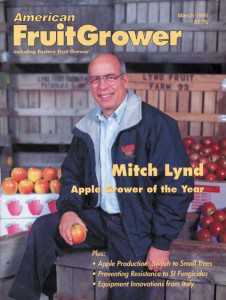 Mitch Lynd (1995)
 Mitch Lynd, the 1995 Apple Grower of the Year, may be officially retired as of January 1 of this year, but he still possesses a keen eye for the factors that define success in the apple industry.
“In this worldwide global competition, you don’t stand a chance unless you have patentable products and an ‘unfair advantage’ such as exclusive rights to a new apple variety or a prime location for a U-Pick operation,” he says.
According to Lynd, utilizing your unfair advantage is crucial because returns to production agriculture pale in comparison to the Dow Jones Industrial Average. Growers can no longer afford to view apples as a commodity. In an increasingly urbanized world, growers must contend with issues from aggressive orchard land business development to stringent food safety requirements.
Lynd deems food safety to be a new issue growers are facing largely because there has been no effort made on the part of commercial buyers to understand the growers’ perspective, and in turn, buyers make absurd demands on growers in regard to food safety requirements. “I don’t think the buyers realize how absurd their requests are. I don’t want to work with them because of it. No amount of money is worth that,” he says.
Although retired, Lynd is still active in the industry. He is a passive investor in Lynd Fruit Farm Inc., of Pataskala, OH, and is president of the Midwest Apple Improvement Association. Lynd considers the breeding program, which he started with Ed Fackler for the purpose of producing quality apples that could withstand adverse conditions, one of the most significant advancements he has seen since he won the award. Lynd feels the organization can make even more progress than it has already. “I want to lead the association to success by helping them to develop new apple varieties,” he says.
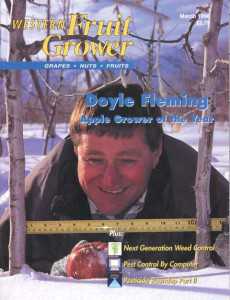 Doyle Fleming (1996)
Perhaps no apple grower got as much done in the unfortunately short time he spent on this planet as Doyle Fleming, who died in 2001. Not many growers can say they started out at the bottom and went out on top. But that was Fleming, who began picking fruit in 1956 in Orondo, WA, while he was still in junior high school. Fleming was lucky enough to start out in the right orchard, as it belonged to another future Apple Grower of the Year, the legendary Grady Auvil.
“Working for arguably the most progressive grower in Washington provided a unique basic training for Fleming,” stated the 1996 Apple Grower of the Year profile. “Auvil’s knack for experimentation rubbed off on Fleming.”
And how. Fleming planted one of the first Braeburn blocks in the U.S. The same can be said for his blocks of Granny Smith. When it came to bagging Fuji, he was one of the first. And as for Gala, which is rapidly becoming one of the most popular varieties, it made its debut on Fleming soil. Not a bad legacy.
Indeed, Fleming’s Wee Hoot Orchards became known as a giant laboratory of sorts. For example, while other growers were mulling high-density orchards, Fleming went at it full bore. He planted Fujis on Malling 9 at 6,000 trees to the acre, later freely admitting that he didn’t bother to do a cost analysis beforehand. “When you experiment, you don’t do a cost analysis to study the concept,” he told American and Western Fruit Grower. “If you did, the answer would always be no.”
Fleming also served the industry well, becoming active in such innovative organizations as the Washington Tree Fruit Research Commission, the Washington State Horticultural Association, and the International Dwarf Fruit Tree Association, among others. He also hosted numerous tour groups of growers from other countries, who were eager to see what was going on at Wee Hoot Orchards. Despite all that, Fleming remained irreverent and modest. “If you’re the first to do something,” he once said, “chances are that people will seek you out as an authority.”
Subscribe Today For
