


Follow us: RSS Feeds Twitter Facebook
Search

United Front For Control

Coordinated efforts to fight the psyllid are the best way to fend off citrus greening. 

March 16, 2011

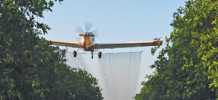
  •  Aerial spraying of large, contiguous acreages is being coordinated and conducted among growers to reduce psyllid populations in certain geographical sections.  © 2008
    Aerial spraying of large, contiguous acreages is being coordinated and conducted among growers to reduce psyllid populations in certain geographical sections.

The most popular acronym floating around the citrus world these days is CHMAs, otherwise know as citrus health management areas. In fact, the No. 1 recommendation from the National Academy of Sciences to the industry was that growers should cooperate on an areawide basis to control the citrus psyllid. This is exactly what CHMAs are designed to do.

Dr. Michael Rogers, UF/IFAS, has been helping coordinate growers and says early data shows the increased effectiveness of controlling the psyllid in large blocks rather than individual growers acting alone. He presented these findings during the Florida Citrus Show in Ft. Pierce.

Easy To Kill, Hard To Control

Experience has shown the psyllid is easily eliminated by most labeled insecticides. However, because there are few options that provide long residual control, and the tendency of the pest to move, full control can be more difficult.
 
Rogers pointed out that multiple applications will be necessary to control the pest. He noted, in Brazil, some growers can make up to 26 applications per year for control. In Florida, this number ranges from six to 10. These multiple applications can be reduced if growers act together through CHMAs.
 
What, When, And How
Growers seeking guidance on the timing of applications and recommended modes of action for psyllid control can find a yearly program at FLCHMA.org.
"One of the biggest problems for growers working alone is they'll apply an insecticide to control psyllids and might see re-infestation within a week or two from psyllids moving in from neighboring groves," he says. "There has been a long history of these type of areawide-management programs for pests in other crops. We are applying this knowledge to CHMAs to increase the effectiveness of our psyllid control sprays and reduce the cost to our growers by reducing the number of applications required to control psyllid populations."

Cooperation Key

Rogers informed attendees of the joint effort between UF/IFAS and Florida Department of Agriculture and Consumer Services (FDACS) to help coordinate CHMAs. He noted the process is in the early stages, but both agencies will help growers define areas throughout the state, align the timing of applications, and coordinate the modes of action used to manage against resistance. While this is a voluntary program, grower participation is crucial for the success of CHMAs.
"UF/IFAS is providing the information on psyllid management and pesticide choice and is helping to define CHMAs," he says. "Meanwhile, FDACS is helping with the mapping of some of these areas, as well as providing psyllid scouting services to help prove this effort is paying off and is a real benefit to growers."

Getting CHMAs Started

Growers interested in starting or joining a CHMA should contact their local Extension agent for more information. For new CHMAs, a planning meeting will be set up to identify potential groves to include and to define the area on a geographic map. In addition, a tentative psyllid control program will be discussed to ensure similar modes of action are used by participating growers.
Rogers pointed out CHMAs don't necessarily have to be large to be effective. And, growers should be certain that CHMAs are logistically practical in terms of covering the area in a timely manner.
UF/IFAS has built a CHMA website (www.FLCHMA.org) to facilitate communication between growers and act as reference point for upcoming sprays and meetings.
"The buy-in from growers has been tremendous so far," says Rogers. "There are probably eight to 10 CHMAs operating because of our efforts, but in reality there are a lot more functioning informally throughout the state. A lot of growers are taking the initiative on their own, so I'd estimate there is about 200,000 acres participating."
According to Rogers, the next step is to get funding for a full-time CHMA coordinator to manage the growing interest and participation in the program.

Comparing Notes

When considering going it alone or joining a CHMA, the following points should be taken into account.

Grove-By-Grove Approach

  • Targets only portion of pest population
  • Refugia left for immigrants, requiring reapplication of insecticides
  • Target pests with limited mobility
  • Low-value crop with medium-to-high pest tolerance
  • Reactive approach to pest presence
  • Complicates pesticide resistance management

Areawide Approach

- Targets entire population
- No refugia, requiring less insecticide use
- Target pests with high mobility
- High-value crop with low pest tolerance (i.e. vector/greening)
- Proactive approach to pest presence
- Facilitates pesticide resistance management

Special thanks to KeyPlex for sponsoring Florida Citrus Show Extended Content Coverage.

Giles is editor of Florida Grower, a Meister Media Worldwide publication.

Leave a comment: (All fields are required)
Name:  E-Mail: 
Type only the numbers from the code into the textbox:
[ CAPTCHA ERROR ] (DO NOT enter the brackets [ ] )