



Avoid Irrigation Runoff
 September 1, 2007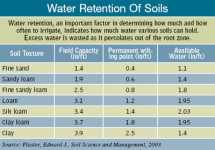

Irrigation runoff wastes water, fertilizer, and energy. Runoff can degrade water supplies, strip topsoil, reduce productivity, and, in some cases, lead to costly fines. A simple irrigation action plan that accounts for plant needs, soil types, and your individual irrigation system can help avoid the costly impacts of runoff.
Know Your Crop
For an effective irrigation plan, first determine the plant’s water requirement or crop water use. This is typically expressed in inches per day for each crop and is determined by multiplying the reference evapotranspiration (ET0) by the crop coefficient (Kc) and microclimate factor (Kmc). The California Irrigation Management Information System (CIMIS) reports this information daily, as do many farm publications and radio programs. Since crop water use changes with the weather and stage of crop growth, this information must be monitored frequently.
Know Your Soil
Light soils (coarse, sandy soils) accept water readily, but don’t hold much. Heavy soils (silt and clay loams) accept water slowly, but hold more. The trick is to apply water at a rate that the soil can accept (to avoid runoff), and to apply no more than the soil can hold (to avoid deep percolation).
The Water Retention Of Soils chart indicates how many inches of water a foot of each soil type can hold at field capacity, how much water is held at the permanent wilting point, and how much is considered available water. Most growers start the season at field capacity with a “full profile” with the entire depth of the root zone full of water, either from rainfall or irrigation. The grower will then manage the root zone’s available water by irrigating in amounts to meet plant water requirements after accounting for rainfall.
If more water is applied than the crop root zone can hold, it will be wasted to runoff or deep percolation.
The key is to match the soil type and slope with an appropriate irrigation application rate and duration to supply plant water needs.
Know Your Irrigation System
The two most critical things to know about your irrigation system are the application rate, or precipitation rate, and the application uniformity, also known as distribution uniformity.
 Application rate is the number of inches of water applied per acre in an hour. To avoid runoff or deep percolation, the application rate must be compared with the soil’s ability to accept and hold water. If the irrigation system wets less than 100% of the field, as is the case with micro-irrigation systems, the application rate within the wetted area should be calculated and compared with the soil information. An irrigation consultant or dealer should be able to help you determine the precipitation rate for your system (See Maximum Precipitation Rates). The rate will depend on the type of nozzles, pressure, and spacing.
If plant water use is .20 inches per day and the precipitation rate for your system is .05 inches per hour, the system would need to run about four hours per day, on average. Precipitation rate tables are available for various products and can be provided by a dealer or designer.
Application uniformity indicates how evenly water is applied throughout the field, and how much over irrigation must occur to ensure the driest part of the field receives enough water. An irrigation system designer calculates the theoretical uniformity of the design. The actual uniformity of an existing system may be determined by taking flow measurements from a number of field emission devices and dividing the average measurement of the lowest 25% of the readings by the overall average. This number is then multiplied by the theoretical application rate to develop a net application rate. For example, if the theoretical application rate is .05 inches per hour and the system application uniformity is 90%, then the net application rate is .045 inches per hour. This is the figure that should be used in irrigation scheduling calculations.
The Action Plan – Putting It All Together
Scheduling irrigation is both an art and a science. It is the process of deciding what days to irrigate, at what time, and for how long. One way to keep track of water applications and water needs is to adopt a checkbook-style water budget. Irrigation or rainfall events may be viewed as deposits, and plant water use viewed as withdrawals. The goal is to manage soil moisture in a way that best meets plant needs while minimizing runoff and deep percolation. A checkbook-style ledger can help you put it all together for an irrigation schedule that will optimize resource use.
Finally, don’t go it alone. Help is readily available from irrigation dealers and manufacturers, government agencies, consultants or associations.
Subscribe Today For
