



Pest Of The Month: Brown Marmorated Stink Bug
 June 1, 2009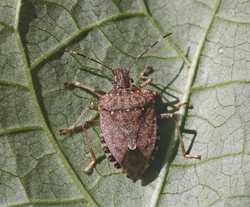
Identification
Although the first specimen of brown marmorated stink bug (BMSB) was positively identified in 2001 in Allentown, PA, it was probably established there at least several years prior to that date. The Florida Department of Agriculture and Consumer Services (FDACS) has detected and intercepted the BMSB several times in the past year in vehicles and transported goods. There are no known established populations in the state.
Typical of other stink bugs, this insect has a shield-shaped body and emits a pungent odor when disturbed. The BMSB has a mottled, brown, approximately 1/2 -inch body, and has characteristic alternating dark and light bands across the last two antennal segments that appear as a single white band in both nymphs and adults. Although the brown mottled color is distinctive, there are several native species of brownish stink bugs that look very similar.
Similar to other stink bugs, the nymphs and adults have a piercing-sucking type of mouthpart. In order to obtain the nutrients of the liquid part of the fruit, stink bugs use these mouthparts in a straw-like fashion by piercing the fruit. Small necrotic spots on fruit and leaf surfaces often result from feeding damage, and it may be compounded by secondary infections and scarring as the fruit matures.
Survival And Spread
Masses of about 25 white or pale-green barrel-shaped eggs are laid in clusters on the undersides of leaves. Nymphs progress through five different stages or nymphal instars. As with all immature stink bugs, the nymphs lack fully developed wings and have been described as tick-like in appearance, ranging in size from 1/8 inch (first instar) to 1/2 inch (fifth instar).
In the Northeast, the BMSB has only one generation per year. In southern China, however, up to five generations occur each year, and the same pattern can be expected as the insect spreads south.
Management
If stink bugs are found flying into homes in the fall, they are probably BMSBs and should be reported to the UF/IFAS Cooperative Extension Service or FDACS-Division of Plant Industry. Specimens should be collected for positive identification.
Subscribe Today For
