



How to Keep Blueberries Pest-Free
 March 7, 2012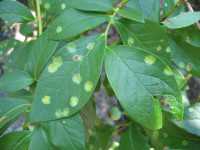
With the headlines blueberries have been getting in recent years, thanks to their health benefits, it stands to reason that growers need to keep up with effective blueberry crop protection strategies. This year’s winter meetings have been filled with discussions on this topic. This reportcovers two talks presented at meetings this past year. The first section, based on a presentation at the Southeast Regional Fruit and Vegetable Convention by North Carolina State University plant pathologist Bill Cline, covers the emergence of a potentially damaging disease: Exobasidium, or green leaf spot. The second section offers a review of new weed control options for blueberry growers, and it is based on a presentation given at the Great Lakes Fruit, Vegetable & Farm Market Expo by Michigan State University’s Eric Hansen.
Exobasidium And Leaf Spot
Symptoms caused by the fungus Exobasidium vaccinii have occurred sporadically in individual blueberry fields for years, but have not posed an industry-wide threat to blueberry production. However, in 2011 growers in North Carolina saw increased incidence of this disease, and symptoms on previously unaffected cultivars such as Legacy and Columbus. The fungus causes spots on both leaves and berries. Spots on fruit are especially problematic because it is impossible for pickers to avoid harvesting affected berries, and nearly impossible for color-sorters and packingline inspectors to remove them during the sorting and packing process.
On berries, infection produces a green spot that fails to ripen normally. Affected berries do not leak or decay, but the green spot on an otherwise uniformly ripe berry is an unsightly defect that could lead buyers to reject the fruit when delivered. On leaves, spots are pale-green on the upper surface but pure white below, with a thin, dense layer of fungal growth on the underside of the leaf. This fungal growth is most obvious on the underside of leaves, but can also occur on infected berries.
As spots on leaves age, they become brown and necrotic, although the white fungal layer is often still visible on the underside of the leaf. Eventually, the unique symptoms fade and the spots become indistinguishable from many other leaf-infecting fungi.
The fungus produces spores on both leaves and berries. They are often a distinctive “musiform” or banana shape, and may be divided (septate).
Little is known about the life cycle of this fungus on blueberry. Infections appear in the spring on developing leaves and berries, but the fungus does not appear to infect later flushes of leaf growth. Lesions have not been observed on other plant parts (stems, buds) and it is not known how this pathogen overwinters. Visually, infections appear to be localized, distinct, and limited to the affected berry or leaf, rather than systemic in the plant. Since blueberries drop their leaves each winter, there may be some quiescent infection stage on or in the remaining, bare dormant stems, or buds that serves as the overwintering mechanism.
Fungicides have been shown to be at least partially effective in controlling this disease. A study by David Ingram and John Braswell at Mississippi State University achieved measurable control on rabbiteye blueberries. The combination of pyraclostrobin and boscalid (Pristine, BASF) was most effective in their tests.
Why is this disease becoming more prevalent? It may be due to changes in the cultivars we grow, the loss of key fungicides in recent years, or changes in cultural practices such as the increased use of irrigation. This disease appears to be an emerging problem not only in North Carolina, but in other southern states as well. The more we know about it, the sooner we will learn how to manage it.
New Herbicides For Blueberries
Michigan blueberry growers have several new herbicides available, but limited experience and information on their efficacy. Chateau (flumioxazin, Valent U.S.A.) and Callisto (mesotrione, Syngenta Crop Protection) have been labeled for two seasons, Stinger (clopyralid, Dow AgroSciences) for one season, and Sandea (halosulfuron, Gowan Co.) was labeled in 2011. These herbicides represent four new modes of action for blueberry growers, and the products vary widely in the weed spectrum they control. Efficacy depends on rate, timing, and soil characteristics. The Michigan State Horticulture Society Trust provided funding to trial some of these products. Here are some observations.
• Chateau is a preemergent product with some postemergent activity if applied with surfactant or crop oil concentrate (COC). Chateau controls a wide range of broadleaf and grass weeds, including chickweeds, dandelion, common groundsel, lambsquarters, eastern black nightshade, several pigweeds, ragweed, and most annual grasses. Chateau needs to be applied before bud break in the spring.
Use 6 to 12 ounces of product per acre. Bushes need to have been in the field for two years. Chateau seems to provide a longer period of control than most blueberry herbicides, so it is effective in the late fall as well as the spring. Chateau will burn developing buds and young leaves if the base of plants is sprayed.
• Callisto provides preemergent and postemergent control of several pigweed species, chickweeds, horsenettle, lambsquarters, marestail, eastern black nightshade, ragweed, and smartweed. Grass control is poor, so combine Callisto with a grass herbicide. Apply Callisto before bloom, either in one 6 fluid ounces per acre application, or two 3-ounce applications at least 14 days apart. Postemergent activity is improved with COC, but Callisto with COC will also injure blueberry leaves and young stems that are contacted. Callisto is labeled for young, non-bearing, and bearing blueberries. For effective postemergent activity, delay Callisto treatments until weeds have begun growing. Callisto will suppress some perennial weeds such as aster and goldenrod.
• Sandea provides preemergent and postemergent control of many broadleaf weeds such as pigweed, ragweed, and smartweed. The primary value of Sandea is for yellow nutsedge control. Treat nutsedge when three to five leaves are present. Two applications with a non-ionic surfactant are most effective. Rates are 0.5 to 1.0 ounces per acre and no more than 2 ounces per year. Pre-harvest interval (PHI) is 14 days.
• Stinger has preemergent and postemergent activity. Stinger is most active on weeds in the composite and legume families, such as thistle, asters, dandelion, goldenrod, ragweed, and clovers. It also controls nightshades, smartweeds, wild buckwheat, and plantain, as well as wild bean or groundnut. Timing is somewhat complicated. Blueberries are most sensitive to Stinger near bloom, so it should not be applied from one week before to one week after bloom. PHI is 30 days. The best times for treatment appear to be before bloom when weeds are growing, shortly after bloom but not within 30 days of harvest, and after harvest. Rates are 2.6 to 5.3 fluid ounces per acre, and not more that 10.6 ounces per season. Stinger is a residual material, so accurate rates per acre are important, even if spot treating by hand.
Herbicide combinations are often needed for control of a broader range of weeds. Combining herbicides with different modes of action also reduces the potential to develop resistant weed populations. Growers should work with the newer products to learn how they perform on their farms. These herbicides have different modes of action than the traditional blueberry herbicides. As a result, they should be helpful in discouraging development of herbicide-resistant weed populations.
Subscribe Today For
