



5 Weeds To Watch in Your Farm Field
 September 18, 2012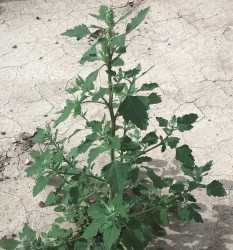
In the heart of South Florida’s vegetable production, these weedy competitors are a primary target of growers’ ire. Left uncontrolled, these weeds can take over fields and rob crops of valuable yields.
1. Common lambsquarters (Chenopodium album)
Common lambsquarters, a member of the goosefoot family, is a broadleaf annual weed common in vegetable and agronomic croplands, roadsides, and disturbed areas. It is an erect, branched plant that can grow from 1 to 6 feet tall. The stem is hairless, vertically ridged, and often has maroon or red stripes. The leaves alternate along the stem with the lower leaves wavy and margined to somewhat lobed, while the upper are often narrower.
The undersurface of younger leaves have a white to grayish-mealy coating. Individual flowers are small, inconspicuous, greenish-gray, mealy, and arise from the ends of stems and leaf axils. A single plant produces thousands of round shiny black or sometimes brown, oval, and flattened seeds, which can persist for years in the soil. This weed species often emerges during winter months, and is found in many fields in the spring. Treatment of vegetables with labeled herbicides early in the season provides good control of common lambsquarters.
5 Weeds To Watch ctd.
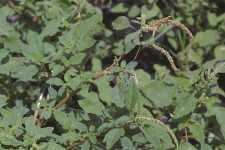
2. Spiny amaranth (Amaranthus spinosus)
Spiny amaranth, a member of the pigweed family, is an annual broadleaf weed common in vegetable and croplands, landscaped areas, orchards, and other disturbed areas. It has smooth, branched reddish stems, usually 1 to 3 feet tall, but occasionally 6 feet tall. The stem has a pair of long sharp spines at the base of most leaves. The leaves alternate along the stem with long stalks.
Leaf blades are usually egg-shaped to oval with the tip somewhat pointed, often with a small bristle. The flowers are green in dense clusters in the leaf axils or at tips of stems. The very small seeds are numerous, flattened, circular with smooth covers. Treatment of vegetables with labeled herbicides early in the season provides good control of spiny amaranth.
5 Weeds To Watch ctd.
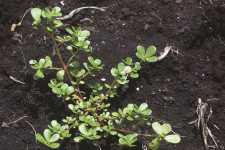
3. Common purslane (Portulaca oleracea)
Common purslane, member of the purslane family, is an annual broadleaf weed common in vegetable and agronomic croplands, landscaped areas, roadsides, and disturbed sites. It has a prostrate, mat-forming habitat with fleshy, smooth reddish or green-colored stems. The stems radiate from the central rooting point reaching lengths in excess of 12 inches. Smooth, shiny, succulent, and stalkless leaves are arranged either opposite one another or alternate along the stem.
The leaf blades are somewhat teardrop-shaped, wider at the tip than at the base. Single yellow flowers or clusters of two to five are found at the end of stems. These flowers open only in sunshine. Numerous tiny, black, flattened, rounded to kidney-shaped seeds are produced in capsules resembling flower buds. Common purslane produces seeds throughout the growing season and has the ability to root again after cultivation, making it difficult to control. Treatment of vegetables with labeled herbicides early in the season provides good control of common purslane.
5 Weeds To Watch ctd.
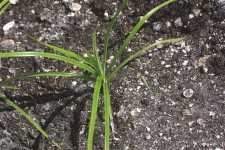
4. Yellow nutsedge (Cyperus esculentus)
Yellow nutsedge, a member of the sedge family, is an aggressive perennial weed superficially resembling a grass. It is common in vegetable and agronomic croplands and prefers moist soils. Yellow nutsedge is difficult to control because of its ability to form dense colonies. The plants range from 6 to 30 inches tall with three-angled (triangular in cross section) stems. The grass-like, yellowish-green leaves are produced at the base of the plant in groups of three, forming a sheath around the stem. Leaves and stems have a waxy or shiny appearance. Flowering stems are erect, unbranched, and triangular.
Yellowish-brown spikelets with inconspicuous individual flowers are born on the ends of flowering stems. Yellow nutsedge spreads primarily by small, hard brown underground nutlets or tubers formed at the tips of creeping stems. It also can spread by seed and creeping rootstocks. The tubers can remain dormant in the soil for several years before producing new plants. Treatment of vegetables with labeled herbicides early in the season provides good control of yellow nutsedge.
5 Weeds To Watch ctd.
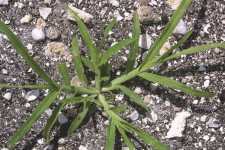
5. Goosegrass (Eleusine indica)
Goosegrass is an annual weed common in vegetable and croplands, landscaped areas, lawns, orchards, roadsides, and other disturbed areas. It has flattened stems 15 to 36 inches long that radiate from a central point forming a mat-like rosette. Leaf blades are flat or folded, smooth or occasionally sparsely hairy on both surfaces, and have rough margins. Stems at maturity terminate in a finger-like inflorescence consisting of 2 to 10 spikes. Spikelets are compressed or flattened in two rows along each spike and contain reddish brown to black seeds. Treatment of vegetables with labeled herbicides early in the season provides good control of this weed.
Subscribe Today For
