



Pest Predictions for the Growing Season
 May 1, 2008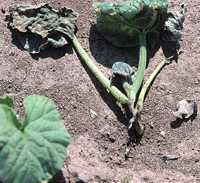
What do Phytophthora, powdery mildew, downy mildew, whiteflies, and squash bugs all have in common? They are potential problems for growers in different areas of the country. According to Extension agents and researchers in various locations throughout the U.S., growers need to check for the presence of these pests by scouting their fields early and often.
Phytophthora blight is a problem in cucurbits, particularly pumpkins, and has been a big problem for growers in Illinois, says Mohammad Babadoost, a plant pathologist in the Department of Crop Sciences at the University of Illinois. He adds that Illinois produces about 90% of the processing pumpkins in the U.S. Babadoost says it is difficult to tell how big the Phytophthora problem will be from year to year because its development depends on moisture and heat. If July is a very warm and wet month, Babadoost says those conditions are favorable for the disease development, potentially creating a recipe for disaster for cucurbit growers.
Phytophthora can cause up to 100% crop loss, as it did last summer in Northeastern Illinois. He adds that Phytophthora also has been a reoccurring threat to pickling cucumber growers in Michigan. The pathogen can attack plants at any growth stage, Babadoost explains. It can lead to seedling death in wet and warm soil conditions. On top of that, vine blight, impacting parts of the vine, can occur at any time, and fruit rot can be a problem from fruit set until harvest.
Another problem for cucurbit growers in this region is downy mildew. Babadoost says one of the first symptoms of this disease is pale green blotches on the surface of leaves. To keep pathogens at bay, growers need to use integrated approaches of cultural methods and chemical application, including seed treatment and foliar spray, he says.
Southern Issues
In Florida, it’s the whiteflies that are at the root of many plant problems. Gene McAvoy, a regional vegetable/horticulture Extension agent in LaBelle, says when production starts in the Sunshine State in September, the whiteflies will be along in no time, followed later by pepper weevils. Whiteflies are mainly a pest of tomato, but McAvoy says he is seeing more problems from this insect on cucurbits, peppers, and other crops. The pepper weevils typically attack peppers and sometimes eggplant, he adds.
Right now, the best way to combat whiteflies is to use a combination of materials. McAvoy suggests using neonicotinoids early on, as growers get a limited number of applications of this type of material and resistance management is critical. After that, growth regulators can be used, followed by adulticides, such as soaps, Fulfill (pymetrozine, Syngenta Crop Protection), Oberon (spiromesifin, Bayer CropScience), Thiodan (endosulfan, Bayer CropScience), Monitor (Arysta LifeScience), Danitol (Valent U.S.A. Corp.), and combinations of pyrethroids and other insecticides.
In particular, one of the latest neonicotinoid insecticides, Venom (dinotefuran) from Valent U.S.A., is registered on tomatoes to control whiteflies and seems to provide good control. “Whiteflies are difficult to control even with the neonicotinoids,” says McAvoy. “When [neonicotinoids] first came out they were great. Now we are seeing some resistance issues.”
In the area of virus and disease, McAvoy says viruses, such as tomato yellow leaf curl, tend to peak in the late fall and spring and downy mildew takes off in cucurbits in wet weather. He adds that bacterial spot is a continuous problem for tomato and pepper whenever there is moisture.
For the viruses, he says control involves targeting the vectors, such as the whitefly. Now, McAvoy and others are looking to new, yet unregistered insect control products to help in the future. Those products include Coragen (rynaxypyr) from DuPont, Durivo and Voliam Xpress, both also with the active ingredient rynaxypyr, from Syngenta Crop Protection, and Movento (spiretetramat) from Bayer CropScience.
Midwestern Woes
Steve Davis, an IPM agent with Texas A&M University, Texas AgriLife Extension, for two counties in the Southern High Plains, says that squash bugs are an issue for pumpkin growers in this area of the state.
Scouting is critical and Davis encourages growers to scout every three days from the time the plants begin to emerge to flowering. After flowering, the squash bugs won’t inhibit plant growth as much, he explains, and scouting can be a little less frequent — about five to seven days.
In Texas, pumpkins and gourds are planted near the beginning of June, so Davis suggests that growers begin the scouting process around 10th or 11th of the month, just as the plants are emerging from the soil. If squash bugs are present, growers will see the brown, glossy egg masses on the bottom of leaves. Typically, says Davis, there can be from 40 up to 100 eggs in a mass.
When growers see the nymphs emerging from the egg masses or they see adults feeding, they need to begin the spraying process. At present, Davis says there are a few pyrethroids labeled for cucurbits.Growers in his area have been using Tundra (bifrenthrin, Agrisolutions).
“Squash bugs are hard to kill even with a hammer and a brick,” says Davis with a laugh. “The adults are particularly hard to get to because they usually are feeding and mating just beneath the soil surface on or around the main stem.”
Getting to the root of the problem, where the adults are feeding, is the optimal solution. Many growers, however, aren’t interested in using a ground rig to spray the insecticide when an aerial spray is much faster, explains Davis. The bottom line, though, is that growers will get better coverage and control using a ground spray rig with increased volume of solution per acre.
In the area of disease, Davis says powdery mildew (PM) is a perennial problem. To control PM, several foliar fungicides can be applied. Davis reminds growers, though, that they can use one or two fungicides from a given class, and then they have to switch to another class to avoid resistance problems.
Subscribe Today For
