



A Vegetable Experiment
 January 1, 2008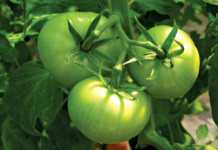
With more than 20 acres of greenhouses sitting idle last fall, co-owner Jerry Quaal of Dan & Jerry’s Greenhouses in Monticello, MN, decided to try his hand at growing greenhouse vegetables. The operation, which owns more than 35 acres of greenhouses in four locations, specializes in growing bedding plants, container perennials, and flowering potted plants in the ornamental market, and is one of American Vegetable Grower’s sister publications, Greenhouse Grower magazine’s Top 100 Growers.
“We do 15 to 18 acres of fall mums and not as many poinsettias — probably 3 to 4 acres of those,” Quaal says. “We really had about 20 acres of greenhouse space sitting empty and so it was an experiment to try an acre of tomatoes and an acre of peppers, and something to utilize the space.”
To minimize risk on its experiment, the operation produced tomato and pepper plants in nursery containers rather than using hydroponic growing methods, so it could reuse the containers. Planting the week after July 4, Dan & Jerry’s began picking in mid-September, when a hard frost killed everything grown outside. Due to warmer than average temperatures in October and most of November, which were heavy picking months, the operation didn’t have to invest much in energy costs. Dan & Jerry’s Greenhouses was able to market its greenhouse vegetables to approximately 40 local grocery stores in the area.
“The ideal thing would be to plant in March or early April, but all of our greenhouses are filled with bedding plants and we even have to look for more space — we have to use con-
tract growers. So we can’t do it then,” Quaal says.
No Idle Hands
Another advantage to growing vegetables through the fall was keeping the operation’s workers busy and keeping them longer, Quaal says.
“We bring up quite a few people on the H-2B program and we wanted to keep them,” he says. “They come up between the end of January through the first part of March, and they have to go back between the middle to the end of October. So growing the tomatoes and peppers was something that allowed us to keep them here, also.”
Already, there are a few hydroponic growers in the area where Dan & Jerry’s Greenhouses is located. Bushel Boy, which produces hydroponic tomatoes, is open all year, while the few smaller ones are closed from December through March due to very low temperatures and high energy costs. Dan & Jerry’s was planning to evaluate the tomato and pepper growing process and its profits this month, and decide, based on those results, whether to plant greenhouse vegetables for harvest in fall 2008.
“The peppers were a pretty easy crop,” Quaal says. “The tomatoes with pruning and caging, that was a little interesting. We put drip tubes for watering in most of the pots. We feel we get a much better quality tomato than the ones out of the ground. The ones we are doing are more homegrown and don’t have the shelflife of a hydroponic.”
Subscribe Today For
