



Roots Run Deep For Fifth-Generation At Heartland Farms
 October 1, 2008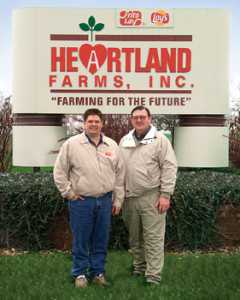
We have all heard this expression from growers: “Farming is in my blood.” That statement also rings true for Richard Pavelski, president of Heartland Farms, Inc., a potato and vegetable farm, headquartered in Hancock, WI.
Heartland Farms’ roots run deep, as this fifth generation farm was originally settled in 1863 by Pavelski’s great grandfather, August Pavelski. More than 100 years later, in 1967, Richard began his farming career, joining the operation full-time. During part of his tenure, the farm was known as A. M. Pavelski & Sons Inc.
According to Pavelski, one of the things that has been a constant in the ag industry is consolidation. He saw to it, however, that his operation was on the buying side of the deal. When he first came on board, the farm owned between 300 and 400 acres, but in 1974, it more than doubled in size with the purchase of 550 acres.
A series of acquisitions took place over the years, and the home office location along with 3,500 acres were purchased in 1990, the same year David Knights formed a partnership with Richard Pavelski to establish Heartland Farms. When Knights, the farm’s vice president, came on board, he helped grow the operation to 14,000 acres with sales exceeding $31 million, and projected to exceed $45
million in 2009, says Pavelski.
Knights’ role on the farm is to run the day-to-day operations, manage agronomy, and purchase equipment and crop inputs. “Some of the toughest challenges are dealing with resistant pests and diseases,” Knights explains. “To deal with the ongoing problem of resistance, we try to use rotation and IPM practices. We also try to build a close relationship with our fertilizer and chemical suppliers.
“Our suppliers know the latest technology and chemicals to help increase control,” Knights continues. “This helps us understand each other’s needs and the issues we are each facing.”
Food Safety And Computers
About 90% of Heartland’s 6,500 acres of potatoes are supplied to Frito-Lay for potato chips. With food safety at the top of this grower’s mind, the farm has a full traceback program in place.
“If Frito Lay has an issue with potato chips, the chips are tracked by a number,” explains Pavelski. “We provide them with information on which field, which bin the potatoes in question were stored, the chemicals and fertilizers that were applied, as well as a minimum of three years of crop history and seed source. Our computer systems allow us to do that instantly.”
Pavelski adds that there is a considerable amount of micromanaging costs that require many tools and need good tracking methods. “To get all the data you want — and it’s not all user friendly — you will need someone in-house to track the data, and customize reports. We have been unable to find a commercially available program, so we write a significant amount of our
programming in-house.”
Handling both the food safety and computer technology aspect of the business is Richard’s son, Jeremie. Jeremie holds a degree in computer networking and has been working full-time on the farm for four years.
The computer not only helps them keep track of crop history data for traceback, it also provides them with year-to-date costs in the field. According to
Jeremie, patterns can be analyzed very quickly. “Accurate data is critical here,” he adds.
And from what Pavelski indicates, between 2007 and 2009, the cost of production will increase by more than $4 per cwt. “Never in my 41 years working have I ever seen it go up by more than 59¢ at the maximum,” he says. “From my perspective, the price of potatoes — the price at farmgate — will increase by 50% to cover production costs.”
However, this doesn’t mean the cost in the grocery store will have increased by 50%. “Farmgate,” he explains, “means there will be a 7% to 10% increase at the consumer level.”
So what does this news mean for the small grower? Continued consolidation. Pavelski says, for example, if it costs $1 million to put the crop into the ground, the farmer must borrow $500,000.
“Take the same farmer in 2009, and it will cost $2 million to put the crop into the ground,” he explains. “Now the farmer has to borrow $1 million just to plant his crop.”
The end result is that there will be people who can’t get financing to put the crop in the ground, says Pavelski. “There are many opportunities in ag, but there is a tremendous amount of risk, as well.”
Pushing Technology
Opportunities also exist by using the latest technology. In 1987, the farm began using precision ag tools, such as precision grid soil sampling and a
variable rate fertilizer applicator.
At the time, says Pavelski, the farm, and Pavelski Enterprises, Inc. (a crop supply business that Pavelski owned), worked with Soil Tech, and Stennis Space Center, located in Stennis, MS,
to get precision placement of fertilizer and chemicals.
In 2004, Heartland began using an Auto Steer program to facilitate accurate planting and band application of crop protectants, as opposed to whole field application. According to Pavelski, this has reduced cost, waste, and the amount of crop protectants used.
Moving Forward
So what direction will Heartland Farms take in the future and where does Pavelski think the industry, in general, is headed? Even though rising costs are a challenge, he remains optimistic about profitability. He adds that the new Farm Bill will present many positive things for the vegetable industry.
His take on the future, however, is cut and dried: “You are either growing or you are dying,” he says. “Growth can’t be at a breakneck pace, either. It needs to be well managed with a determined long-term vision.”
Thinking outside of the box, Pavelski says a large dairy operation may become part of the farm, down the line.
Why would he opt to get into the dairy farming business? He answers with one word: Nutrients. “Now that the costs of commercial fertilizers have tripled, it makes sense to have a dairy farm,” he concludes.
Subscribe Today For
