


Almond Breeding Breakthrough! The Future Is Now With ‘Nonpareil SC+’
 December 24, 2024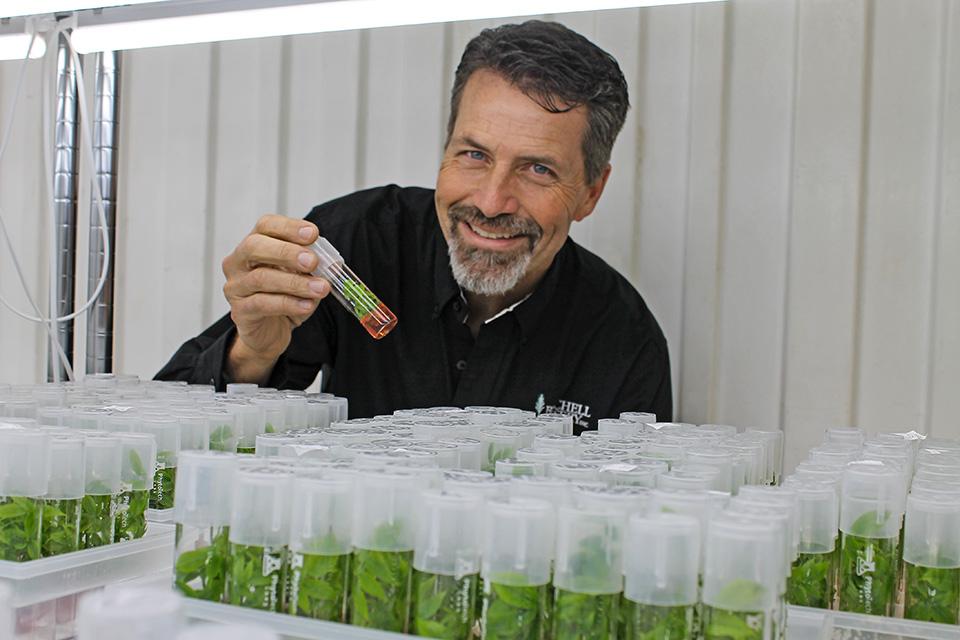
Burchell Nursery owner Tom Burchell created the ORIGINS Genome Research Initiative in 2018 to address several issues facing almond growers, including ‘Nonpareil’ self-compatibility, harvest timing, drought tolerance, pathogen resistance, flower timing, chill requirements, universal pollen, and compatibility. He’s now eager to introduce ‘Nonpareil SC+’ to the market.
Photo by David Eddy
For someone who prefers a conservative approach to making announcements, Tom Burchell sure knows how to start the New Year with a bang. Beginning in January 2025, Burchell, the third-generation owner of Burchell Nursery, in Oakdale, CA, is marketing the first and only self-compatible almond variety that is universally pollen cross-compatible with any other almond variety, according to the company. Six years in the making, the variety is branded by Burchell Nursery as ‘Nonpareil SC+’, a Genesis Almond Variety.
“Growers have probably been saying, ‘Is this possible?’” Burchell says. “We want to let the growers know now that it is possible. And we’ve done it.”
Burchell Nursery is now taking, on a first-come basis, 2027 order reservations for ‘Nonpareil SC+’ test orchards.
The company’s sales team will host three RSVP town hall events — Feb. 19 in Parlier, March 6 in Modesto, and March 20 in Davis — to preview the self-fruitful almond variety and share the work being done through its ORIGINS Genomic Research Initiative, which originated in 2018.
“A lot of people are going to have questions,” Burchell says. “This is just a simple mutation in the gene that controls self-incompatibility in the plant. We’re not introducing any foreign genes, and the plant is a non-GMO. Moreover, the self-fertility trait is naturally found in nature. We have self-fertile almonds already: ‘Shasta’ is self-fertile, ‘Independence’ is self-fertile.
We are creating this same ‘natural’ mutation by precision gene editing without making it GMO or anything like that. Simple mutations like this have no formal regulatory hurdles that you have to go through when creating a simple mutation by gene editing.”
Self-Fertility Precedent
Founded in 1942, Burchell Nursery established, in the 1960s, its own breeding program, which eventually took the name Burchell Breeding Inc. in 2020. The nursery has bred various almond varieties, such as ‘Carmel’, ‘Monterey’, ‘Fritz’ and ‘Wood Colony’, that have generated more than 30% of the annual revenue for the almond industry statewide. In addition, it has introduced many stone fruit varieties, including ‘O’Henry’ and ‘Elegant Lady’.
In 2015 Burchell Nursery patented one of the first self-fertile almonds in the ‘Shasta’ variety. “And that’s been doing great,” Burchell says. “Growers can plant one variety. They don’t need a pollinator.”
Four years later, the company accomplished the same feat with ‘Pyrenees’.
In 2018, in between introducing the self-fertile ‘Shasta’ and ‘Pyrenees’ varieties, Burchell saw the need to work with a genetics company to bring such almond varieties, particularly ‘Nonpareil’, to the industry in a more timely fashion. He partnered with New Haven, CT-based Verinomics, founded by Steve Dellaporta, a renowned Yale professor of genetics.
“We made a switch to really focus more on the almond process because we were seeing the advancement in genetics to use crosses for self-fertility and bringing in self-fertility for almonds,” Burchell says. “People were really enjoying these self-fertile varieties; planting a solid block, one variety, and really enjoying the production that that gave them, the lower cost that it’s giving them. Less bees — you still need a hive here and there but not three hives an acre. Uniform pruning, uniform harvesting, all that goes with more efficiencies. Growers were saving money and were making more money with these self-fruitful varieties.”
But none of those varieties was ‘Nonpareil’. Not yet at least.
Picking Up the Pace
Verinomics, already versed in the gene editing of various crops, would change the game where ‘Nonpareil’ is concerned — with an assist from the self-fertile ‘Shasta’ variety that Burchell Nursery had already produced.
“Now that we had a self-fruitful variety in ‘Shasta’, we could cross it with ‘Nonpareil’ or cross it with something else that wasn’t self-fruitful, and then that self-fertility gene can pass through the offspring,” Burchell says. “But many times it wouldn’t cross. You make a thousand crosses, and only a few of those will have that self-fruitful gene.”
RELATED CONTENT: Why You Need To Plan New Almond Plantings Carefully
Moreover, with vegetatively propagated varieties, such as ‘Nonpareil,’ the varietal is gone forever once standard genetic crosses are made.
Previously, breeders would check for self-fertility by planting trees in the field. “We’d grow them for three to four years, wait for them to fruit, wait for them to flower, see if they were self-fruitful or not, and then eliminate the trees that weren’t,” Burchell says. “That took up a lot of space, a lot of time. You’re talking four or five years to evaluate this stuff. It takes a long time to breed and introduce a variety.”
Verinomics took infinitely less time to do so by first determining the entire genome sequence of the many varieties that Burchell had established over the years. It then searched those genomes to identify the self-incompatibility gene that blocks pollination and, through gene editing, removed the incompatibility function in the plant.
Burchell Nursery could now make a genetic cross between ‘Nonpareil’ and ‘Shasta’ and grow the progeny of those seeds.
“Generation after generation of backcrossing to ‘Nonpareil’ will start to eliminate the things that make it ‘Shasta’ and make it more like ‘Nonpareil’,” Burchell says.
Classical breeding would have taken a century to accomplish as much.
“But through gene editing, we can go in and remove the gene and have a loss of function mutation that eliminates the plant’s ability to accept its own pollen, so it does accept its own pollen
and not touch anything else,” Burchell says. “The ‘Nonpareil’ tree is the same, the ‘Nonpareil’ kernel is the same, the ‘Nonpareil’ shell is the same, the ‘Nonpareil’ leaf is the same. Everything’s the same, but it accepts its own pollen. That’s the gene-editing advancement that kind of speeds up what we would normally do through classical breeding.”
Subscribe Today For
