



Grower Experiments with Hydroponic Vegetable Production
 April 1, 2008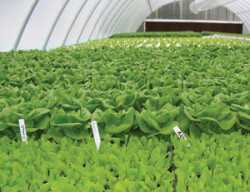
Paul Mock just celebrated his second anniversary. The second anniversary of his hydroponic business in West Virginia, that is. Located in Berkeley Springs, Mock’s greenhouse business, which is known as Mock’s Greenhouse & Landscaping, is a family-run operation.
Coming from an ag background, Mock helped his parents run their bedding plant business in Pennsylvania for years. He took over the operation in 1983 when his father passed away and later added Christmas trees to the list of offerings.
Fast forward to a few years ago when Mock started his hydroponic venture in West Virginia. To help him get established, the new operation included a landscaping department. He began the business in 2006 with three greenhouses, one for lettuce and two for tomatoes. Last year, he expanded and constructed two greenhouses for basil and two houses for watercress and lettuce. Mock plans to add two more greenhouses this summer.
Now, the greenhouse vegetable enterprise — which includes lettuce, basil, watercress, cucumbers, and tomatoes — accounts for about 80% of his business, and the business is year-round. About 10% is Christmas tree sales from both the West Virginia and Pennsylvania operations, and 5% is water garden and landscaping.
Mock’s hydroponic business is about 120 miles from the Baltimore and Washington, DC, area. He says the property is in a rural area, with only 16,000 people in the entire county, so it’s not a prime location for a retail outlet.
“But 120 miles away are 3 million people,” he points out. “The result is we are not suitable for retail or a garden center as we are not adjacent to a freeway.”
Obtaining Buyers
To make a profit, Mock knew what he had to do: contact produce buyers in the Baltimore and Washington, DC, areas. He now sells about 30% of his produce to Whole Foods Market. The other 70% is sold to produce brokers that deal with restaurants and institutions in the Washington, DC, area.
“I have several buyers, so I don’t have all my eggs in one basket,” he explains. He adds that about one-tenth of 1% of his produce is sold at his hometown farmers market, Berkeley Springs Farmers Market, on Sundays for 26 weeks of the year.
What makes growing hydroponically a benefit for Mock is the year-round production. Offering fresh produce all year keeps buyers happy, he says.
Right now, the tomato blossoms are forming in his greenhouses. They will be ready for sale starting at the end of this month, and they will be ripe for picking through December. His lettuce crop also is available year-round. Soon, Mock will have watercress and basil to sell on a weekly basis, too.
In order to have produce constantly available for buyers, Mock is continuously sowing and harvesting. “When you walk into our greenhouses, you will see four stages of growth,” he says. “We are harvesting one to two times a week.”
Challenges in the greenhouse are different from field production, Mock continues. “There are no tractors, but I do have to set up greenhouse structures,” he explains. “It’s a different set of inputs and challenges. The nice thing about hydroponics is your nutrients can be controlled in a precise way.”
Nutrients, he explains, are controlled by the fertilizer injector based on the inputs he provides. The nutrients are adjusted depending on plant growth stage or after a tissue sample report. “Basically, you are starting with a fertilizer recipe and you adjust it from time to time,” Mock adds.
“We get a 97% pack-out on our lettuce,” he says. “In a 3,000 square-foot greenhouse, in one year, we can harvest 80,000 heads. That’s unheard of in outside production.”
Mock grows produce on about 20,000 square feet, which is a half acre of greenhouse space. The produce, he says, is tagged as being grown without crop protectants. His hydroponic inputs, however, are commercial fertilizers. “We don’t need to apply any other pesticides because we watch the heat and humidity and use insect screening to keep the bugs out.”
Future Growth
Mock’s to-do list this year includes the construction of two more greenhouses. “I want to get everything up and running and fine tuned,” he says. “In 2007, that was a year where I had to use some of my labor force for construction purposes. Now that we won’t be doing as much construction, I will be working on production.”
The additional challenges in 2008 will, just like for everyone else, include increasing fuel costs. Mock adds, however, that despite climbing fuel prices, he doesn’t have to worry about labor and immigration issues.
He and his family handle the bulk of the work. In addition to daughters Meghan and Kalee and wife Raynette, he employs one other full-time person.
To offset rising fuel costs, however, Mock found it necessary to make cuts in other areas, particularly in the area of equipment. Some of his equipment is brand new and some of it is used. In the past, Mock has purchased used hydroponic growing channels, computers, and benches. “A lot of people get leery of used equipment, but I’ve learned that there are times when you have to buy new things and there are times that used equipment will do the job,” he says.
In order to continue down the path to success, Mock is looking to obtain continuity in all areas, including labor, production, and cash flow.
“When I get settled in 2008, I will know specifically how much labor, resources, heat, and revenue will be representing all production,” he concludes. “Then, if needed, I can start fine-tuning certain areas to make things more efficient.”
Subscribe Today For
