



Rotating Trellis is a Lucrative Opportunity for Berry Growers
 April 21, 2011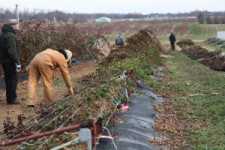
For growers in colder climates, raising blackberries might not be out of the question anymore. USDA-ARS scientists recently developed a trellis system that means growing blackberries in the Midwest and Northeast is now possible.
The trellis system, called the Rotatable Cross-Arm (RCA), was designed by Fumiomi Takeda at the ARS Appalachian Fruit Research Station in Kearneysville, WV. Trellis Growing Systems, an ARS partner based in Fort Wayne, IN, is already marketing the system.
How It Works
The trellis features an upright post and a long cross arm at the top, which rotates 180 degrees. Growers can attach blackberry canes to the trellis and position the plants close to the ground. Then, a thin, porous polyethylene cover can be laid over the plants to protect them from the winter chill. In the spring, the cover can be removed, and growers can reposition the cross arm so the plants get sufficient sunlight and rainfall.
Results of studies conducted in 2009 and 2010 in West Virginia showed promising results. The RCA systems produced up to 15 pounds of Siskiyou blackberries (known to favor mild climates) on each plant, where the canes were spread horizontally near the ground to reduce cold exposure. The polyethylene blanket successfully insulated the plants from the temperatures, as well.
Takeda anticipates that by 2012, there will be at least 100 new acres of blackberries planted in the Midwest using the RCA trellis system. “I may be over optimistic, but when this acreage comes into full production in two years, there can be as much as a $3.5 million increase in annual revenue for specialty crop farmers in the Midwest,” he says.
Subscribe Today For
