



Mystery Disorder Targets Tomatoes
 May 1, 2008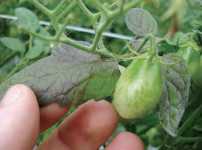
Tomato growers in Hillsborough and Manatee counties have noticed a new plant disorder in a number of fields. The condition begins to show up about four weeks after transplanting and consists of an interveinal purpling of the upper leaf surface of individual petioles that gradually spreads to the entire leaf blade. The disorder has been called tomato purple-leaf disorder (TPLD). The leaf purpling appears only to develop on leaves exposed to sunlight, while shaded plant tissue doesn’t show symptoms. Leaves with TPLD do seem to decline and senesce prematurely. At this time, it is believed that grape tomatoes are most vulnerable to TPLD.
UF’s Institute of Food and Agricultural Sciences (IFAS) researchers Gary Vallad and Bielinski Santos have been searching for the cause of TPLD. Early studies suggest the condition develops sporadically on individual plants, and then increases in incidence and intensity over time. While the cause is unknown, the localized nature of TPLD suggests a virus or other biological agent may be to blame. However, the sensitivity to sunlight is uncharacteristic of any known virus.
Other possible causes of TPLD could be related to crop management, the application of pesticides and surfactants, or other environmental factors, or due to an interaction between these factors. On the affected farms, the crop was routinely sprayed twice or three times per week with a variety of inputs (up to 5 products at a given time) mixed in a single tank.
Subscribe Today For
