



New Pest Alert! Heads up for the Two-Spot Cotton Leafhopper
 December 17, 2024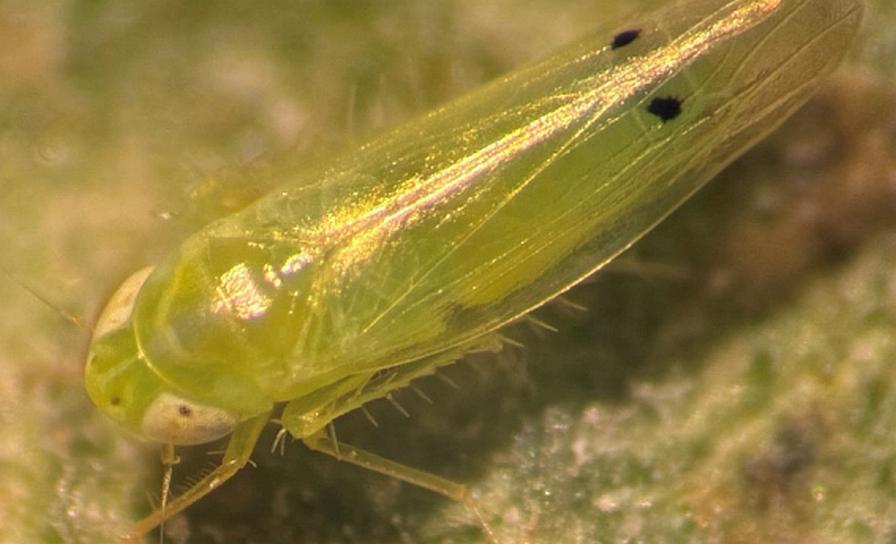
Closeup of an adult two-spot cotton leafhopper.
Photo by Daphne Zapsas, USDA-APHIS-PPQ, Biological Science Laboratory Technician
Feels like it’s been a minute since Florida issued a new pest alert. The last one I recall was an alert for the lime swallowtail in Feb. 2023. But that was then. Now we are talking about the two-spot cotton leafhopper. The notorious pest of cotton, okra, eggplant, and others has become established in the Caribbean basin. And it recently was detected in several counties in Florida, from Miami-Dade County in the south to Jackson County in the north.
A little background information on the two-spot cotton leafhopper indicates it was first detected in the U.S. Virgin Islands and Puerto Rico in spring 2023. At the time, the only other Western Hemisphere record for this species was a single male labeled “Cuba” deposited in the U.S. National Museum. There are no other prior or subsequent reported finds in Cuba. The two-spot cotton leafhopper is native to the Indian Subcontinent and east to Japan and Micronesia.
The following information is via the pest alert released by the Florida Department of Agriculture and Consumer Services Division of Plant Industry (FDACS DPI).
Crops Affected
Two-spot cotton leafhopper can cause serious damage to cotton, okra, eggplant, peanut, roselle and other crops. Yield losses may exceed 50% in some crops.
Identification
Two-spot cotton leafhoppers feed on the lower surface of leaves, extracting the contents of the cells. This causes yellowing, reddening, then browning of leaves, characteristic of a syndrome called “hopperburn,” along with wilting and curling of the leaves.
Adults two-spot cotton leafhoppers are tiny. They superficially resemble other leafhopper species such as the potato leafhopper. They can be distinguished by a dark spot on each wing and often by two dark spots on the head. A few other leafhoppers in Florida also have spots on the posterior half of the wings, but those species are not primarily green. The two spots on the wings are nearly always visible and will distinguish this species from other tiny green leafhoppers.
Plant Hosts
Some of the main hosts for two-spot cotton leafhopper include okra, peanut, soybean, cotton, sunflower, eggplant, potato, mung bean, and cowpea.
What To Do If You Find Two-Spot Cotton Leafhoppers
Two-spot cotton leafhoppers are so tiny the severe damage is likely to be noticed before the leafhoppers themselves. For practical purposes, if large numbers of leafhoppers are found feeding on cotton, okra, eggplant, roselle, or hibiscus, the infestation should be considered a suspect colony. Samples from Florida should be sent immediately to FDACS-DPI, Entomology, in Gainesville, FL.
In the meantime, surveys are ongoing.
For more information, visit fdacs.gov.
Subscribe Today For
