



Weed Control Follow Up: Consider These Dacthal Herbicide Alternatives
The EPA recently issued a cancellation order for Dacthal herbicide. All uses of Dacthal are prohibited. The crop groups impacted by the loss of Dacthal are onions and brassica vegetable crops. This herbicide has been the mainstay for establishing seeded onions due to its excellent crop safety on delicate seedling onions.
We evaluated Nortron (Bayer) and soil disinfestation with steam as alternative base weed control treatments for onion. There are few potential herbicide replacements for Dacthal, and steam was considered, as it is a physical method that is potentially useful in both organic and conventional crops.
Which Products We Tested
We assessed steam injection and spray applications of Dacthal 6F, Nortron 4SC (Bayer), GoalTender 4F (NuFarm), and Buctril 2EC (Bayer) on direct-seeded dry bulb onions at Salinas, CA. Soil type was a sandy loam soil and treatments were replicated four times.
We injected steam into raised beds, since a 5-foot-wide by 3-foot-deep band aligned with where onion was seeded the next day. The steam injection raised soil temperatures to 158ºF for a dwell time of at least 20 minutes.
For our pre-emergent (PRE), we applied Dacthal at 8 pts/A and Nortron at 16 fl oz/A; followed immediately by overhead irrigation. For the post-emergence (POST), we applied GoalTender at 6 fl oz/A when 50% of onions were at the second-leaf stage. We also applied Buctril POST, one week after the GoalTender application.
We also hand-weeded and conducted weedy checks.
We direct seeded Sakata Seeds’ ‘Great Western’, a yellow bulb onion, in two plant rows per bed. The trial was sprinkler irrigated every other day until crop emergence; then converted to drip irrigation. The crop received drip irrigated at twice-weekly intervals until maturity.
To gain an accurate evaluation, we assessed weed density counts by species. We also rated crop injury, using a scale of 0 to 100 (no injury to dead).
After we allowed the bulbs to dry down for three weeks at maturity, we then lifted and harvested, then graded them. Culls (<1¼” diameter), Medium (2¼-2½”), Large (2½-3”) and Jumbo (3¾-4¼”). Data were subjected to analysis of variance, and mean separation was performed using LSD’s (P=0.05).
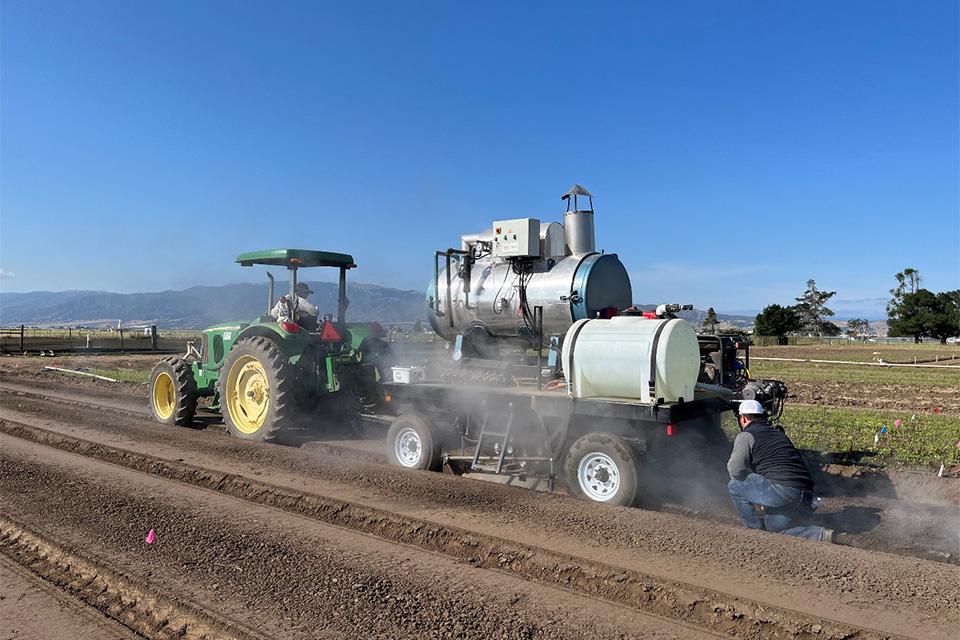
Band steam application for onion. Steam was injected into a band aligned with where onion was seeded in a subsequent operation.
Photo by Steven Fennimore
What We Learned
The weeds present were shepherd’s-purse (Capsella bursa-pastoris), henbit (Lamium amplexicaule), burning nettle (Urtica urens), and purslane (Portulaca oleracea).
Among the base treatment weed control with steam alone was as good or better than Dacthal herbicide or Nortron alone. The onions were not injured by steam, Dacthal, or Nortron.
Regardless of base treatment, all the treatments with POST Goaltender and Bromoxynil were effective on weeds. Onion injury from sequential treatments of Goaltender and bromoxynil were comparable, ranging from 27% to 35% injury at 3 DAT (days after transplanting), declining to 17% to 25% by 14 DAT.
All treatments had similar numbers of cull, medium, and large bulbs.
Steam alone, steam followed by GoalTender and Buctril POST, and Dacthal PRE alone treatments produced the highest numbers of jumbo bulbs, similar to the weed-free nontreated check.
Steam alone, steam followed by GoalTender POST and Buctril POST, and Dacthal PRE alone treatments produced the highest weight of jumbo bulbs, similar to the weed-free check.
Higher production of jumbo bulbs is an indication of selectivity in the treatment, a combination of minimal injury to onion and excellent weed control.
Steam disinfestation provided better weed control than Dacthal at 8 pints/A. However more engineering work is needed to develop a steam applicator that will be cost effective in onion.
The sequential treatments of GoalTender and Buctril POST were effective on weeds and safe to onion regardless of the base treatment of steam, Dacthal or Nortron. Nortron does appear to be the best alternative to Dacthal for early season weed control in seeded onion.
Herbicide Study in Brassicas
Small acreage brassica vegetables need additional herbicide options. Among the vegetables grown in California are several niche crops such as bok choi, broccoli raab and brussels sprouts that have a limited number of registered herbicides such as Dacthal.
Syngenta’s Dual Magnum (S-metolachlor) has a food use tolerance for use on brassica head and stem crop group 5-16, which includes crops such as bok choi and brussels sprouts as well as brassica leafy greens subgroup 4-16B, which includes crops such as kale.
There is a lack of data for Dual Magnum on a wide variety of seeded and transplanted brassica vegetables, however. We evaluated Dual Magnum applied PRE on six direct-seeded brassica vegetables during 2019 and 2020 including bok choi, broccoli raab, collard greens, mizuna, radish, and mustard greens. Dual Magnum was evaluated PRE in transplanted brussels sprouts and kale.
The results indicate that the seeded and transplanted brassica vegetables were tolerant of Dual Magnum. Labelling of Dual Magnum is currently under evaluation in California.
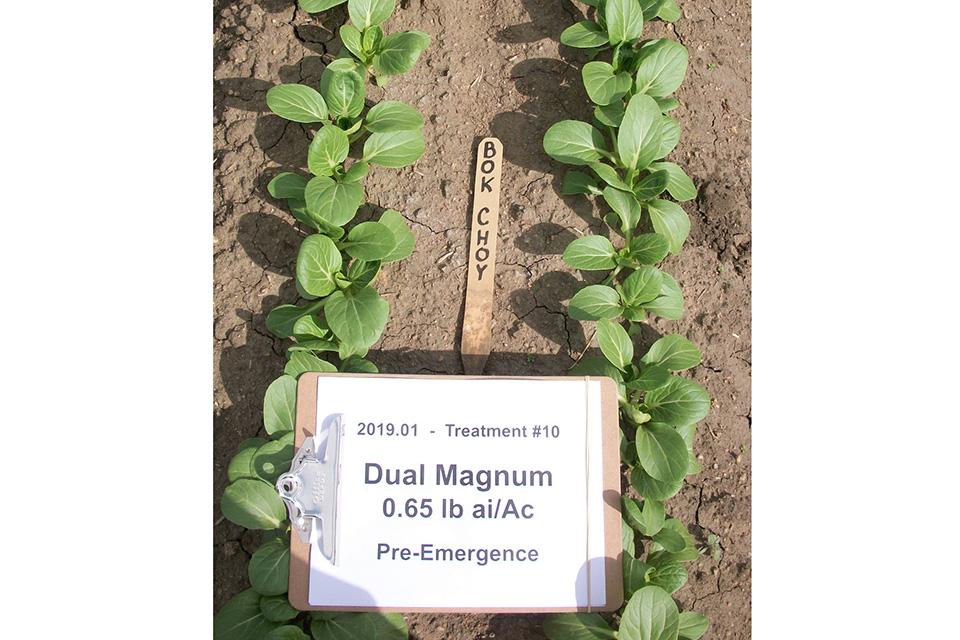
Demonstration of excellent crop safety of Dual Magnum on bok choi.
Photo by Steven Fennimore
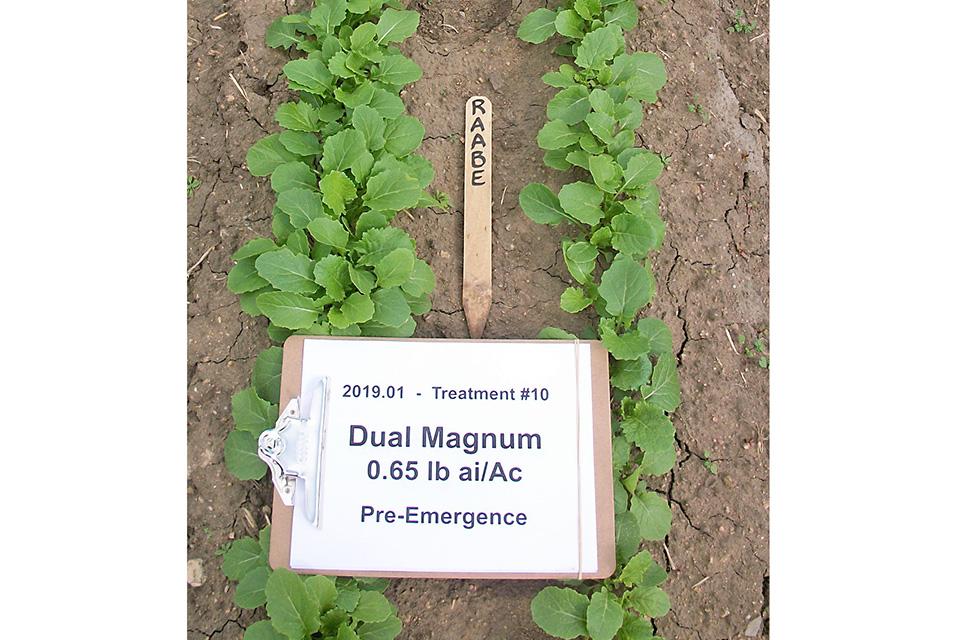
Demonstration of safety of Dual Magnum on broccoli raab.
Photo by Steven Fennimore
Subscribe Today For
