



How to Handle Vegetable Crops Hit by Hail
 January 20, 2025
 Anytime a hail storm or damaging weather event comes to a farm, the result is uncertainty, loss of momentum, and a series of tough decisions for the farmer. I’ve stood looking out at many acres of hail-damaged crops not having any idea of how to lead my staff who stood behind me waiting for direction.
To build a portfolio of skills and knowledge, immediately ready for use on damaged plants, I’ve experimented with recovery techniques after hail storms and kept records of yields so that decisions are easier and less time is lost to deliberation.
Swiss Chard
Swiss chard leaves are so delicate and thin that even a light hail storm can create holes and shred leaves. Removing damaged leaves is important to speed up plant growth, decrease chances of disease, and to create efficient future harvests. For clean up, I’ve tried two main methods: I used a knife to top the plant completely, quickly cutting across the stems, being sure to keep the crown of the plant intact, and I’ve more carefully removed all damaged leaves by cutting them and their stems off two or three at a time, leaving smaller leaves completely uncut.
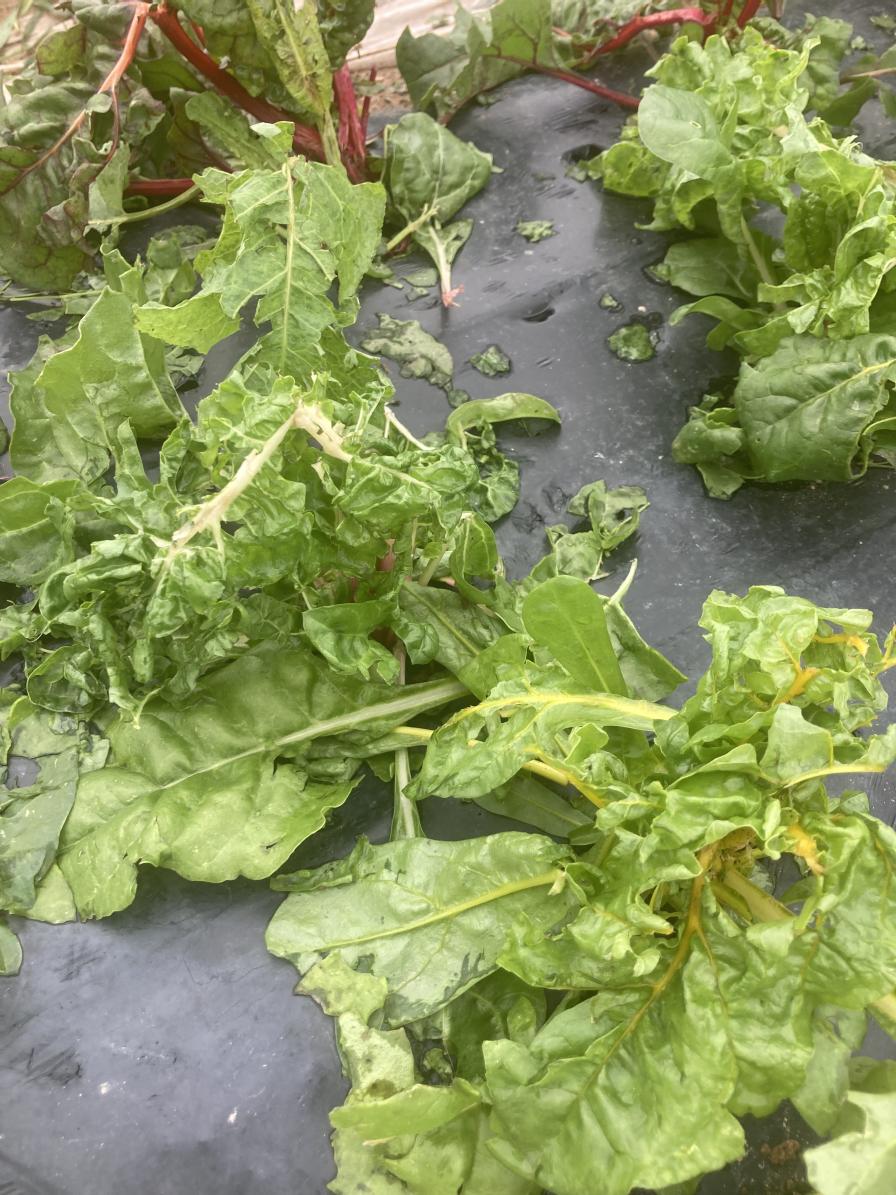
Photo by Anna Littman, Ivy Creek Family Farm
Only the last method, cutting two or three leaves off at a time, resulted in a subsequent profitable crop. This method took me 40 minutes per 150 by 3 foot bed, planted with three rows of Swiss chard per bed, planted 12 inches apart. Once the damaged leaves were carefully removed, the plants grew quickly and I was able to harvest again in 10-14 days. The occurrence of hail damage in the small leaves was low, likely because they are nestled in at the base of the plant, fairly covered by larger leaves.
Kale
The method I use with kale is similar to that of Swiss chard, removing damaged leaves. Kale clean-up is faster than Swiss chard because it is possible to use both hands, rather than a knife, to quickly remove damaged leaves by pulling them downward on both sides of the plant. Kale clean-up takes about 20 minutes per 150 by 3 foot bed, planted 3 rows, 15 inches. With , I found there is a likelihood of damage on the smallest leaves because they are high up on the plant, and often directly exposed to hail.
If there is extensive damage in the kale crowns, recovery can take longer than is possible for a profitable crop, particularly if customers expect perfect kale leaves. In this case, I’ve found that mowing the crop down and focusing on subsequent crops is a better choice than continuing to put resources into weekly plant care. If small leaves did not experience extensive damage, kale plants can produce a harvestable crop within 7 to 10 days of clean up.
Head Lettuce
In general, mature crops are at a higher risk for hail damage than newly planted crops, and this is particularly true with lettuce. Because lettuce grows so quickly, small lettuce plants, two weeks old or younger, can almost always bounce back from hail damage to produce good yields. At harvest time, weeks after a hail event, I simply direct my staff to remove outer leaves that appear damaged.
If a head of lettuce is close to maturity when hail hits, all is still not lost. In this case, some types of lettuce can handle a full cutting of the head and then regrow a second head as long as the cut is made above the crown. This is a great method for varieties like ‘Red Gem’, ‘Hampton’, ‘Brentwood’, and ‘Salanova’ heads. The sooner the lettuce is cut back after the hail damage, the more likely they will grow a second usable head. Typically, the second growth is best used for mix. This method does not work as well for summer crisp lettuce like ‘Magenta’ or ‘Cherokee’. However, summer crisp lettuce, or any vertical lettuce is less likely to have extensive damage from hail during a light storm.
Onions
When a severe hail storm hit my farm last spring, I was harvesting both mature overwintered onions and also caring for month-old onions, newly planted. Both were decimated by the hail, with damage to the leaves. In the days after the hail, I harvested as many of the mature onions as I could, but, it became clear that where the hail hit the onion bulbs, they rotted. Because the hail damage was difficult to spot, selling the crop was risky.
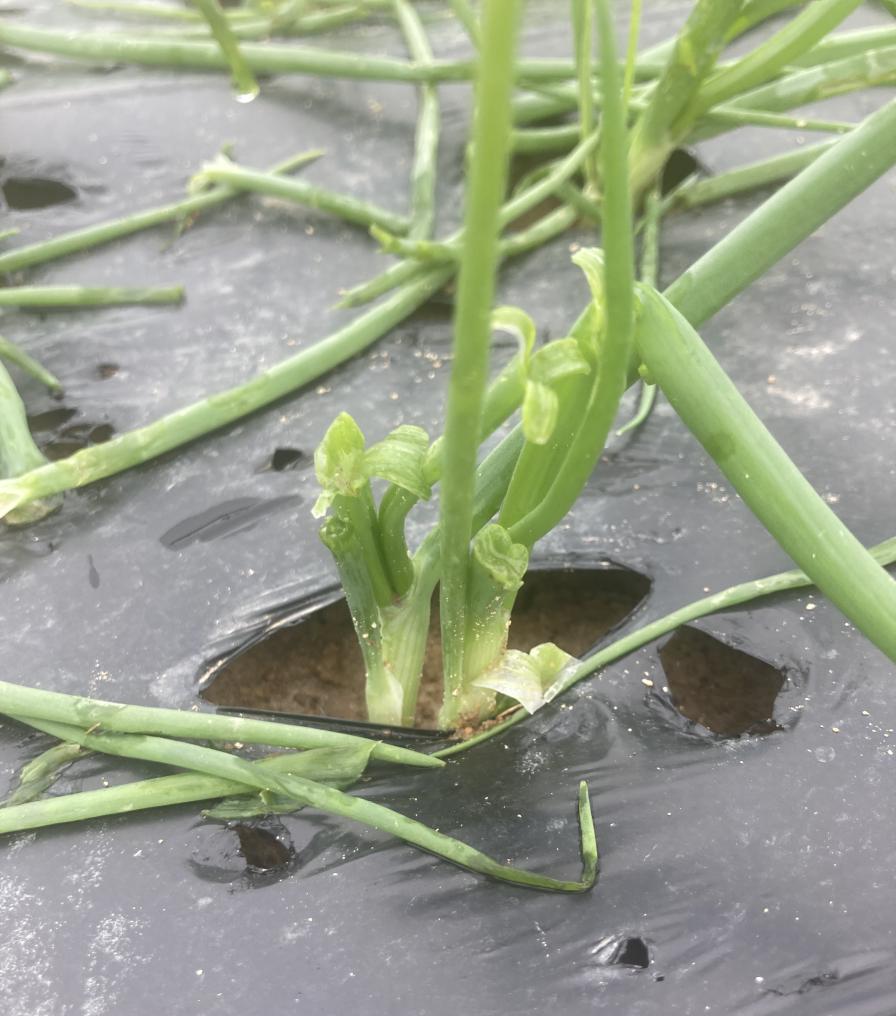
Photo by Anna Littman
I only was able to sell what I examined closely, which meant the onions were not a profitable crop. I chose to continue growing the smaller, month-old onions, and I sprayed them with Actinovate (Mychorrhizal Applications) to protect them from disease. We continued using Actinovate weekly until harvest. Unfortunately the damage to the leaves was great enough during the hail storm that 30 % of the onions were rotten at harvest. The time it took sorting the rotten from the good onions made the crop a loss. With long-term crops, and particularly with crops whose damage is hard to detect until harvest, the risk post-hail is high.
Broccoli
The severity of hail damage on head broccoli depends on the crop’s stage of maturity. Even a light hail storm can severely damage fully mature broccoli heads, leaving ugly pock marks on the crowns. A moderate hail storm can send ice pellets several inches into the crown, resulting in rot that develops a few days after the storm.
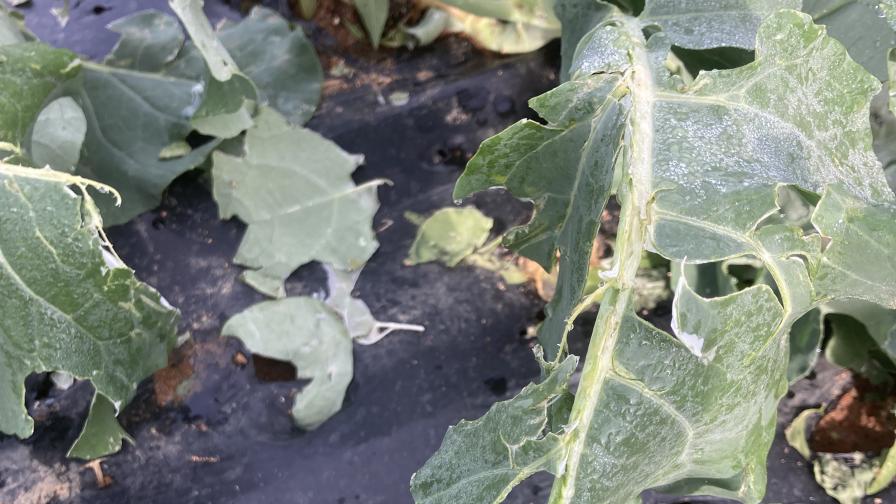
Photo by Anna Littman
In recent years a severe hail storm came to my farm in early May, just as the baby crowns were forming. Every leaf on the plants was ripped to pieces. Stems were broken off, hanging. Out of curiosity and desperation for a crop, I spent hours cleaning up the plants, cutting off the most damaged leaves and all of the stems that were broken where rot was forming. I treated the plants with Actinovate immediately and then weekly. Within 3 weeks the plants produced broccoli heads that were marketable. Some of them had blemishes, but very few had any rot.
Subscribe Today For
