



Solutions Found by Vegetable Growers for Wildlife Control Challenges
In our 2024 State of the Vegetable Industry survey, growers highlighted the significant wildlife control challenges posed by deer, birds, and rodents to their operations, sharing valuable insights into the impact these pests have on crop yield, quality, and overall efficiency.
Their experiences shed light on the innovative strategies and solutions being tested in the field, as well as the approaches that have proven less effective, helping to shape a deeper understanding of the resources and support growers need to mitigate these issues.
Wildlife Control Challenges
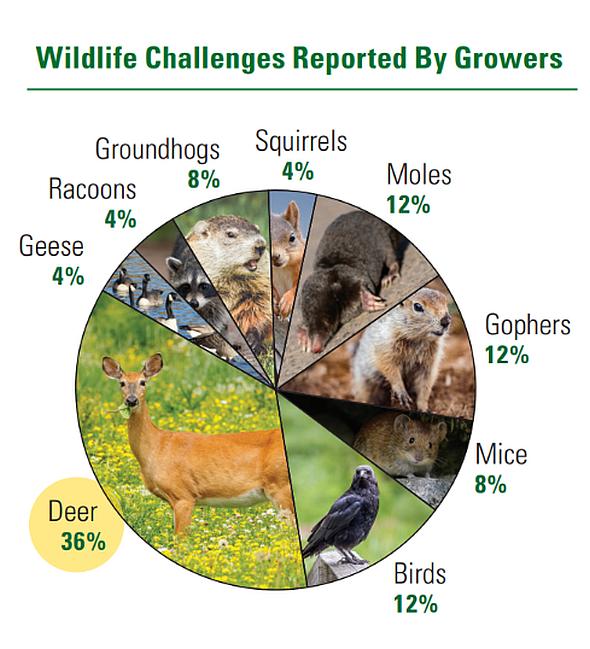
Deer problems begin shortly after sprouting, consuming tender seedlings and nipping off the tops of beans, peppers, and tomatoes, which stunts plant growth and results in little to no produce.
As corn matures, deer partially damage large quantities of ears, while full-size pumpkins are impacted by bites that make them unmarketable. Deer also feed on citrus tree foliage to the point of defoliation, stunting tree growth and reducing production.
The primary problem comes from white-tailed deer — hungry, smart, and persistent — who eat a wide variety of crops, including spiny cucurbits and tomatoes, destroying entire seasonal harvests in a single night.
Birds cause significant damage by feeding on fruit, especially sweet cherries, which they peck at, ruining the fruit and leaving it sticky. Crows often feed on red apple varieties, while blackbirds damage corn. Geese, now year-round residents, have become a constant nuisance, nipping at strawberries and purple hull peas.
Rodents cause significant damage in various ways. Groundhogs feed on produce at nearly every stage, while raccoons become problematic as plants mature, particularly sweet corn. Moles target sunchokes, parsley, potatoes, and fruit trees, and gophers damage roots, especially in young trees. Mice, gophers, and squirrels chew on roots and bark, with mice gnawing around the base of both young and mature trees, damaging the cambium layer of crops.
What Works
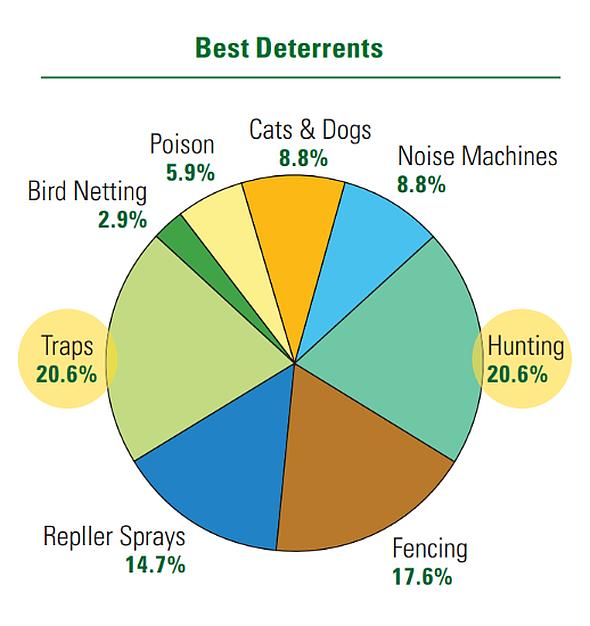
Deterring wildlife can be challenging, with varying levels of success from different methods. Traps, repellent sprays, fencing, and hunting have shown moderate to good effectiveness, while noise machines, cats and dogs, poison, and bird netting have had limited or temporary impact.
Electric fences, combined with strategies like using dryer sheets or running multiple hot wires, offer better control, though they require constant maintenance.
For birds, netting provides the most reliable protection, though it can be costly for large areas. Overall, addressing pest issues often requires a combination of approaches, and no method is completely foolproof.
What Doesn’t Work
Many deterrents have proven ineffective in protecting crops from wildlife.
Deer deterrents like sprays, reflective tapes, and dryer sheets have little lasting impact, as animals quickly become accustomed to them. Electric fences, while effective, are costly and require constant maintenance, as deer often find ways to bypass them.
Rodents, including mice, gophers, and voles, are difficult to control with traps and poison, as populations quickly rebound without sufficient predatory control.
Birds, particularly crows and blackbirds, are also difficult to deter with scarecrows, noise machines, or owl kites, which quickly lose their effectiveness. Most traditional repellents and deterrents, whether for deer, birds, or rodents, have limited success, leaving farmers with the need to continuously experiment and adapt their strategies.
Each farmland presents unique challenges, and what works for one farmer may not be effective for another. Different wildlife issues require tailored solutions, and it often becomes a process of trial and error until you discover what works best for your specific field.
Subscribe Today For
