



More Effective Disease Control in Your Vegetables via Crop Rotations
 March 7, 2025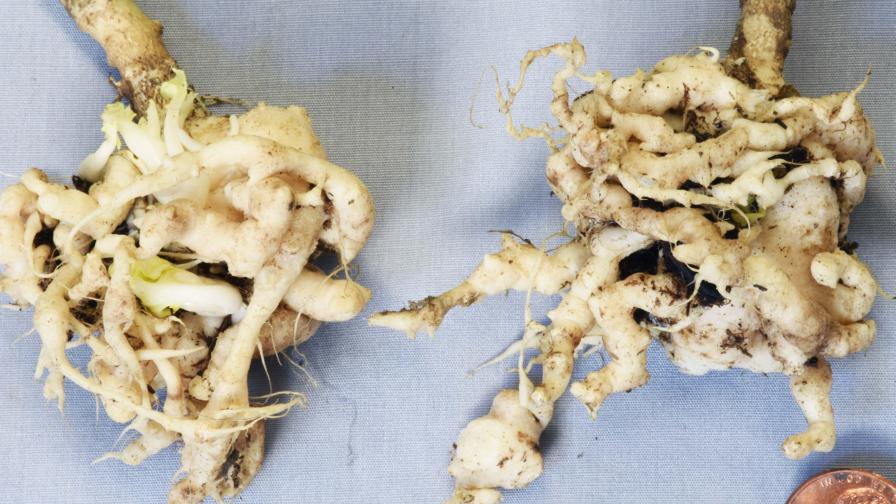
Crop rotations can be key to keeping problematic plant pathogens at bay. Here, the clubroot pathogen causes massive root deformities and builds up in soil if crucifers are repeatedly planted.
Photo by Steven T. Koike, TriCal Diagnostics
Plant diseases are one of the most challenging obstacles facing growers, with microscopic pathogens regularly threatening crop yields and quality. A biological reality is that if a farmer grows the same or closely related crop too many consecutive times, and if the farmer puts in the same crop too often over a short period of time, the pathogens will be harder to manage. Frequent use of crops that are hosts to a particular pathogen allows these microbes to feed and feast on their favorite foods; this situation can result in fungal or bacterial population spikes.
Soilborne diseases
Over-planting host crops can cause long-term problems for managing soilborne pathogens. Once soilborne fungal or bacterial populations climb to damaging levels, crops are at risk. For example, clubroot disease, caused by the primitive fungus Plasmodiophora, develops on crucifer crops such as broccoli, Brussels sprouts, cabbage, and cauliflower. If a grower program depends heavily on crucifer plantings, this pathogen can increase in the soil with each crucifer planting and eventually result in widespread crop losses. A good rotation scheme in this case would de-emphasize crucifers and plant any non-crucifer crop. Side note: it is well established that clubroot does not develop as severely at higher soil pH levels, so a disease IPM plan will include planting non-crucifers as well as liming the soil.
In contrast to Plasmodiophora, which has a narrow host range, a soilborne pathogen like Verticillium has a very broad host range. If a field has a history of Verticillium, an ill-advised crop rotation would include consecutive and frequent plantings of susceptible hosts such as lettuce, strawberry, artichoke, tomato, pepper, potato, and other row crops. The soilborne pathogen Rhizoctonia is another example of a persistent fungus that can cause diseases on multiple commodities such as lettuce, cauliflower, celery, cilantro, and spinach. Frequent or consecutive plantings of these row crops could encourage rapid increase of Rhizoctonia populations. A good plan will include non-host crops in rotation with susceptible ones.
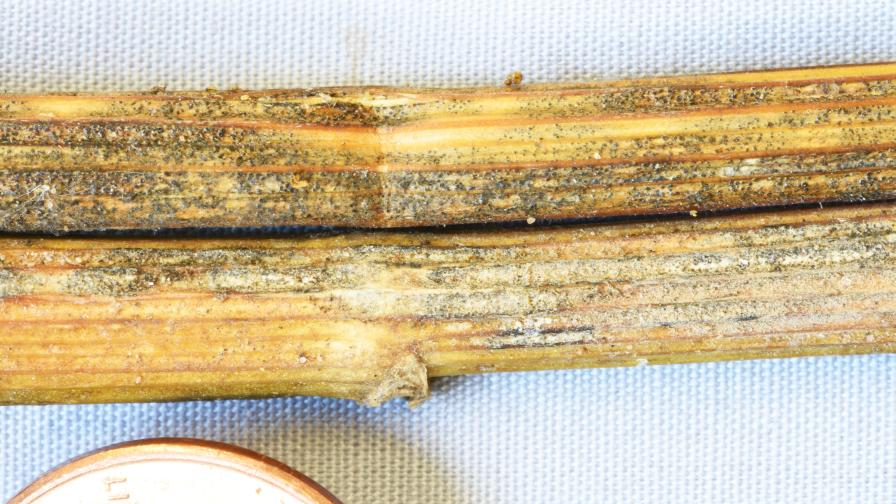
Black structures of the celery late blight pathogen enable the fungus to survive on dried up celery crop residues.
Photo by Steven T. Koike, TriCal Diagnostics
Foliar diseases
One might initially think that crop rotations pertain only to soilborne issues. However, management of foliar diseases can also be helped by crop rotations. If a crop is severely affected by some foliar pathogens, once the crop is harvested and gone, those pathogens still can be present at the site and be viable in small bits of leaf and stem tissue. Even if dried out, crop residues in the field can harbor viable bacteria (for example black rot of crucifers) and fungi (such as late blight of celery) that can splash up onto a susceptible crop that is planted next. Crop rotation measures would suggest planting a non-host crop or cover crop next, allowing for complete decomposition of infested plant residues.
Fusarium wilts
If the main soilborne concern is Fusarium wilt, then crop rotations are mostly straightforward: just don’t use susceptible cultivars of the crop that hosts that particular Fusarium wilt pathogen. Fusarium wilt pathogens tend to have a very narrow spectrum of infectivity, infecting only one type of crop. Fusarium wilt of tomato only occurs on tomato, Fusarium wilt of lettuce is only on lettuce, Fusarium wilt of basil is found only on basil. A few interesting exceptions do occur, however. For many decades it was known that the Fusarium wilt (or “Fusarium yellows”) pathogen of celery can only cause disease on celery. Recent research, though, has found that the celery Fusarium wilt fungus can also cause disease on cilantro and possibly even on parsley. This discovery violates the traditional “One Fusarium wilt pathogen to one host crop” rule. Growers are therefore advised to keep current on research findings that may alter established crop rotation recommendations.
Planning strategic crop rotations
Here are recommended steps for designing strategic crop rotations. (1) Identify the pathogens of concern. Through soil tests, tests of previously diseased crops, and records, create a list of pathogens that are documented, significant concerns for each ranch, block, or lot. (2) For each of these locations, list all crops in your overall program that could be planted there. In this list, be sure to include resistant varieties if these are available and used in your program. (3) Compare the two lists. Assign a favorable rating (“yes we can plant”) to crops that are not a host of or are resistant to the pathogens; assign a less favorable rating (“wait and re-consider”) to crops known to suffer losses from the pathogens. (4) Confirm your findings with your management team, pathology experts, professional advisors, and extension personnel.
Subscribe Today For
