


Fruitful Takeaways: 5 Things I Saw on the IFTA Summer Tour
 August 4, 2026
 The July 19-22 International Fruit Tree Association (IFTA) summer tour ranks as the best of the five IFTA conferences and tours — winter and summer combined — that I’ve attended since 2020. Sure, it helped that this one wasn’t held in 17-degree weather or a blizzard, but that was hardly the only reason the Hudson Valley event stood out.
About 90 attendees aboard two buses toured New York’s Hudson Valley, making nine diverse stops over two full days that stretched from 8 a.m. to 8 p.m. and began and ended in Poughkeepsie. The itinerary blended orchard innovation, diverse production systems, packing technology, and value-added enterprises in a way that impressed even longtime IFTA Educational Director Greg Lang.
“I really like how the tour flowed, with a lot of diverse crops and innovative ways to be profitable — fresh market, PYO, processed products, cider, distillery, dozens if not hundreds of varieties, etc., followed by orchard and packing house technologies and innovations, and fantastic food fueling our tour energy,” he said. “For the progressive and resilient growers that make up the IFTA membership, there are strategic benefits to be had from deep dives into orchard practices, and there are strategic benefits to be had from thinking outside the ‘deep dive orchard practices’ box.”
Among the many takeaways from the tour were these five:
1. Technology Meets Orchard Design
One of the tour’s most innovative stops was Hurds Family Farm, where seventh-generation grower Charles Hurd showcased a 3.5-acre high-density apple planting built around a center pivot irrigation system. Rather than viewing the pivot as simply an irrigation tool, Hurd described it as the hub of an integrated management system for water, nutrition, evaporative cooling, biologicals and, eventually, autonomous equipment.
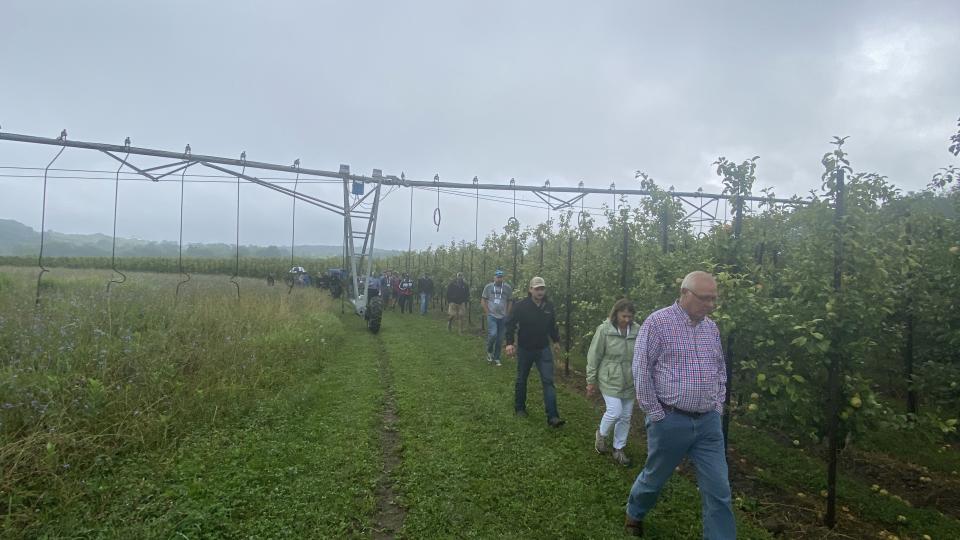
Photo: Thomas Skernivitz
“The overhead line is what I use for spraying. I use that for fertigation. I use that for biologicals,” he said. “The drop hoses are used for fertigation, evaporative cooling, and even warming when needed.”
Hurd emphasized that every management decision begins with data. Repeated leaf sap analysis, combined with soil, water and crop observations, guides nutrient prescriptions for individual orchard blocks.
“Everything in this system goes back to one place. Everything that goes out in this system comes back. I can test it. I can reuse it,” he said while describing the farm’s water recapture system.
Throughout the tour, Hurd stressed designing orchards with automation in mind. The curved planting pattern, 5-by-5-foot spacing, and individually supported trees were all developed to accommodate autonomous equipment and precision management.
“It’s not just this expensive thing in this field, but it’s a whole system,” he said, explaining how the pivot, injection equipment and future autonomous machinery are intended to function as one integrated platform.
Perhaps Hurd’s clearest takeaway came during his discussion of nutrition management. “Everything is driven by sap analysis,” he said. “You have to be doing sap analysis … at least three times a year to know where you’re going.”
2. Direct Marketing/Value-Added Agriculture
Rather than relying solely on wholesale apples, Golden Harvest Farms in Valatie, NY, has built a diversified business around fresh-market apples, pick-your-own, farm market sales, distilling, specialty vinegars, a tasting room, agritourism, and special events.
Third-generation apple grower Derek Grout established Harvest Spirits Farm Distillery in 2007 after successfully lobbying state lawmakers to create New York’s farm distillery license. Today he crafts award-winning spirits — including Core Vodka and Cornelius Applejack — along with specialty vinegars made from fruit grown on the farm.
“About 20 years ago I learned that you could make vodka from hard cider,” Grout said. “You distill hard cider into vodka with the right equipment. We bought this equipment from Germany, and I convinced my dad to turn one of his CA (controlled atmosphere) rooms into a craft distillery to make better use of the surplus cider apples and make vodka from apples. I had no experience in distilling. We have no family history and no family recipes, so it was a big gamble for my dad to say, ‘Yeah, we’re going to take a perfectly good CA storage room right in the center of the farm and let the fourth out of five sons make a go of making spirits from apples.’
“The cool thing about spirits from apples is they don’t go bad. They’re infinitely shelf stable. And in the case of aged spirits, once you put them in an oak barrel, they actually gain value over time, although some evaporates during aging. You can turn a commodity like apples into sweet cider, ferment that into hard cider, distill it twice, age it in a used bourbon barrel, and end up with a premium product.”
One of Harvest Spirits’ signature products begins while the apples are still on the tree. On a small number of Snapdragon trees, a tiny developing apple is carefully placed inside a glass bottle that is secured to the tree. The fruit matures inside the bottle throughout the summer. Once ripe, the stem is clipped, the bottle is removed and cleaned, then filled with clear apple brandy and sold as a premium specialty product.
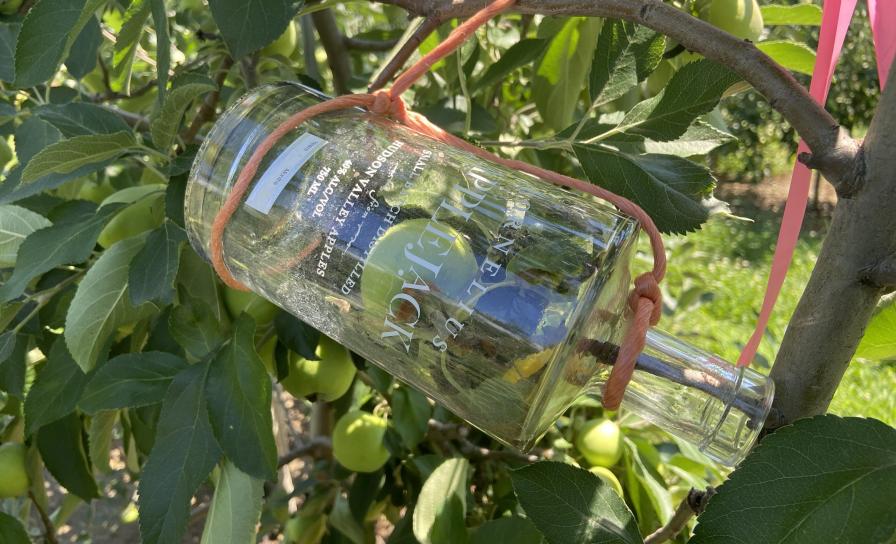
Photo: Thomas Skernivitz
Harvest Spirits also produces raw apple cider vinegar, fire cider, and apple balsamic vinegar. Unlike traditional balsamic vinegar, which begins with grapes, Grout’s version starts with fermented apple cider. The cider is converted into vinegar before being slowly concentrated and aged to develop sweetness and complexity without artificial additives.
“Balsamic vinegar is not a protected name like Champagne or Calvados. Traditional-method balsamic is protected, but the word ‘balsamic’ is not,” Grout said. “My idea was to do what they’re doing with balsamic vinegar and apply it to apples. We started making vinegar 12 or 15 years ago and had a lot of failures. We finally got it right during COVID, when we had a lot of time to think.
“It’s apple cider vinegar and apple cider concentrate that you’re reducing to a certain level of Brix, sweetness, acidity and viscosity without adding extra sugar or color. It’s shelf stable and, unlike spirits, can be sold nationwide. This is another product we developed here that creates greater value from our apples.”
3. Crop Diversity
As Cornell Integrated Pest Management Program Fruit IPM Coordinator Anna Wallis noted, no Hudson Valley operation better exemplifies specialty crop diversity than Samascott Orchards. The Kinderhook, NY, farm grows more than 100 apple varieties along with hundreds of other fruits and vegetables. Two hundred of its 1,000 production acres are devoted to pick-your-own, making it the largest PYO operation in Columbia County.
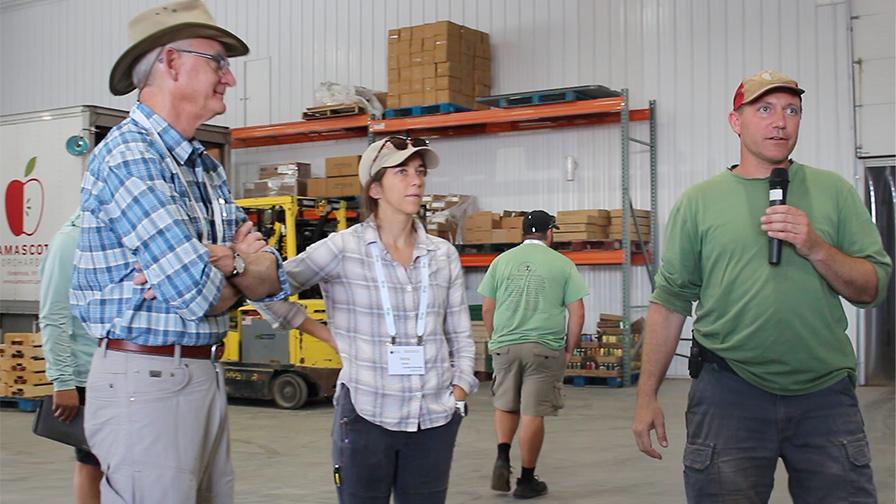
From left: Greg Lang, Anna Wallis, and Jake Samascott during the IFTA Summer Tour stop at Samascott Orchards in Kinderhook, NY. Photo: Thomas Skernivitz
“Any kind of fruit and vegetable you can think of, we’ll see a lot of them when we drive around,” owner Jake Samascott told IFTA members. “All of the produce goes to farmers markets — five days a week in New York City and seven different markets overall. We also do three local markets in Hudson, Great Barrington, and Troy.
“Most of what we harvest goes to farmers markets. Pick-your-own remains an important part of our business, but it’s very seasonal, and there’s only so much a customer will take. Farmers markets operate year-round. They never stop. That’s a great outlet for us.”
4. Spring Freeze After-Effects
Nearly every stop on the tour included discussion of the devastating April 21 freeze that affected orchards throughout the Mid-Atlantic and Eastern United States.
Russell Bartolotta, President of Klein’s Kill Fruit Farms in Germantown, NY, described the impact on his apple and peach operation.
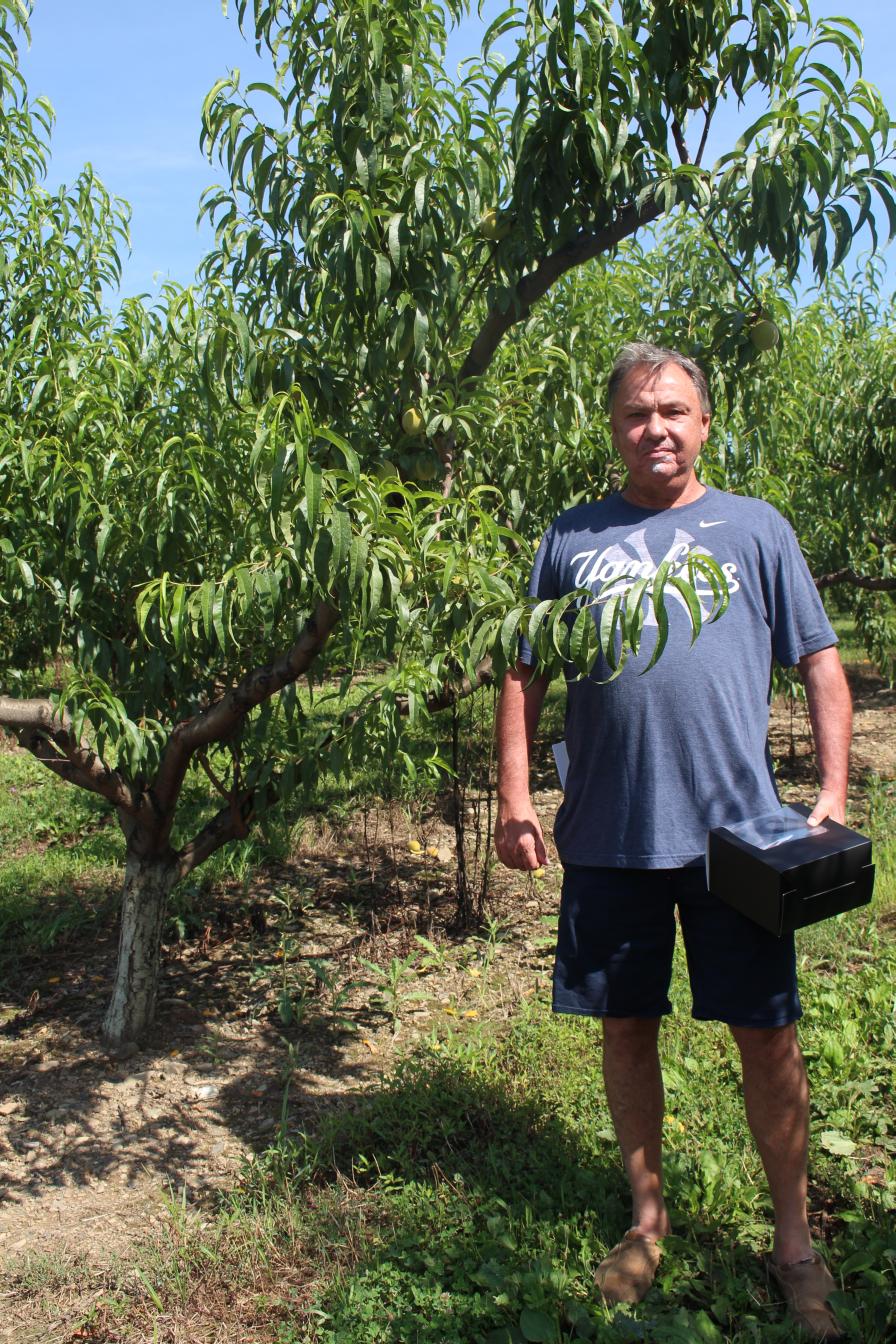
Russell Bartolotta of Klein’s Kill Fruit Farms in Germantown, NY. Photo: Thomas Skernivitz
“This year was a trying year for everybody in the Hudson Valley and all through the Mid-Atlantic,” he said. “On April 21, temperatures dropped into the low- to mid-20s, and some farms even reached 18 or 19 degrees. We happened to be at tight cluster to early pink. The lower valley was already in full bloom, and growers in Pennsylvania and Virginia were hit even harder.
“We had helicopters that night, as we always do, along with wind machines. We had an inversion, and the helicopters raised temperatures 4 to 6 degrees. The earlier peaches suffered the most damage. I still have about 80% of an apple crop. So far it’s clean, but we’ve still got to battle the storms.”
The conversation underscored how dramatically spring weather can reshape a growing season, even for operations equipped with sophisticated frost-protection tools.
5. Robinson Farewell
Cornell University professor and IFTA Hall of Famer Terence Robinson addressed members one final time via video from Geneva, NY, during the tour’s closing session at the DoubleTree in Poughkeepsie. Robinson, who officially retires in December, leaves behind one of the most influential careers in modern apple production.

Photo: Thomas Skernivitz
Lang summarized Robinson’s impact while introducing his longtime colleague.
“I am pleased to introduce my esteemed colleague, Dr. Terence Robinson, one of the world’s most influential apple production researchers and educators, with more than four decades of advancing the science and profitability of modern orchard systems. Since joining Cornell’s New York State Agricultural Experiment Station (now Cornell AgriTech) in 1984, he has transformed commercial apple production through pioneering work on high-density orchard systems, including development of the Tall Spindle training system, probably the most widely adopted and profitable apple production system in the world today.
“His research has also been instrumental in the development and evaluation of the USDA-Geneva apple rootstocks that have dramatically improved orchard productivity, disease resistance and grower profitability around the globe. Beyond his high-impact research, Dr. Robinson has shared his expertise through more than 1,000 scientific publications, grower presentations, on-farm demonstrations, field days and workshops.
“Dr. Robinson’s impact includes decades of leadership and service to the IFTA. He has educated generations of fruit growers through IFTA conferences, orchard study tours and technical sessions, helping bridge the gap between research and practical orchard management. In recognition of his extraordinary contributions, he was inducted into the IFTA Hall of Fame in 2015.
“His career has also been honored with election as a fellow of the American Society for Horticultural Science and receipt of the prestigious Wilder Medal from the American Pomological Society, recognizing a lifetime of exceptional service to pomology. Through his research, teaching and unwavering commitment to growers worldwide, Dr. Robinson has helped shape the future of modern apple production and had a lasting impact on the global fruit-growing community. Please join me in welcoming Terence to IFTA one more time.”
Interpoma, Here We Come
The Hudson Valley tour may be over, but IFTA’s travel schedule is just getting started.
Next up is “IFTA in the Alps,” an international tour scheduled for Nov. 21-28 through Switzerland, Germany, and Italy, culminating at Interpoma 2026. Participants will spend several days around Lake Constance (Bodensee), visiting pome and stone fruit operations in Switzerland and Germany, along with Germany’s KOB Research Centre, which serves one of Europe’s premier fruit-growing regions for apples, cherries, pears, peaches, plums, and apricots.
“With the chance to see production of tree fruits of every kind, talk with leading growers about their unique challenges and new technology adoption experiences, plus see what the future may hold as researchers innovate and commercial orchard applications develop, it is no wonder that IFTA members have been looking forward to this Interpoma sequel ever since our 2022 visit, which focused solely on Italy,” Lang said. “Get those passports ready.”
Looking ahead to 2027, IFTA returns to Grand Rapids, MI, for its annual winter conference Feb. 7-10. It will mark the organization’s third visit this decade to the Amway Grand Plaza, following conferences there in 2020 and 2023.
Next July, the association travels to British Columbia, where members will explore one of North America’s premier fruit-growing regions during the annual summer tour.
Subscribe Today For
