


Get to Better Know the Beneficial Predators in Potato Fields
 November 6, 2026
Potato fields are home to far more than the insects and mites we consider pests. Look closely, and you should also find a diverse community of predators. The species and relative abundance vary by potato-growing region, but commonly include lady beetles, big-eyed bugs, damsel bugs, minute pirate bugs, lacewings, predatory stink bugs, ground beetles, rove beetles, predatory mites, and spiders.
Many are generalists that feed several kinds of prey, including aphids, thrips, and the immature stages of psyllids, leafhoppers, Colorado potato beetles, loopers, and spider mites. These hungry predators are remarkably good at finding prey and can help keep pest numbers in check. That’s why we call them “beneficial predators,” or just “beneficials.”
Learn to Identify the Good Guys
Look for beneficials while scouting for pests. Examine the tops and bottoms of leaves, especially where aphids or other potential prey occur. Give potato plants a quick shake over a pail or sweep the canopy with a net to find active predators you may miss during visual inspections. And don’t forget to look down. Ground beetles, rove beetles, and spiders may be lurking on or near the soil surface.
Learning to recognize beneficials takes some practice because adults may look nothing like their immature stages. Lady beetles are a good example. Most people recognize familiar dome-shaped adults, but their larvae, which are also predatory, are dark gray or black, often with reddish-to-yellow markings, and resemble tiny, spiky alligators.
Even the adults may fool you. Lady beetles aren’t always red with black spots. Depending on the species, they can be orange, yellow, or black, and some have no spots. Their other life stages can be confusing, too. Lady beetle eggs can resemble Colorado potato beetle eggs, and a lady beetle pupa can look surprisingly like a shriveled Colorado potato beetle larva.
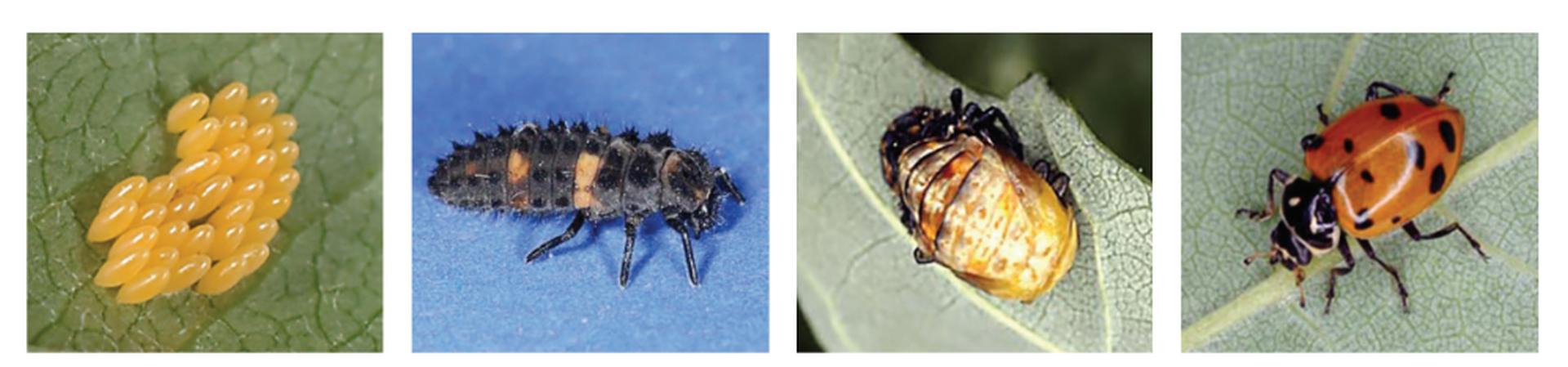
The photos (left to right) show convergent lady beetle eggs, a larva, a pupa, and an adult. The convergent lady beetle is one of the most common lady beetle species found in potato fields.
Photos: Joseph Berger, Bugwood.org.
Insecticide Choices Can Reshape the Predator Community
How we manage insect pests can strongly influence how many beneficial predators remain in a field.
Researchers sampled 31 commercial potato fields in Washington managed with broad-spectrum insecticides, selective insecticides, or organic practices. Big-eyed bugs, damsel bugs, and spiders accounted for more than 90% of the foliar predators they collected. Ground beetles, rove beetles, and spiders made up more than 90% of the ground-active predators.
Predator densities were the lowest in fields treated with broad-spectrum insecticides. In contrast, fields managed with selective insecticides had predator populations similar to organic fields while maintaining lower pest densities similar to fields receiving broad-spectrum insecticides.
Some Insecticides Are Harder on Beneficials Than Others
An insecticide’s effect on predators depends on its toxicity, spectrum of activity, exposure route, and duration of biologically active residues.
Pyrethroids can be especially disruptive because they are highly toxic to many arthropods. Predators that escape direct exposure during application may still encounter residues as they move across treated plant surfaces searching for prey. Because pyrethroids can leave biologically active residues for days or even weeks, opportunities for exposure can persist long after application.
Like pyrethroids, organophosphates and carbamates are broad-spectrum neurotoxins that can kill predators during application or through contact with residues, although the persistence of those residues varies among products.
Natural pyrethrins, usually permitted in organic systems, can also be toxic to beneficials on contact, but they break down rapidly in sunlight and generally pose a much shorter residual hazard than synthetic pyrethroids.
Systemic insecticides, such as neonicotinoids, can be softer on predators — not necessarily because they aren’t toxic, but because the insecticide is absorbed and moves within the plant, reducing some opportunities for contact exposure. This is especially true when insecticide is applied to the soil rather than foliage. Predators may still be exposed during foliar applications or when opportunistic plant feeders, such as predatory stink bugs and big-eyed bugs, occasionally feed on tissues or fluids of treated plants.
Selective insecticides affect a relatively narrow range of insects, often by targeting biological processes or life stages particularly important to the target pest. The greater the difference between the target and predator in their susceptibility to that mode of action, the more selective the insecticide can be. Examples include chitin synthesis inhibitors such as Rimon (novaluron, UPL), which affect developing larvae; feeding blockers such as Carbine (flonicamid, FMC Corp.), which target sap-feeding pests; and RNA interference insecticides such as Calantha (ledprona), which target a genetic sequence specific to the target pest.
This doesn’t mean growers must always avoid insecticides. They can be indispensable when pests threaten significant economic damage. Instead, consider effects on beneficials as another important factor when choosing an insecticide.
Subscribe Today For
