



Watch Out for This Parasitic Weed That Preys on Potatoes
 September 1, 2026
 Dodder is one of the most unusual weeds you may ever see. Unlike most weeds, dodder is a true parasite that depends on its host for water, nutrients, and the energy it needs to survive. There are many species of dodder, but the most agriculturally important is field dodder (Cuscuta campestris).
While it’s not a major potato weed, several regions of the U.S. have reported it in potato production systems, especially where field dodder occurs, and many susceptible crops are grown in rotation.
Development and Appearance: Dodder seeds germinate in the spring when soils reach about 60°F. The seedlings are rootless, leafless, threadlike stems that must find a host within about a week to survive. They appear to do this by sensing volatile chemicals released by nearby plants and growing toward them.
When a host is found, the dodder stem wraps tightly around it and forms specialized feeding structures called haustoria. These structures penetrate the host stem and connect directly to its vascular system, allowing the parasite to withdraw water, carbohydrates, and nutrients. Dodder produces little chlorophyll and cannot make enough of its own food through photosynthesis.
As dodder continues to grow, its stems climb and reach out to find adjacent plants. Dodder infestations often resemble tangled strands of string draped over the crop canopy. Many people compare them to Silly String, and at first glance you might think you have come across the remains of a kid’s birthday party. The yellow or orange stems are easy to spot against their green host plants.
During the growing season, small white to yellow bell-shaped flowers develop in clusters along the stems. These flowers produce small capsules containing several hard-coated seeds. A single plant can produce hundreds to thousands of seeds, depending on the dodder species, host plant, and growing conditions.
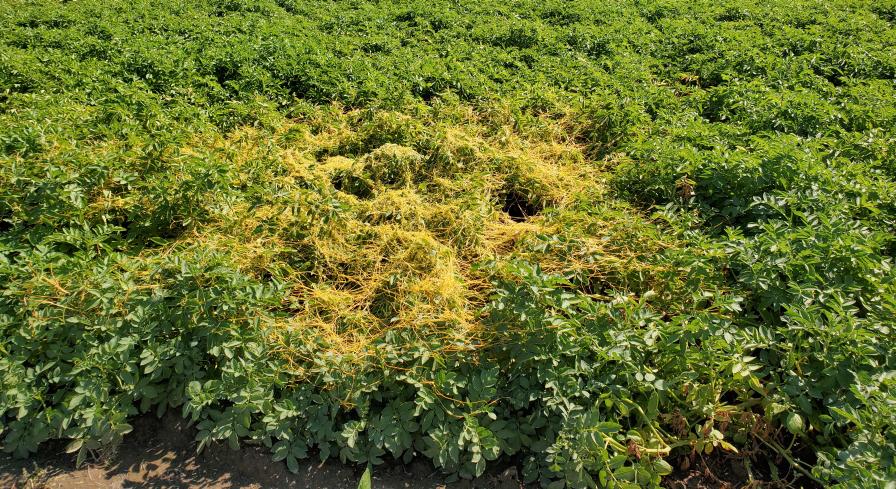
Notice the “Silly String” nature of dodder as it coats the top of these potato crops.
Photo: Carrie H. Wohleb
Survival and Spread: Dodder survives primarily through its long-lived seed. Freshly produced seed may germinate the following spring, but many remain dormant in the soil for years, creating a persistent seedbank and recurring infestations.
Dodder seeds are easily transported from field to field in contaminated soil and plant residues. Shared tillage, cultivation, and harvest equipment is one of the most common means of spreading seeds between infested and clean fields. Seeds may also spread from contaminated crop seed, irrigation water, manure, tare dirt, birds, and other animals.
Damage: Dodder weakens host plants by diverting water, nutrients, and carbohydrates that would otherwise support crop growth. Heavy infestations can reduce plant vigor, increase stress, cause early senescence, and decrease yields.
Infestations tend to be relatively small and localized in potato crops, and significant losses are unusual. But infestations can become larger and recurring when dodder is well-established in the crop rotation. Field dodder has many broadleaf hosts and is often associated with alfalfa, tomato, onion, and carrot crops, where damaging infestations are more common.
Cultural Management: Preventing dodder from establishing is easier than eliminating it later. Thoroughly clean equipment after working in infested areas. Scout field edges, irrigation ditches, and other non-crop areas where dodder may establish weeds before spreading into adjacent fields.
Cultivation may suppress dodder by burying young dodder seedlings and eliminating susceptible weed hosts. Once dodder attaches to its host and forms haustoria, however, cultivation provides little control and may even spread infested plant material within the field.
Small infestations can be managed by pulling or mowing infested plants before seed develops. Burning patches of dodder can kill the seeds attached to the vines or on the soil surface, but is unlikely to kill buried seeds or eliminate an established seedbank.
Chemical Management: Herbicides, such as trifluralin (e.g., Treflan) or pendimethalin (e.g., Prowl H20), can suppress seedlings before they attach to a host. Their value in potatoes may be limited since potatoes are typically planted many weeks before dodder germinates. By the time dodder emerges, herbicide residues from a preemergence or early post-emergence application to potatoes may be insufficient for reliable control.
Once dodder is attached to a host, chemical control becomes even more difficult because the parasite is physically connected to the crop. Most post-emergence herbicides that kill dodder also kill the host. They may help limit infestation, as with mowing, but will not prevent future issues if dodder seed has already been produced.
Subscribe Today For
