


Ways Insect Growth Regulators Work Best for Tree Fruit Growers
 October 5, 2026
 Insect growth regulators are not necessarily about killing the insect that is causing trouble in the orchard today. Their strength lies in interfering with development and preventing a pest from successfully progressing through its life cycle. That makes insect growth regulators, or IGRs, potentially valuable tools against several tree fruit pests. It also makes knowing precisely where a pest is in its life cycle especially important.
“A lot of the new chemistry for insects and diseases is very specific these days,” says Amy Irish-Brown, a Valent Sustainable Solutions Sales Specialist and former Michigan State University Extension educator. “It’s not as broad spectrum as it was 30 or 40 years ago.”
Consequently, she says, “there’s not as much room for mistakes or being sloppy in your timing.”
Irish-Brown recommends concentrating trapping and monitoring on pests that historically cause the most problems in an orchard. Records from previous seasons can also reveal trends and identify areas requiring greater attention the following year.
BEAT CODLING MOTH TO THE FRUIT
Codling moth provides a particularly good example of why developmental stage matters when using an IGR.
Once a larva hatches, the opportunity to control it can be remarkably short, says Allison Walston, Valent Senior Product Development Manager for Insecticides. A newly hatched larva may remain exposed for only minutes to perhaps an hour before entering the fruit. Once inside, it becomes an internal feeder and is largely protected from insecticide applications.
That makes determining biofix and following degree-day accumulation important.
Walston says females begin laying eggs at approximately 100 degree-days after biofix. The more typical egg-hatch period occurs around 200 to 250 degree-days, while approximately 1,200 degree-days marks the beginning of the next generation in areas where multiple generations occur.
The approximately 100-degree-day window creates an opportunity for an IGR directed at the egg stage. By the 200- to 250-degree-day period, the target is increasingly the newly hatching larva.
The distinction illustrates an important characteristic of an IGR program: Growers are not simply asking whether codling moth is present. They are asking what stage is present and which mode of action fits that stage.
IGRs can also play a role in resistance management. Walston recommends rotating active ingredients and identifies IGRs, Bt insecticides, and insect viruses as tools with modes of action different from conventional insecticides. Using those different modes of action can help reduce selection pressure for resistance.
Those tools fit within a broader codling moth program that also includes mating disruption, pheromone trap counts, degree-day models, orchard sanitation, and adequate spray coverage.
FOLLOW SAN JOSE SCALE CRAWLERS
San Jose scale provides another illustration of stage-specific management.
Andrew Rodstrom, Valent Pacific Northwest Field Market Development Specialist and a former Washington State University researcher, emphasizes the importance of understanding the scale’s life cycle.
Young San Jose scale emerge as mobile crawlers. They disperse from beneath the female’s protective covering, find a location on the tree, and settle down to feed. Severe infestations can spot fruit, reduce yield, and, in extreme cases, kill limbs or trees.
The crawler’s brief period of mobility creates both a monitoring opportunity and a treatment window.
Rodstrom recommends degree-day models to anticipate crawler emergence and peak movement. Pheromone traps can detect male flight, providing an indication that crawler activity should follow, while tape placed around limbs can capture moving crawlers and confirm activity in the orchard.
Growers should look for scale on bark rather than leaves, using a hand lens when necessary to determine whether scale is alive beneath its waxy covering. Older trees may require particularly careful examination of bark on limbs and terminals.
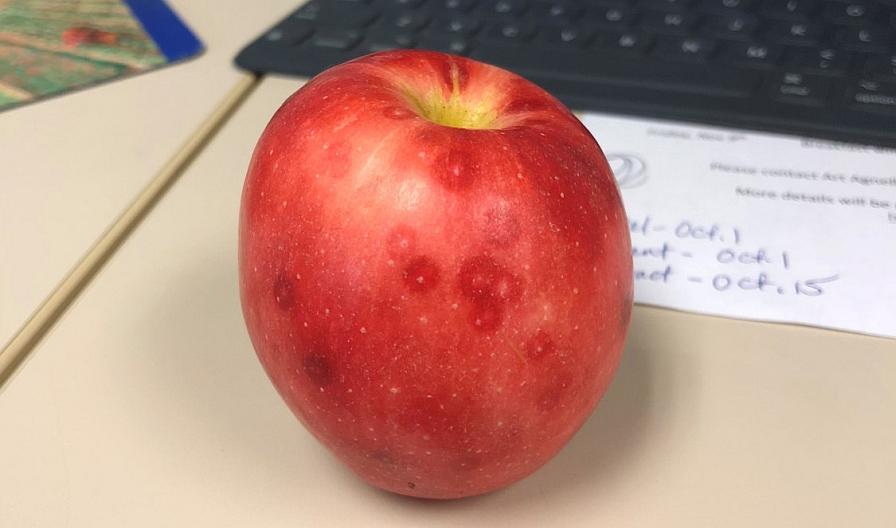
This recently harvested ‘Gala’ apple is showing symptoms of San Jose scale.
Photo: Amy Irish-Brown
Unfortunately, growers sometimes discover the problem only when red spotting becomes apparent on fruit at harvest.
Rodstrom recommends recording the location of those infestations — historically with flags and now potentially through electronic mapping — so growers know where to concentrate monitoring and management the following season.
BUILD THE PROGRAM EARLY
That emphasis on life stage and monitoring closely parallels recommendations from University of Georgia Entomologist Brett Blaauw, whose work focuses on San Jose scale management in Southeastern peaches.
Blaauw recommends beginning management before crawlers appear.
For delayed-dormant treatment, he recommends horticultural oil at 1.5% to 2%. Coverage is critical: Blaauw recommends 150 to 200 gallons per acre on pre-pruned trees in orchards with a history of scale pressure. Once trees have been pruned, approximately 100 gallons per acre can be effective. He also recommends considering an IGR with the oil to enhance scale control.
But missing the dormant window does not eliminate the opportunity for management.
Blaauw tracks San Jose scale development beginning Feb. 1 using a lower developmental threshold of 51°F and an upper threshold of 90°F. The season’s first major crawler peak occurs around 700 accumulated degree-days.
The model tells growers when to start looking particularly closely. Field monitoring tells them what is actually happening.
Blaauw recommends visually inspecting limbs for live scale and wrapping infested branches with electrical tape topped by double-sided tape. Tiny yellow crawlers caught on the tape provide direct evidence that crawler movement has begun. Monitoring should be concentrated in blocks with a known history of scale.
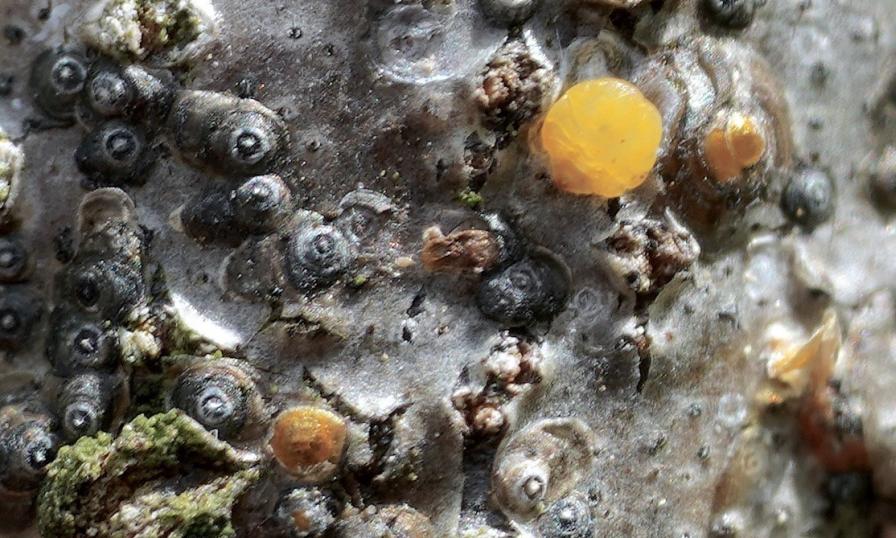
This image shows a couple of exposed adult female scale insects with a few of the immature “crawlers.”
Photo: Brett Blaauw
When crawler activity begins increasing, IGRs are among the in-season management options Blaauw recommends. Conversely, crawler treatment may not be necessary in every block, particularly where dormant oil applications provide adequate suppression.
The appropriate chemistry changes again once crawlers settle.
If active crawlers can no longer be found in a block with a history of scale, Blaauw recommends shifting management strategy rather than treating the population as though crawlers are still moving.
That makes the approximately 700-degree-day prediction less a spray date than a signal to intensify monitoring.
DO NOT FORGET THE BENEFICIALS
The IGR discussion extends beyond codling moth and scale.
Rodstrom points to woolly, rosy, and green apple aphids as examples of pests for which treatment decisions should account for naturally occurring biological control.
“There’s a really good biological control of beneficial impacts on these pests,” he says, describing the decision to spray as a “delicate dance” between the aphid population, the treatment threshold, and the beneficial insects already feeding on the pest.
An unnecessary insecticide treatment can reduce beneficial populations, he notes, while some insecticides applied against other pests can actually flare aphid populations.
Monitoring should begin in late May to early June as shoot leaves rapidly expand. Signs include curled leaves, the characteristic white cottony covering associated with woolly apple aphid, ants feeding on honeydew, and, eventually, sooty mold developing on honeydew-contaminated fruit.
Research also shows activity of IGR-containing programs against woolly apple aphid, although the larger IPM lesson may be more important than any individual treatment result: Determine whether natural enemies are keeping the population below a treatment threshold before intervening.
TIMING BECOMES PART OF THE PRODUCT
Taken together, the examples illustrate why IGR use is difficult to separate from insect phenology.
For codling moth, the approximately 100-degree-day egg-laying period provides an opportunity to target eggs before larvae penetrate fruit. At 200 to 250 degree-days, the target increasingly shifts toward newly hatching larvae.
For San Jose scale, Rodstrom’s emphasis on male flight, degree-day models, and crawler monitoring provides the information needed to anticipate the vulnerable mobile stage. Blaauw carries that approach into a season-long program incorporating dormant management, spray coverage, degree-day accumulation, direct crawler monitoring, and appropriately timed IGRs.
Even the aphid example adds another consideration: Pest presence alone does not necessarily justify treatment if beneficial insects are already providing adequate control.
That helps explain Irish-Brown’s observation about today’s increasingly specific pest-control tools. Greater selectivity can provide growers with additional modes of action and opportunities to integrate chemistry into IPM programs, but it also increases the importance of knowing precisely what they are targeting.
IGRs therefore are not a stand-alone answer. They are another tool within a larger management system.
Applying an IGR simply because a pest is present misses much of the point. The more useful questions are which developmental stage is present, when the next vulnerable stage will occur, and whether monitoring confirms that the predicted window has arrived.
With IGRs, the best treatment opportunity may come not when growers see the most insects, but when pest biology says those insects are most vulnerable.
Subscribe Today For
