


What Growers Can Do Better to Stay Ahead of Cyclospora
 November 5, 2026
Growers know how much work goes into keeping produce safe. But the 2026 Cyclospora outbreak highlighted a problem that better farm practices alone can’t solve.
“We are already out there doing our ag water assessments, doing our water treatments, treating our water as necessary, checking all growing areas for any potential food safety risks,” says Mike Clements, Farm Manager at Top Flavor Farms.
And that work begins well before planting, he adds.
The question now isn’t simply what more growers should do. It’s whether the industry has the knowledge and tools to address a parasite that behaves very differently from familiar foodborne pathogens.
A Different Kind of Pathogen
Unlike E. coli or Salmonella, Cyclospora is a parasite. Its biology makes it particularly difficult to study, detect, and control.
Researchers cannot readily grow the organism in laboratory cultures, limiting their ability to test treatments and understand how it behaves under different conditions, says Trevor Suslow, a UC Davis emeritus produce safety specialist. They also struggle to obtain enough Cyclospora oocysts — the parasite’s environmentally resistant life stage — for research.
Those limitations slow the development of better testing and treatment methods. And they create a problem for growers trying to apply what they’ve learned from years of research on bacterial pathogens.
For example, irrigation water treatments can be effective against E. coli and Salmonella without necessarily controlling Cyclospora.
“They won’t touch Cyclospora,” Suslow says of treatments commonly used against bacterial pathogens.
Other technologies, including UV and ozone treatment, may offer options, but applying them at the scale needed for commercial vegetable production can be expensive and complicated.
What Can Growers Do Now?
Growers routinely assess their agricultural water sources and look for potential contamination risks. But what happens when those risks originate beyond the farm?
A grower may know the condition of an irrigation system without knowing everything happening upstream — particularly when water sources are shared across a growing region.
That’s where Trevor Suslow sees an opportunity to strengthen existing food safety programs.
Suslow argues that growers would benefit from better regional information about water quality, including testing that identifies contamination associated with human wastewater.
Rather than requiring every farm to develop its own monitoring system, researchers and Extension specialists could help collect and share information about risks affecting an entire growing region.
That information could become especially valuable following flooding, wastewater releases, or other events that may affect agricultural water sources.
“Helping the growers with information about the quality of their water, rather than putting the full burden on them,” is the goal, Suslow says.
The approach would not eliminate the need for farm-level assessments. It could, however, give growers better information for deciding when additional precautions are warranted.
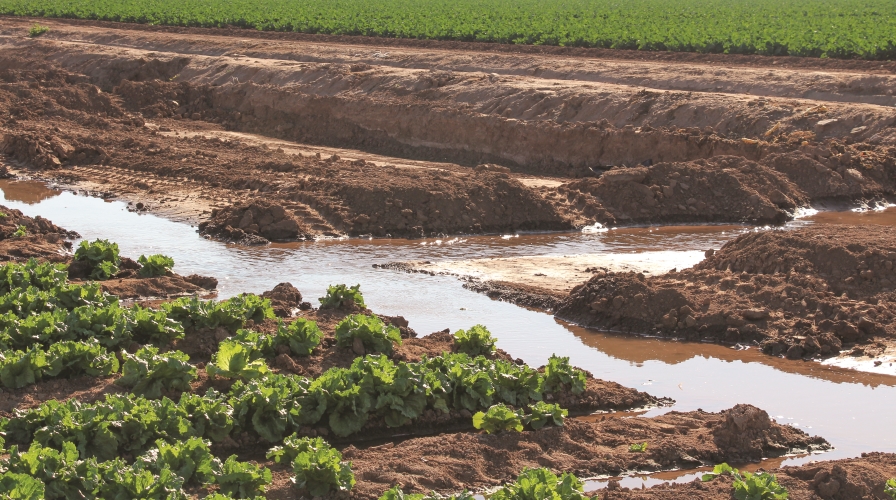
Growers need better regional water-quality information to assess contamination risks beyond their farms. Photo: Carol Miller
Building a Better Investigation System
Another problem became clear during the 2026 Cyclospora outbreak: Even after investigators identified the implicated product, determining exactly how contamination occurred remained difficult.
FDA found Cyclospora in environmental samples collected during its investigation in Mexico. But those findings did not conclusively establish the route of contamination.
That uncertainty matters. Without a clear understanding of how contamination happened, preventing a similar incident becomes more difficult.
Researchers are working on an approach that could help.
Suslow, Channah Rock of the University of Arizona, and Michelle Danyluk of the University of Florida have received a pilot grant from the Center for Produce Safety to develop a framework for coordinated investigations. The project is scheduled to begin in January 2027, although Suslow says he hopes to begin work sooner.
The goal is to establish a system that can draw on researchers, laboratories, and regional expertise to investigate contamination events more effectively.
It’s an ambitious undertaking, Suslow acknowledges, but one he believes is needed.
The industry also needs stronger cooperation among government agencies, researchers, and growers, says John Torres, IFPA’s Vice President of U.S. Government Relations.
Government investigators have limited resources, he notes. Better coordination could help the industry respond more quickly and make better use of available expertise.
More Requirements Aren’t Always the Answer
Growers are already navigating food safety requirements from government programs, industry standards, and individual buyers.
Those requirements don’t always align.
Clements says Top Flavor works through overlapping standards while conducting preplant ranch assessments, monitoring water sources, and addressing potential risks. The concern is whether additional requirements will meaningfully reduce contamination risks or simply add work and expense.
Suslow points to water testing and setback distances as areas where requirements don’t always reflect the available science or regional conditions.
That distinction is particularly important for smaller operations, which may lack the resources to adopt costly technologies or maintain increasingly complicated compliance programs.
The next advances in Cyclospora prevention may not come from adding another checklist to growers’ existing programs.
They may come from better research, more effective treatments, stronger regional monitoring, and faster investigations that help growers understand where the risks actually are.
Until then, growers face a difficult reality: They can follow established food safety practices and still lack some of the tools needed to address Cyclospora.
Closing that gap will take more than another set of requirements.
Where Our Knowledge Gaps Are
- Detection. Finding and tracing Cyclospora in environmental samples
- Treatment. Identifying effective controls that are practice at field scale
- Investigation. Connecting evidence across farms, water systems, and agencies.
Subscribe Today For
