



Applying the 4Rs to Nitrogen Management in Vegetable Crops
 October 7, 2025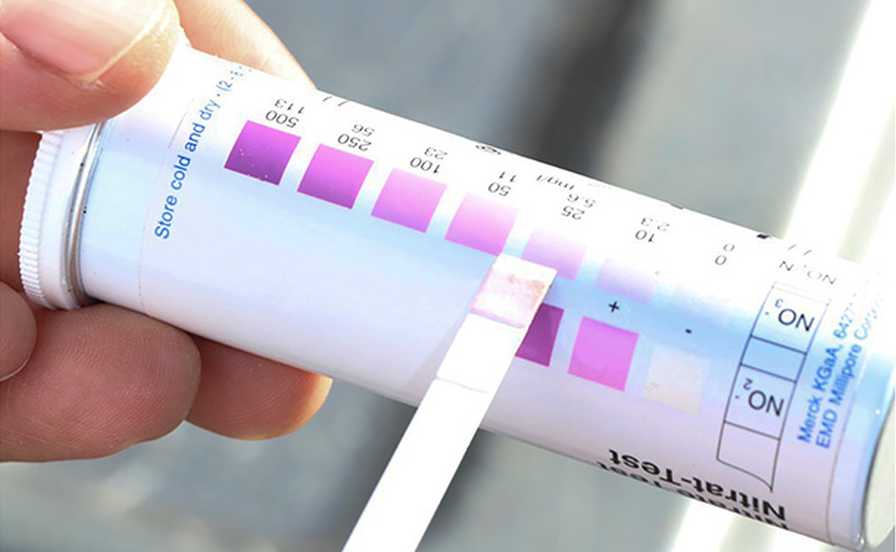
The soil nitrate quick test can help growers figure out the right rate of nitrogen fertilizer to apply to their crops.
Photo by Michael Cahn
Most of us know the 4Rs for efficient fertilizer use: the right source at the right time in the right place at the right rate. But what does this rule mean in the context of managing nitrogen for vegetable production?
Nitrogen is a complicated nutrient. It can exist and transform into different forms in the soil. The nitrate form of nitrogen is negatively charged and tends to move with water in the soil. Nitrate can be easily taken up by plant roots but is also easily leached during rain and irrigation events. The ammonium form of nitrogen is positively charged and can bind with soil particles and therefore moves slowly in the soil and is less likely to leach.
Ammonium can also be taken up by plants, but soil microbes usually convert ammonium quickly into nitrate (nitrification). The urea form of nitrogen has a neutral charge, and is more mobile in soil than ammonium, but typically less mobile than nitrate. Urea is transformed into ammonium by soil enzymes (urease). Soil microbes decompose organic amendments and plant residues releasing mineral nitrogen for plant uptake (mineralization). In situations where much more organic carbon is available than nitrogen in the soil, bacteria also can immobilize nitrate so that it is unavailable for plant uptake. Under anaerobic conditions soil microbes convert nitrate into a gaseous form of nitrogen (denitrification).
With so many different pathways for nitrogen, how would one apply the 4Rs for vegetable production?
Right Source
Let’s begin with the first R, the right source. In most situations, soil microbes quickly transform urea and ammonium nitrogen into nitrate, so the source may not seem to matter.
However, when applying nitrogen fertilizer through a drip system, it can make sense to use ammonium forms of fertilizer to reduce potential leaching of nitrate. But under cool conditions, ammonium containing fertilizers might not be the best choice.
Soil microbes are less active in converting ammonium to nitrate under low soil temperatures. So adding urea and ammonium forms of fertilizer could result in a buildup of ammonia in the soil which can be toxic to vegetable roots.
Right Time
The second R, the right time, depends on the nitrogen uptake pattern of the crop.
Vegetable crops take up less nitrogen early in the growing season compared to later. So often it does not make sense to apply nitrogen fertilizer at or before planting, unless the soil has a very low supply of nitrogen.
Also, fertilizing just before heavy rainfall or irrigation events can lead to leaching losses of nitrate. Once the crop enters the rapid growth phase, nitrogen fertilizer is usually needed to keep up with crop N requirements. With drip, small doses of nitrogen can be applied during irrigations to supply just enough nitrogen to match the crop N needs.
Splitting up fertilizer applications into smaller amounts minimizes nitrogen losses and reduces fertilizer costs.
Right Place
The right place, the third R, is usually the region of the soil where most of the plant roots are concentrated. One of the benefits of fertigating through drip is that fertilizer is delivered to where crop roots have proliferated.
Fertigating through overhead sprinklers or furrow irrigation is less precise in placing fertilizer near the roots than drip and can often lead to losses of fertilizer in runoff, which can pollute receiving water bodies. It makes sense to sidedress fertilizer with a tractor if the crop is irrigated by sprinkler or furrow. But when and how often a sidedress application can be done is limited to when a tractor can access the field. Wet soil conditions or when plants get too large can limit the timing of sidedress applications.
Right Rate
The last R, the right rate, is often the most difficult to get right. Not only does the right rate depend on the crop uptake rate, but it also depends on how much nitrogen is available to the crop from other sources besides fertilizer.
Significant amounts of non-fertilizer sources of nitrate are often available in the soil for crop uptake. This is because nitrogen may have mineralized from plant residues incorporated into the soil from a previous vegetable crop, or from compost or other organic amendments applied before planting.
Soil organic matter also mineralizes slowly releasing nitrogen. On the other hand, very low soil nitrate levels in the soil may indicate that additional fertilizer is needed, especially if the crop is in a phase of high nitrogen demand.
The best strategy is to check soil nitrate levels before fertilizing using the quick nitrate soil test. That involves collecting a composite soil sample from ten or more locations in the field and testing using a weak calcium chloride extractant and nitrate sensitive test strips.
Another source of nitrogen that can substitute for fertilizer is nitrogen in irrigation water.
Water pumped from many wells in vegetable growing regions may contain a significant amount of nitrate. This nitrogen is essentially free fertilizer for your crop, and crediting N in irrigation water can lead to significant savings on fertilizer.
In summary, nitrogen is a complex nutrient to manage because it is converted into different forms through microbial processes in the soil including mineralization, immobilization, and denitrification. Also, the nitrate form of nitrogen can be easily lost by leaching, so careful water management is required for efficient nitrogen use when growing shallow rooted vegetables.
Though the rule of the 4Rs is a useful framework to think about nitrogen management, the best strategy for each of the Rs will depend on the crop, soil type, weather, cultural practices, and irrigation methods.
Subscribe Today For
