



Pheromones at Heart of Anti-Love Connection for Grape Mealybugs
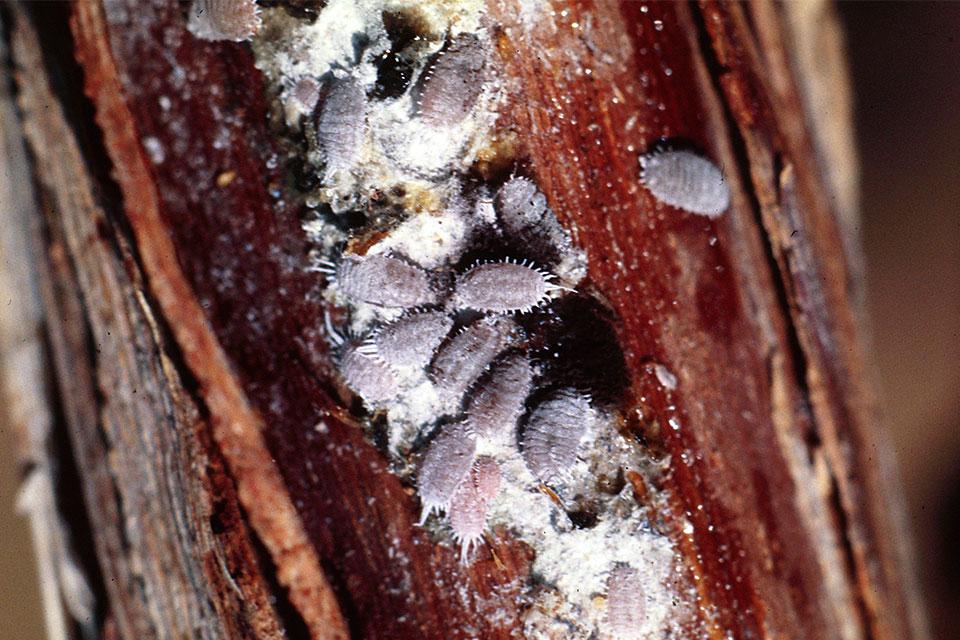
Up close with grape mealybugs.
Photo by Whitney Cranshaw, Colorado State University, Bugwood.org
The grape mealybug is a persistent vineyard pest in California and other fruit-growing regions. Grape and vine mealybugs are found in the Golden State as well as the Pacific Northwest, contaminating grape clusters and causing direct crop losses.
Managing the stubborn insects requires an integrated approach that combines biological and chemical controls with common cultural practices, such as equipment sanitation and use of certified planting material.
Preventing mealybug reproduction altogether is another powerful weapon in the grower arsenal, says Monica Cooper, a Farm Advisor for the University of California Cooperative Extension in Napa County. Mating disruption programs use synthetic sex pheromones to interfere with mealybug communication, making it difficult for winged males to locate their earthbound would-be partners.
While insecticides are the main method for managing mealybugs, mating disruption is a proven tool that aligns with demand for more sustainable pest control practices. Disruption programs typically involve hanging pheromone dispensers, although farmers have the option of applying sprayable formulations during the growing season.
PHEROMONE RECOGNITION
The goal is to interrupt the mating process initiated by the female mealybug’s sex pheromone, a chemical that both guides the male’s search and triggers courtship behaviors. Pheromones are secreted through insect exocrine glands — most mealybugs reproduce sexually, with wingless females producing powerful chemicals to attract males for mating.
“Sex pheromones are probably the most common pheromones that we use synthetically in IPM programs,” Cooper said during a webinar sponsored by the Washington State Wine Commission and Washington State University. “We use them for both detection and mating disruption.”
Pheromone detection is the necessary first step for any viable disruption program, notes Cooper. Researchers detect these chemicals via gas chromatography, then assess their viability for synthesis and mass production. Efficacy is tested in the vineyard, but lab studies can also determine pheromones’ potential for success.
Pheromone-laced traps are placed in the field, where they capture clusters of male mealybugs for study.
“The mealybugs are then identified and counted,” says Cooper. “Luckily for us, male mealybugs have a distinctive orangish-red color, and they also have a fairly distinctive body shape. There may be other insects in the trap, but between the color and shape of the body, it’s fairly easy to identify the male mealybugs.”
THE NEXT STEP
After detection, growers can decide how and when to employ a pheromone-centric intervention. Synthetic versions of the chemical are often loaded into passive dispersal devices — the dispensers release the pheromones, creating a cloud that “blinds” males, leading to fewer matings, a lower reproductive rate, and a significant decline in pest damage.
Formulations can be further circulated as an aerosol or flowable spray, allowing the grower flexibility in application. As male mealybugs naturally follow the female’s pheromone plume, simulating this mating environment is the most effective strategy for interrupting the reproduction cycle, says Cooper.
“In the case of when we put out dispensers — or use a flowable product for mating disruption — we get clouds of pheromones within the vineyard,” she says. “That makes it very difficult for the male mealybug to orient to the female. That will either delay mating or mean that mating will not happen altogether.”
PROPER TIMING
Timely application is essential if mating disruption is to serve as a key component of an IPM program, adds Cooper. For instance, Washington state farmers should deploy pheromone dispensers in June, coinciding with the start of the grape mealybugs’ mating flights. A second generation of adults appears later in summer, with mating occurring between late July and September.
Mating disruption works well alongside biological controls like the parasitic wasp Anagyrus vladimiri, whose larvae naturally feed on mealybugs. While combining these actions can reduce insect populations, growers will need to exercise patience, says Cooper.
“It can take a couple of years before the populations really start reducing, and mating disruption is more effective at lower population density,” Cooper says. “You’ll also get greater results and continual decrease in mealybugs with consecutive use (of mating disruption practices).”
Subscribe Today For
