



A Growing Challenge: When the Public Doesn’t Understand Farming
Despite agriculture remaining one of Colorado’s top industries, a dramatic population shift has widened the gap between public perception and the reality of growing food. Over the past 40 years, Colorado’s population has grown from 2 million to nearly 6 million, mainly in metro areas. The result is a public policy environment that is often uninformed about agriculture and, at times, openly hostile to farmers.
Well-intentioned legislators introduced a wave of environmental bills aimed to restrict, or outright eliminate, certain crop protection tools in recent years. In many cases, a united farm lobby successfully testified against provisions that would have made production unworkable.
Then SB21-087 passed in 2021.
The agricultural labor rights bill bundled provisions that had taken other states years to implement: unfettered access for “key service providers,” new break and heat-related work requirements, and, most consequentially, overtime pay for agricultural workers.
During debate, farmers warned lawmakers that overtime mandates could have unintended consequences for agriculture, concerns later supported by economic studies. Some growers who spoke out faced intense activist pressure.
From Defense to Strategy
After SB21-087 was introduced, the Colorado Fruit & Vegetable Growers Association (CFVGA) was still relatively new and did not yet have a lobbyist. The board quickly contracted Husch Blackwell Strategies and began working with lobbyists.
That decision paid off. Their work helped move specific overtime provisions into a rulemaking process, allowing for education of regulators rather than blanket mandates. The outcome was an overtime threshold of 48 hours per week, or 56 hours during highly seasonal periods for qualifying operations. It was a modest win, but one that mattered.
At the same time, growers continued to face mounting pressure from produce buyers, increased audit requirements, and rising compliance costs, often leaving them feeling blamed for simply producing safe, high-quality food.
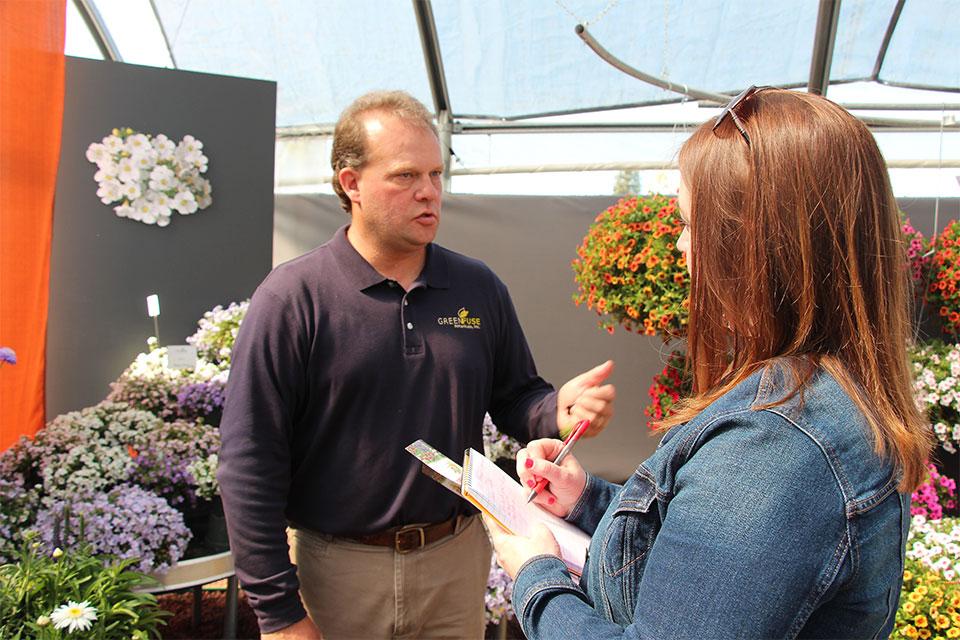
Direct engagement with the media allows growers to explain how food is grown — before others define it for them.
Photo by Carol Miller
Investing in Advocacy
CFVGA took a new step in late 2023 by allocating a line item in its modest budget for “advocacy public relations,” committing $16,000 in 2024 and another $16,000 in 2025.
With that limited investment, CFVGA partnered with Colorado-based Philosophy Communication to place opinion editorials written in-house and help tell the produce-farm story through broadcast media. The board focused its message on two core themes: the accelerating loss of farms and the idea that food security is national security.
The 2017 and 2022 Census of Ag paints a stark picture. Colorado lost more than 7% of its farms in just five years. Nationally, the U.S. became a net importer of agricultural products for the first time in 2023, a shift driven in large part by labor costs and regulatory pressure on fruit and vegetable growers.
Those messages resonated. An opinion editorial by CFVGA President Joseph Petrocco ran in a major metro newspaper, and Denver television stations featured CFVGA and its members in on-farm interviews that helped translate the realities of food production for an urban audience.
A smaller but strategic part of the campaign included targeted social media posts and advertising aimed at educating elected officials and policymakers.
“With agriculture generating $47 billion annually for Colorado’s economy, we knew these stories would resonate,” said Philosophy Communication’s Grace Markley “Losing 2,800 farms in a five-year period is tragic and eye-opening.”
Aligning with Partners
CFVGA has found powerful synergy among itself, Philosophy Communication, and its lobbying team.
“Colorado’s population is concentrated in urban areas, which makes education about rural Colorado and agriculture even more important,” said lobbyist Lisa LaBriola. “On-farm interviews on predominantly urban news stations go a long way in helping consumers and policymakers understand what it actually takes to bring produce from field to plate.”
That alignment is seeing results. During the 2024 legislative session, lawmakers rolled back one major piece of SB21-087, eliminating all “key service provider” provisions. CFVGA is now working to prevent further reductions in the overtime threshold, advocating to keep it no lower than 60 hours per week.
Unity among agricultural organizations has been essential. Speaking with one voice has strengthened credibility and amplified impact.
For CFVGA, the lesson is clear: telling agriculture’s story — clearly, consistently, and in public — is no longer optional. It is a necessary part of ensuring that policymakers, and the public they represent, understand what it truly takes to grow food in modern America.
Subscribe Today For
