



Marking 60 Years of Drip Irrigation Innovation
 March 10, 2026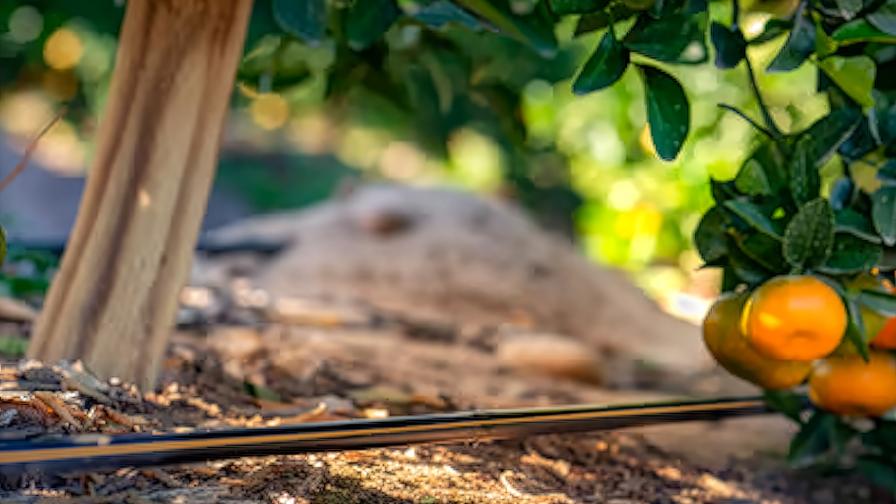
In high-density blocks, low-rate drip irrigation helps bring trees into production sooner and harvest more of the orchard at the same time.
Photo: Netafim USA
For six decades — from a desert kibbutz to California’s Central Valley — I have had the exciting good fortune to watch drip irrigation change how fruit and nut growers all over the world think about every precious drop of water.
At Kibbutz Hatzerim in Israel’s Negev Desert in the mid-1960s, we were a small group of farmers trying to grow crops in poor soil with limited water. An engineer came to us with an unusual proposal no one else would listen to: Feed trees and vegetables with slow, steady drops of water. We studied his results and decided it was a small enough risk to test the system in our own orchards. And the results spoke for themselves. After just the first season, we saw almost double the yield while using far less water. That trial became the starting point for Netafim and for the style of precision irrigation many fruit growers use today worldwide.
Although my title has changed many times, I still describe myself first as a farmer from Hatzerim, in a tiny country that had to conserve resources. We started Netafim in a corner of our wood shop, simply trying to solve our own problems. Our group talked about “growing more with less” to describe what we had already seen in our fields. With drip and later subsurface drip, we could raise yields and quality while keeping water use down.
FRUIT AND NUT SOLUTION
In 1975 I joined Netafim full-time. A few years later I was asked to help build Netafim USA, first from my living room in Los Angeles. It quickly became evident that California’s Central Valley should be our home base in America, so we moved to Fresno. Working with local dealers and growers, we adapted designs that had started in the Negev to suit almonds, pistachios, citrus, and vineyards in California. Seeing those systems perform in real blocks validated what we had learned years before in our own orchards.
For fruit and nut growers, drip irrigation is not only about saving water; it is about control and consistency. Orchard farming involves large investments and high risk, and you cannot afford trees that slip into stress at the wrong time. By placing water and nutrients directly in the root zone on a steady schedule, growers keep moisture more uniform through bloom, fruit set, and sizing. In modern high-density orchards with compact trees and smaller root zones, focused drip lines feed the active roots instead of wetting the surrounding areas. With this targeted efficiency, growers are not paying to irrigate ground that will never carry a crop.
LESS WATER, MORE YIELD
Over the decades, it’s been gratifying to see drip and subsurface drip irrigation systems immeasurably improve the daily reality for thousands of growers. These systems cut water use while increasing yield, which means, for many small farms in harsh environments, the difference between losing ground and expanding. In high-density blocks, low-rate drip helps bring trees into production sooner and harvest more of the orchard at the same time.
Some of the most interesting projects I have worked on combine drip with organic inputs. In California dairies, subsurface drip is used to apply dairy effluent directly to the soil near the root zone. This effluent-water mix is a creative win-win on many fronts. It significantly reduces fresh water use, protects groundwater, and turns a waste stream into a rich nutrient source for forage crops or nearby orchards.
LESSONS LEARNED
I like to describe drip irrigation as part of the concept of tikkun olam, or “fixing the world,” because it touches water scarcity, food security, and the needs of small farmers, no matter where they are. I’ve noted that the most important lessons have always come from the field.
Looking ahead, I expect fruit and nut growers to embrace real-time data, tracking pressure, flow, soil moisture, and plant-stress data to fine-tune their operations, and to rely on “irrigation as a service” models that provide both hardware and support where appropriate.
Sixty years after that first trial at Hatzerim, the outcomes are still clear to me: Treat water and nutrients as valuable managed assets, and how you irrigate will shape the future success of your orchard or vineyard.
Subscribe Today For
