



New Lettuce Resists Leafminers
 March 1, 2009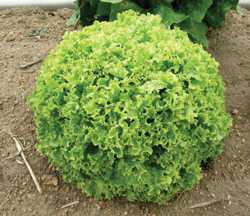
Green leaf lettuce is a favorite of both salad lovers and destructive leafminers, also known as Liriomyza langei. That is why Agricultural Research Service (ARS) plant geneticists Beiquan Mou and Edward Ryder developed the first leafminer-resistant green leaf lettuce. Seed samples of MU06-857, the resistant variety, are freely available for production or research purposes, according to Mou, including the development and commercialization of new cultivars.
Based at the ARS Crop Improvement and Protection Research Unit in Salinas, CA, Mou and Ryder screened more than 100 kinds of lettuce from ARS’ Pullman, WA-based collection and elsewhere. They selected the Salinas 88 lettuce variety and a red leaf lettuce as parents for the new green leaf offspring, and put it through seven years of laboratory, greenhouse, and field tests.
“MU06-857 is the first in a series of leafminer resistant varieties being developed in our breeding program, including green leaf, red leaf, romaine, and crisphead lettuces,” says Mou. “We are also combining leafminer resistance with resistance to downy mildew, corky root, lettuce mosaic virus, and tipburn for multiple resistances. We have also released two spinach germplasm with resistance to leafminer mines.”
Filling A Hole In Leafminer Control
Adult leafminers, common in California, Florida, and Hawaii, are shiny black flies with a yellow triangle on their backs. They ruin leaves when they puncture them to feed on sap, causing great crop losses. Females lay eggs inside the leaves and when larvae hatch, they feed on the leaves, creating mine-like tunnels. The leafminers in Florida are believed to be a different species, Liriomyza trifolii, which also have caused severe crop damage in southern California and Arizona desert areas, according to Mou.
“Damage caused by adult sting and larval mining of cotyledons and leaves may stunt seedlings and cause stand reduction, reduce photosynthetic capacity, render lettuce leaves unmarketable, and provide an entrance for disease organisms,” says Mou. “The larvae and pupae may get trapped in the lettuce plants, so a crop field or a shipment to other countries, like Japan or Mexico, may be rejected because of the crop contamination with live insects.”
Traditionally, growers have used pesticides to control leafminers, though trying to control adult flies is ineffective at best, says Mou, and the only chemical available for larval control is cyromazine (Trigard, Syngenta Crop Protection), which is hampered by plant-back restrictions that prohibit the planting of any non-labeled crop within 12 months of the last application.
“Insecticides for adults do not provide economic control because flies can easily move around and the treated field is subject to reinfestation from adjacent untreated crops and weeds,” Mou says. “The effect of Trigard lasts only about a week. It has been well documented that leafminers can develop a high degree of resistance to a broad range of insecticides.”
Thus, the development of a leafminer-resistant green leaf variety, MU06-857, provides many benefits, including resistance to stings caused by leafminer adult flies and lettuce mosaic virus (LMV). However, MU06-857 is not resistant to leafminer mines caused by larval feeding, Mou says. LMV is spread by green peach aphids (Myzus persicae) and gives leaves a sickly mottled or mosaic appearance, rendering the lettuce unmarketable.
“There are no other effective ways to control leafminer adults,” he says. “Resistant varieties remain the most economical means of pest control. If leafminer pressure is high, growers may also need to use other control measures to combat the insects. I always think that resistant varieties should be a part of the integrated pest management system.”
Their use, he says, decreases chemical, machinery, fuel, and labor costs and reduces workers’ exposure to hazardous chemicals. In addition to potentially greater quality, marketability, and value of green leaf lettuce at retail, the resistant varieties reduce pesticide residue in plants and contamination of soil and groundwater, Mou says.
Subscribe Today For
