



Pest Of The Month: Aster Yellows
 October 10, 2011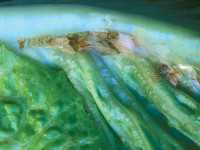
Aster yellows impacts a variety of crops including lettuce and celery. This disease is vectored by the aster leafhopper when it deposits the phytoplasma, a bacteria-like organism, into the plants.
This pest typically makes short visits into fields and then leaves, as it prefers to stay near water and weedy areas.
For lettuce and celery, the main symptom is distortion. In celery, the symptoms are obvious as the texture changes and the long shanks of the petioles are twisted, stunted, and yellow.
Lettuce plants also turn yellow and can be stunted. Blisters, however, can form within the head and go unnoticed until several layers of leaves are peeled back. In addition, infected lettuce leaves close to the mid-rib are often orange and pink in color. This can be a problem at harvest as the infection occurs inside the leaves and the quality defect goes unnoticed.
About 90% of the symptoms will be along field edges near weeds and a water source. If growers can establish the location of the infestation, they can diagnose the problem. Symptoms typically occur two to three weeks after leafhoppers have injected the pathogen into plant leaves.
Conduct A Preharvest Test
In the West, lettuce growers are encouraged to do a preharvest test and check for damage. If blistering on lettuce is noticed, they need to determine what areas of the field will not be harvested to avoid jeopardizing quality.
To combat the problem, growers need to keep detailed planting records. If they have been growing lettuce and celery in specific locations, perhaps near a creek, and if they notice symptoms of aster yellows, they need to rotate other crops, such as broccoli or spinach, in those fields that aren’t susceptible to this pest.
Subscribe Today For
