



Pest Of The Month: Bagrada Bug
 July 22, 2011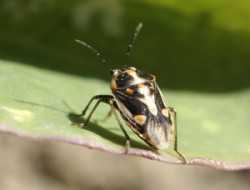
The Bagrada bug is a small stink bug native to Africa. This pest was initially reported in California in June 2008, says John Palumbo, a professor and Extension specialist at the University of Arizona. Since that time, the pest has spread throughout southern California, Arizona, and northern Mexico, wherever cole crops are grown.
The adult Bagrada bug looks similar to the harlequin bug, but is smaller in size and has a different pattern of color on the thorax and wings. “Adults have been observed depositing eggs in small clusters on plant foliage, and are thought to lay eggs on the soil near host plants,” says Palumbo.
The pest has five nymphal instars, which appear orange upon initially hatching, but gradually darken as they mature. The life cycle of the Bagrada bug can be completed in three to four weeks. Palumbo adds that several generations per year can occur.
Many Suitable Hosts
“I have not seen a cole crop, or any other Brassica plant species, that this pest will not feed on,” offers Palumbo. The pest mainly attacks leaf foliage, petioles, and stems. The results, he says, are starburst-shaped lesions on plant tissue.
As adults and nymphs feed very similarly on plant foliage, it is adult feeding that causes the most damage. “Adults begin infesting fields from surrounding vegetation during stand establishment,” he explains. “They feed on the direct-seeded plants immediately after emergence of the hypocotyl and cotyledons. Many plants are killed at this time and seedling mortality can result in significant stand losses. On transplants, the bugs will feed on both the tender terminal growth as well as the older, hardened leaves.”
Determine Pest Presence
Growers should begin scouting at plant emergence in direct-seeded crops. In transplanted crops, the plants should be inspected the day following transplanting. “Bagrada bugs can often be found walking on the soil surface during stand establishment, so pay close attention to the bed tops and furrows when walking through fields, particularly on field edges,” Palumbo suggests.
Because it is critical to prevent damage at stand establishment on developing seedlings, Palumbo says that one adult per 3-row feet of seedlings or transplants during stand establishment is too many and can result in stand losses or plant damage.
Once the crop reaches the sixth- to eighth-leaf stage, however, plants appear to be able to better withstand feeding damage, says Palumbo. He adds that “the relationship between Bagrada damage and cole crop mortality, yield, and maturity is not yet well understood.”
Control Options
To control this pest, Palumbo suggests a rotation of products with various modes of action. In general, he says, insecticides with contact activity have provided the most effective control during stand establishment. On larger plants, Palumbo says the use of foliar-applied neonicotinoids via ingestion provides control.
Products that can be used in rotation include pyrethroids, neonicotinoids, such as Belay (clothianidin, Valent U.S.A. Corp.), Venom (dinotefuran, Valent U.S.A. Corp.), Scorpion (dinotefuran, Gowan Co.), and Assail (acetamiprid, United Phosphorus, Inc.), as well as Lannate (methomyl, DuPont Crop Protection), and Lorsban (chlorpyrifos, Dow AgroSciences).
The best control strategy, concludes Palumbo, is to rotate among pyrethroids and organophosphate/carbamates during stand establishment, and alternate with foliar neonicotinoids once plants get larger.
Subscribe Today For
