


New Data Graphic: Last Season a Mix of Good and Bad for Berry Growers
 April 27, 2026
 Berry growers have been riding the “superfood” surge since the early 2000s. A quarter-decade later, they are still gliding along better than most despite hitting many of the same speed bumps that are slowing the farmers of other crops.
According to the annual State of the Industry survey conducted by American Fruit Grower/Western Fruit Grower, exactly half of its berry grower respondents report an increase in revenue compared to the average of the previous three seasons.
At the same time, there is more variability than usual — 39% claim a decrease, including 23% whose revenue fell by more than 10%. Only 11% report a flat season.
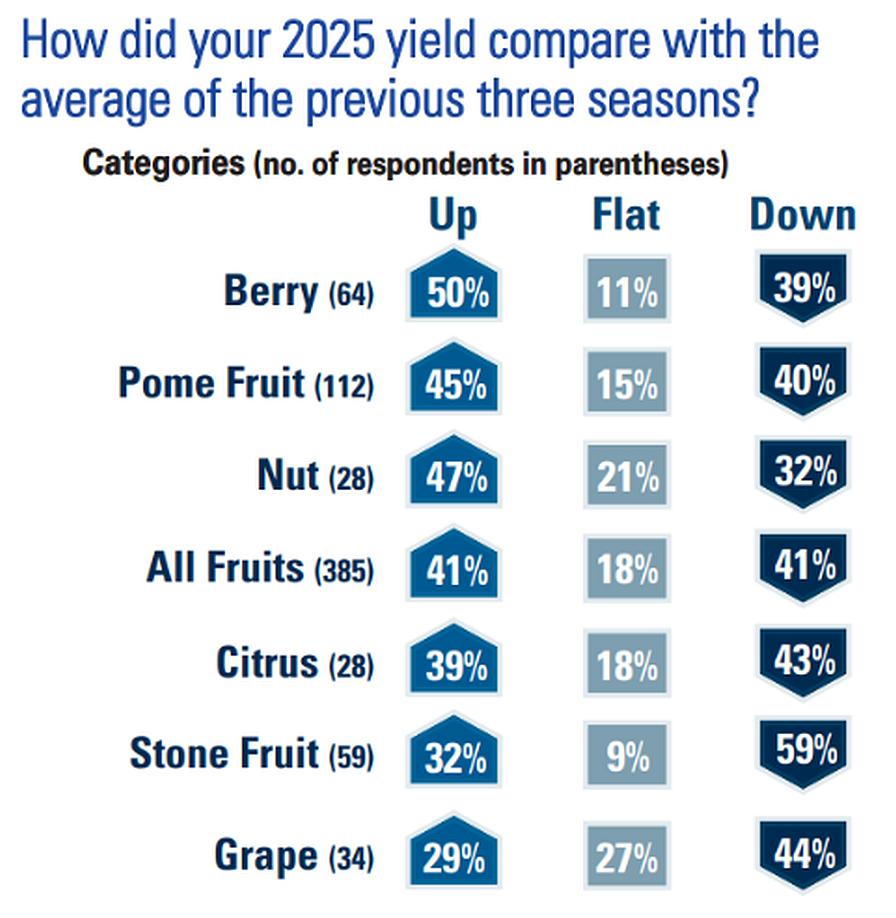
Some growers had one of their best years ever; others broke even or worse. How did the fortunate ones do it? These are several of the strategies that paid off last year:
Price increases: No tactic was more popular last year, especially in U-pick and direct sales, although, to clarify, this was more often a necessity than a strategy and in some cases still not enough to offset rising costs. For instance, “We had to raise prices,” a Pennsylvania blueberry and raspberry grower says. In the case of a South Carolina blueberry and blackberry, “We increased prices, but it was inadequate,” he says.
Production expansion: When in doubt, boost production of your current berries, as was the case of an Arkansas blackberry grower. Or add a new berry crop altogether, such as strawberries in the case of another Arkansas grower.
A Wisconsin grower began selling both conventional and certified organic berries on the same farm last season. “We sell most as U-pick, and I believe we are one of the few farms to do this,” the grower says. “By raising the organic price and adding the lower-priced conventional berries, we were able to make this the most profitable strawberry year for us.”
Improved soil health: With regenerative agriculture gaining in popularity, more progressive growers are making this a long-term investment.
“We focused on soil health and improving efficiency in our cultural practices,” a California caneberry and strawberry grower says.
Another California grower used microbiology to improve soil health.
More efficient labor, including automation: Labor pressure is clearly pushing growers toward mechanization and efficiency gains. Two separate blueberry growers in New Jersey respectively note their use of mechanical harvesting and more automation in packing and harvesting. A peer in New York state preaches for improved employee efficiency.
Direct-to-consumer and value-added sales: The push toward capturing retail margins instead of wholesale remains strong. A New York grower stopped selling excess berries to the canning market at a reduced price and instead canned and sold the berries themselves.
External factors, including weather: Many growers acknowledge profitability was partly out of their hands. “The weather was more favorable,” a California grower says. “Conditions allowed for better production.”
“We had a boom in blueberries outside of our control,” a New Hampshire grower says, “but also we got volunteers from (the University of New Hampshire) to help weed and harvest.”
Meanwhile in Louisiana, a blueberry grower credits improved irrigation, although the biggest impact was benign environmental conditions: “a warmer spring and a good amount of rain.”
Infrastructure investments: Growers are investing, although, granted, these are longer-term return on investment actions. A Montana grower added a greenhouse. Meanwhile in Indiana, a grower of all four major berries focused on expansion throughout the year, adding new trellis wire and more planting space.
Click here to see more findings from the 2026 State of the Fruit and Nut Industry survey.
Subscribe Today For
