



How Digital Twin Technology Can Help Strawberry Growers Gain Ground
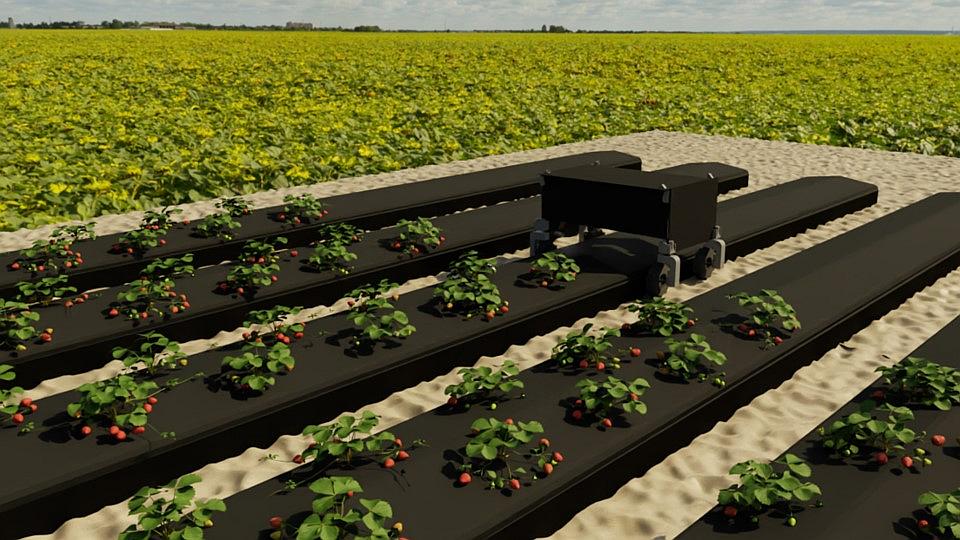
Pictured here is a virtual strawberry field via digital twin technology. Image courtesy of Dana Choi

Have you heard of digital twin technology? It creates virtual replicas of objects, systems, or processes that can predict system behavior as they interact in a simulated environment. A team of scientists at the University of Florida are using the modern technology to improve strawberry production practices.
UF/IFAS Professor Dana Choi and her team of fellow scientists have now shown the robotic system, powered by artificial intelligence (AI), is accurate and that it saves time and labor. How are they doing this? A few years ago, Choi’s team built a digital twin of a strawberry field that copies every row, leaf and berry at life-size. Within that virtual field, scientists let the robot drive around and take thousands of photos of a simulated commercial farm in Hillsborough County, FL.
Newly published research shows that AI trained exclusively in a digital twin technology environment using simulated strawberry fields achieved 92% accuracy in detecting fruit, without relying on real-world training data.
“Because the computer-simulated field never goes out of season, new berry-spotting tools can be prototyped even in the summer – speeding innovation,” Choi says. “The findings also mean lower development costs. Companies can test robotic pickers or smart sprayer designs in the digital twin, first, ironing out bugs before real-life trials. That ultimately lowers the price of new technology.”
The robot trained entirely on synthetic images also estimated real-world fruit diameter with only 1.2 millimeters of error – “good enough for commercial grading, using only synthetic, simulated data,” adds Choi.
This demonstrates the potential of AI models trained in virtual environments to support commercial decision-making tasks, such as classifying fruit based on characteristics like size or quality. If growers know precise fruit size and volume, they can predict their yields and know when to harvest.
For more, continue reading at blogs.ifas.ufl.edu.
Subscribe Today For
