



Watering Well In Western States
 November 1, 2009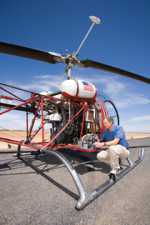
Agriculture accounts for 80% of the country’s water consumption, and 90% in some Western states, according to USDA. But with water supplies for agriculture decreasing at alarming rates, finding ways to increase efficiency is paramount.
That’s exactly what ARS scientists Doug Hunsaker and Andy French with the U.S. Arid Land Agricultural Research Center in Maricopa, AZ, are doing. They are working to develop an irrigation management system that combines remote sensing imagery with simple crop models to monitor actual crop water needs in fields.
Get The Picture
Since 2001, Hunsaker and French have been working on a system that is not about the specific method of irrigation (i.e. sprinkler, drip, flood) but instead about using satellite images and estimates of crop growth to determine how much water to apply and when.
“The study initially began as a way to improve a standard method for estimating water use — a Food and Agriculture Organization publication known as FAO-56 — by adjusting predictions according to plant growth throughout a field,” Hunsaker says. “In the standard method, only weather and soil data are needed. But by looking at an entire field using remote sensing, you can make better decisions about irrigation.”
Recently, the approach was tested on a cotton field, where they were able to estimate water needs on a day-by-day basis within small areas of the field. “This capability can provide tremendous water savings and boost crop production because precision irrigation systems can be adjusted to more accurately match areas determined to have low or high crop water needs,” Hunsaker says.
According to Hunsaker and French,
the system is still several years away from fruition, because affordable satellite pictures are not readily available. Eventually, though, they would like to incorporate local knowledge of soils and crop history into the system and offer a Web-based product that allows growers to have their own databases for soils, field boundaries, and irrigation equipment. “Ultimately, the goal is to make it practical for any farmer to optimize their use of irrigation water using
‘decision support’ tools,” Hunsaker says. “The underlying science is being developed by us. The tools would be provided by private concerns.”
Good To The Last Drop
Laj Ahuja, research leader at the Agricultural Research Service’s Agricultural Systems Research Unit in Fort Collins, CO, is also working to address the
water supply issues facing growers. Ahuja and his colleagues have conducted studies to determine tactics for irrigating with less water based on critical growth stages in crops. “For example, in corn, the flowering and seed formation stages are more sensitive than the initial vegetative growth stage, and the water shortage during the latter stages will decrease yield more,” Ahuja says. “With limited water available, we would like to make sure there is no severe stress during the vegetative stage and there is low stress during the reproductive stages.”
The model also determined how dry the soil could get during a critical or sensitive growth stage, and how much water would need to be applied without wasting any. “This depends upon the soil type,” Ahuja says. “A sandy soil will need to be irrigated more often than a clay soil.”
Ahuja also points out that different vegetable crops have different critical stages. “For any location with long-term weather and rainfall data, a validated crop growth model for a vegetable can be used to determine when is the best time to apply the limited water available, as well as how often to apply and how much each time,” he adds.
In addition, the models can be used to determine the best mix of vegetables to grow in a given location, as well as the right amount of fertilizer and when to apply it. “We have to use the limited water in the best possible way to maximize the yield — get more out of each scarce drop of water,” Ahuja says.
Subscribe Today For
