



Bright Prospects
 November 1, 2007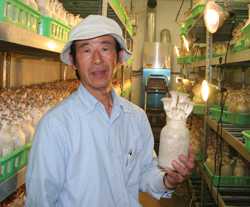
There’s a burgeoning interest among growers in California’s San Joaquin Valley who are seeking to diversify by growing specialty mushrooms. Richard Molinar, the University of California Cooperative Extension Small Farms/Specialty Crops farm advisor in Fresno, says that more than 40 people turned up at a recent meeting eager to learn more about the business. The interest is understandable, as Molinar says some grocers are paying growers on the order of $3 a pound for oyster mushrooms. “There’s a lot of potential there,” he says.
Armed with a $76,000 USDA grant, Molinar is midway through a three-year study on the feasibility of growing mushrooms. These are not the common white button mushrooms, however. He’s studying the prospects for growing more high-dollar types such as oyster mushrooms. There are currently only three commercial specialty mushroom growers in the Fresno area. One is Sun Smiling Valley Farm, a rather ironic name considering their “King-Oh” mushrooms are grown entirely indoors.
The “King-Oh” trade name refers to the king oyster mushrooms that Jiro Watanuki, and his wife Nina, grow. They produce about 1,000 to 1,500 pounds of mushrooms per week in their 7,000-square-foot facility, which is just one year old, but business is so good they plan on doubling production in the near future. They sell to grocers from Fresno to San Francisco, as well as restaurants and farmers’ markets.
Sanitation Is Critical
Originally from Japan, Watanuki grows mushrooms as it’s traditionally done in his native country. In fact, all of his equipment, from the sterilization units down to the plastic bottles in which the mushrooms are grown, was manufactured in Japan. Each culture has its own unique way of producing mushrooms, explains Molinar, and the bottles are Japan’s signature.
The process begins with the sterilization of the bottles. They are steamed at 212°F for nine hours, then go over night into a room with ultraviolet germicidal lights. It’s critical that the growing containers, in this case the bottles, be sterilized, says Molinar. “If other bacteria got in there the mushrooms might not grow,” he says. “Bacteria are like weeds.”
The mushroom seed, or spores, is also sourced from Japan by Watanuki. It is incubated in a laboratory in Japan, and Watanuki receives it in the form of mycelium. For a growing medium, Watanuki uses white fir sawdust, with rice bran and wheat bran mixed in for nutrients. He does not use chemicals, and is working on trying to get organically certified. That’s more difficult than one might think, says Molinar. “It’s tough to find rice bran and wheat bran that’s organically grown,” he says.
Controlled Climate
The bottles are then placed in cultivation rooms for a month. The cultivation room, like all the other rooms in the growing process, is very well insulated so the climate can be precisely controlled. The bottles are “decapped” so that the mushrooms will come out evenly, and, when they are finally harvested, they will look perfect.
One of the first rooms is a dark fogging room where the mushrooms spend five days to get a good start with plenty of moisture. They then go through a series of steps, moving from room to room with various amounts of light and humidity. From the time the pinheads finally sprout, it’s only about 10 days until harvest.
It’s obviously a labor-intensive process and energy-intensive, as well. Asked if he pays a lot for electricity, Watanuki is interrupted by his wife, who smiles, shakes her head, and says “Lots and lots — and lots.”
Subscribe Today For
