



Profitable Vegetable Crops for a Small Farm

As a small-scale farmer, both my land and my delivery van are limited in size. Because of this, it’s important that I consider the space it takes to grow, deliver, and store crops when I’m selecting which to prioritize. The most profitable crops for my scale of farming are compact, quick growing, and high yielding. In addition to the dozens of varieties of vegetables I grow, herbs fit this profile and have proven to be an important part of my farm’s financial success.
To illustrate the importance of herbs in my crop lineup, consider this: 24 kale packed in a 1.8 bushel box sell for $96 retail or $42 wholesale in my area. In that same volume, I can fit a minimum of 50 bunches of parsley and 50 bunches of dill, which sell for $300 retail or $200 wholesale.
That difference matters on a small farm because what we can sell is partially determined by how much product we can fit in our van, our walk-in coolers, and market stand.
Over the past two decades, I’ve grown sage, rosemary, lavender, comfrey, thyme, oregano, anise hyssop, mint, basil, cilantro, dill, and parsley. While all the herbs bring variety to the market booth, four stand out as herbs that grow quickly, sell well, and are the most profitable for us.
Basil
Plant breeding has made huge breakthroughs to create downy mildew resistant varieties of basil that grow well both outdoors and indoors. Last year, I grew ‘Prospera Italian Large Leaf DMR’ and ‘Prospera DMR’. This season, I’m adding ‘Noga Prospera Active DMR’, also produced by Genesis Seeds.
To further protect the crop, we treat our basil weekly with Regalia (Marrone Bio Innovations) to give it further protection from disease. To extend our basil harvest, I also grow several beds of our basil indoors. Planting two 100-foot beds inside yields 80 to 100 bunches of basil harvested weekly consistently for four months.
To prevent wilting, we harvest stems at least 6 inches long, band five to eight stems together, and place the bunches in water — just like you would do with flowers. Customers who trim the stems and keep them in water at home often report their basil stays vibrant for weeks.
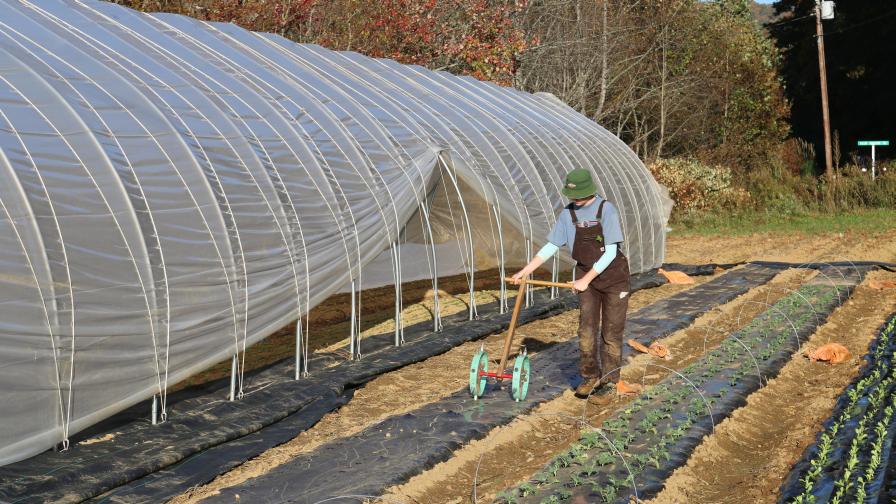
Ivy Creek Family Farm is a fan of the Two Bad Cats Dibbler, which helps prep the bed for lettuce and cilantro at one time.
Photo by Carol Miller
Parsley
We seed parsley in mid-February and transplant it eight to ten weeks later. It’s a workhorse: the first herb we plant in April and the same beds produce through October. Two 150-foot beds yield 100 to 200 bunches weekly all season.
Because it stays in the ground so long, we use landscape fabric to suppress weeds and conserve moisture delivered through drip irrigation. Parsley is our top seller with chefs and a steady hit at farmers markets. We’ve had consistent success with ‘Giant of Italy.’
Cilantro
Herb customers tend to buy weekly, so consistent availability is key. We seed and plant 50 bed feet of cilantro every two to three weeks. Each planting provides two quality cuttings before bolting.
We often pair cilantro with small lettuce heads, since both fit a four-row, 6-inch spacing. That lets us prep beds with the same Two Bad Cats Dibbler setting and keep the process efficient. Both ‘Calypso’ and ‘Cruiser’ perform well for us.
Dill
Dill ranks among our most profitable crops because we sell every part of the plant. The leaves and stems are bunched as culinary herbs, the flowers go into bouquets, and chefs prize the blooms as edible garnishes.
Our best successions come in spring and fall. We plant a full 100-foot bed in late April, late May, and late August, and scale back to 50 feet in June and July when heat limits growth. This keeps dill available during peak cucumber season without overcommitting space.
When tunnel space is available, we plant dill inside in mid-September for late fall sales. It also grows well outdoors under row cover, but we’ve found tunnels easier to manage for season extension.
Each spring, we harvest dill three to four times for culinary use, then cut the flowers once the plants bolt. ‘Bouquet’ is the only variety that meets our standards for both quality and versatility.
Herbs don’t just add fragrance to our market stand—they’ve become the backbone of our profitability. Compact, high-value, and dependable, they let a small farm make the most of every square foot, delivery mile, and cooler shelf.
Subscribe Today For
