



Potato Problems? 7 Tips for Submitting Samples to a Diagnostic Lab
 November 9, 2024
 Do you want to to know what’s wrong with your potato plants or tubers? Consider sending a sample to a plant diagnostic laboratory. Many universities and state agencies operate diagnostic clinics, and some commercial laboratories offer diagnostic services.
Here are some things to know before submitting a sample.
1. Dead plants and completely rotted tubers are not helpful. Collect samples with early or original symptoms before they are masked by advanced necrosis, decay, or secondary problems. Opportunistic pathogens that infect through preexisting wounds or dying tissue are common. Their presence can hinder the diagnosis of the underlying cause of the damage, which could be a primary pathogen, a pest, or an abiotic problem.
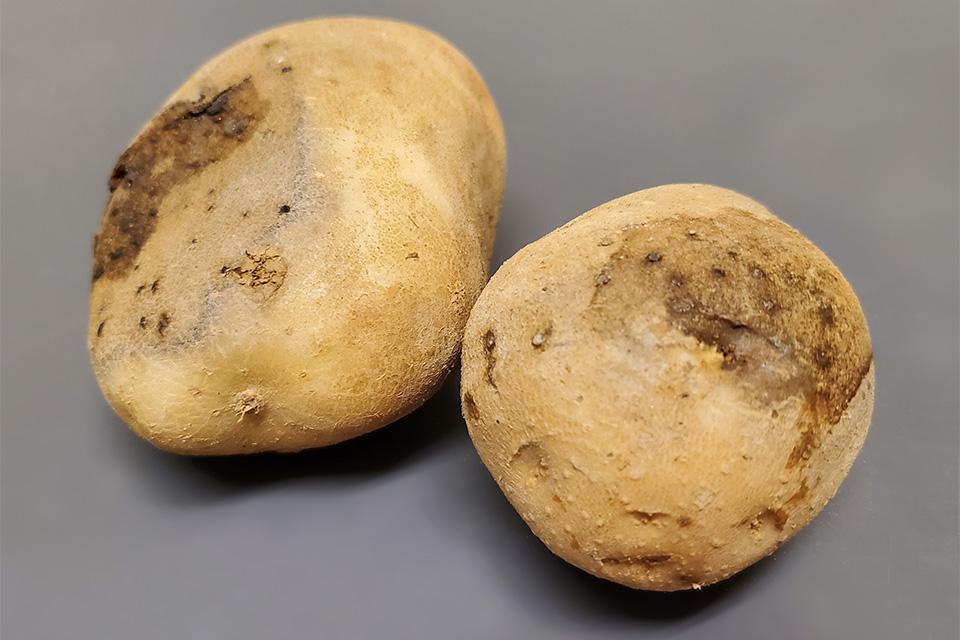
Potato diagnostic opportunity? Tuber rot example — good to test.
Photo by Carrie H. Wohleb
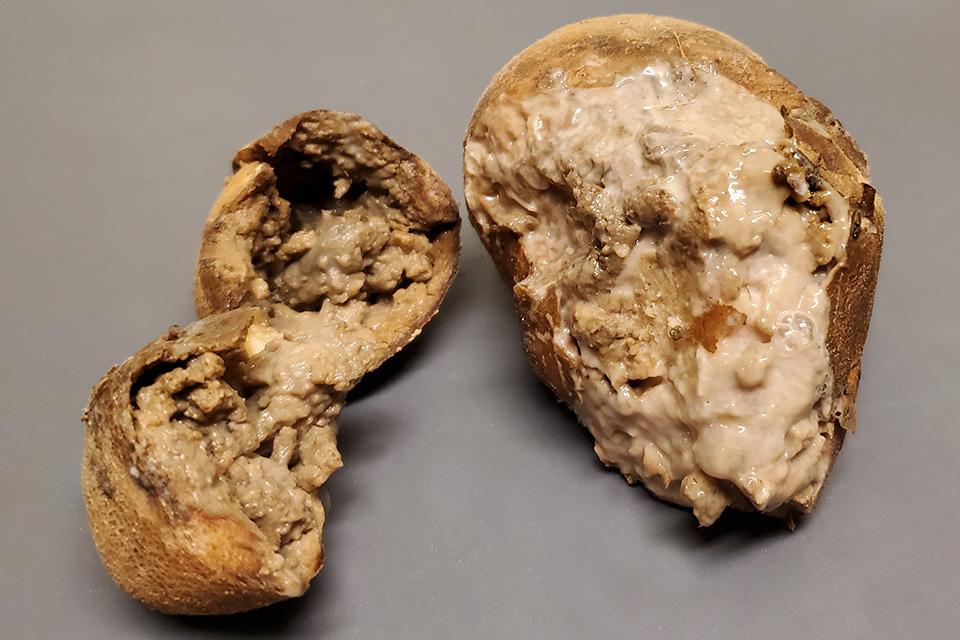
Potato diagnostic missed opportunity. Tuber rot example — too far gone to test.
Photo by Carrie H. Wohleb
2. Collect as much of the plant as possible and send plenty of material. Symptoms can occur in parts of the plant that are distant from the infected or injured parts. It helps to submit entire plants, with leaves, stems, roots, stolons, and tubers. Use a shovel and dig the plant, to preserve root integrity, and include some of the soil around the roots. If sending entire plants is impractical or impossible, send what you can so the diagnostician has enough material to work with. Sometimes, I send a plant with typical symptoms and include portions of other plants to represent the range of symptoms in the field.
3. Send a healthy plant for comparison. Some symptoms are difficult to rate without a basis for comparison. How else can a diagnostician see that a plant is stunted? I suppose you can tell them, but it’s better when they can see for themselves. A healthy plant can indicate color, vigor, and morphological (structural) differences in the problem plant. It may also help to distinguish natural leaf or root senescence from damage caused by a pathogen, pest, or other external factor.
4. Fill out a sample submission form. Most diagnostic laboratories have online, downloadable forms to submit with your sample. In addition to contact information, the forms include questions to help them diagnose your problem. They usually ask for a description of the symptoms, including when they were first observed, whether they have spread, and the extent and distribution of symptoms in the field. They may request a summary of your management practices, especially crop rotation, tillage, fertilizer and pesticide applications, and irrigation. They may also ask about recent weather conditions. Answer these questions as completely as possible, providing as much detail as you can.
RELATED CONTENT: What’s Wrong With My Potato Crop? Dig Down for Answers
5. Send some pictures. They can help the diagnostician know how the problem looked in the field when the sample was collected. A range of pictures is best, starting at the field scale, zooming in on symptomatic plants, and then taking several close-ups. A picture of problem plants next to healthy plants can help (for reasons mentioned above). The photos can be emailed to the laboratory.
6. Carefully package your sample. If sending entire plants, wrap the roots and any attached tubers in a plastic bag to prevent any dirt from contaminating the leaves and stems, then put the whole plant in another plastic bag. Sometimes, I layer paper towels or newspaper around the plant before placing it in the bag; it helps to absorb excess moisture. Each plant you send should be individually bagged and labeled. Potato tubers and other wet, fleshy material can be put in a paper bag before placement in a plastic bag. Don’t forget to include the submission form. Pack everything in a sturdy box.
7. Get your sample to the laboratory ASAP. Keep it somewhere cool if it cannot be sent immediately. Make sure it doesn’t arrive on a weekend or holiday. The last thing a plant diagnostician wants is a leaky box of slimy plants and rotten tubers that sat on their doorstep in the sun all weekend.
Subscribe Today For
