



Learning More About Optimal Grape Growing Made in the Shade
 December 10, 2024
 The San Joaquin Valley Winegrowers Association presented Professor Larry Williams with its lifetime achievement award in a Nov. 8 ceremony at the Big Fresno Fairgrounds. Over the course of his 36-year career at UC Davis, Dr. Larry Williams, a plant physiologist, helped determine the nitrogen and potassium needs of raisin, table, and wine grapes throughout the state. However, he is probably best known for his extensive research on grapevine water use and vineyard irrigation management.
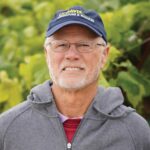
Larry Williams
Photo courtesy of UC Davis
Williams showed that vineyard water use (ETc) can be reliably estimated by multiplying reference evapotranspiration (ETo) by a crop coefficient. Reference ET can be obtained from private or public weather stations, such as the California Irrigation Management Information System (CIMIS). The crop-coefficient (Kc) accounts for crop characteristics that differ from the reference crop, including the type of plant, growth stage, and canopy architecture, and is usually determined experimentally.
Using a weighing lysimeter at the University of California Kearney Agricultural Center in Parlier, Williams found that the Kc was approximately equivalent to the percent shaded area multiplied by 0.017. Therefore, the Kc should be affected by vine growth stage, trellis design, and row spacing, and may also be affected by vineyard location. To better understand how these factors affect Kc, Dr. Williams visited vineyards throughout California, measuring shaded area, leaf water potential, and applied water amounts, and calculating ETc.
He found that the seasonal increase in shaded area was significantly correlated with the accumulation of degree-days to the extent that a Kc can be estimated from degree days accumulated from budbreak. In vineyards across California, seasonal Kcs increased as a linear function of degree days until maximum shaded areas were attained, approximately 800 degree-days after budbreak, and plateaued thereafter. The estimated Kc values did not decrease after maximum canopy size was attained, unless leaf area was lost, for example by insects, mechanical harvesting, or if irrigation is greatly reduced prior to leaf fall.
Trellis and row spacing strongly affected the Kc. Wider trellises spread the canopy and increase shaded area more than narrower trellises, and thus vineyards with wide trellises will have greater Kc values. For example, mid-season Kcs for vineyards with Lyre or vertical-shoot positioned (VSP) trellises with 8-foot row spacings were 0.96 and 0.49, respectively. In addition, the mid-season Kc was inversely correlated with vineyard row spacing – the closer the row spacing for a particular trellis, the greater the mid-season Kc. For example, the mid-season Kc for a VSP trellis on and 10-foot row spacings were 0.87 and 0.52, respectively. In contrast, the effects of vineyard row direction and location were minor.
Currently there are various other options for determining ETc. However, estimating ETc from ET and a Kc retains certain advantages. For example, when satellite imagery is used to derive canopy coverage, the revisit frequency may be longer than desired, and cloud cover can further delay new estimates of vine growth.
Further, historical degree day data can help determine potential vineyard ETc, which could help in designing an irrigation system for a new vineyard. Moreover, it could also be used to estimate potential water requirements of a specific trellis and/or row spacing. Third, an irrigation schedule could be estimated throughout the growing season using historical ETo and temperature data to predict the crop coefficient.
Lastly, reliable Kc values could be used to validate the amount of stress vines experience if the ETc/ETo is calculated within the vineyard itself or remotely obtained. A more detailed summary of the study findings was recently published online in an open access paper.
Previous University of California faculty who were recipients of the San Joaquin Valley Winegrowers Association Lifetime Achievement award include: Kent Daane (2023), Deborah Golino and Andy Walker (2022), Doug Gubler (2016), George Leavitt (2014), and Pete Christensen (2012).
Subscribe Today For
