



TATSI Tack: How Scientists Are Taking a Quantum Leap for Fruit Improvement
 December 12, 2024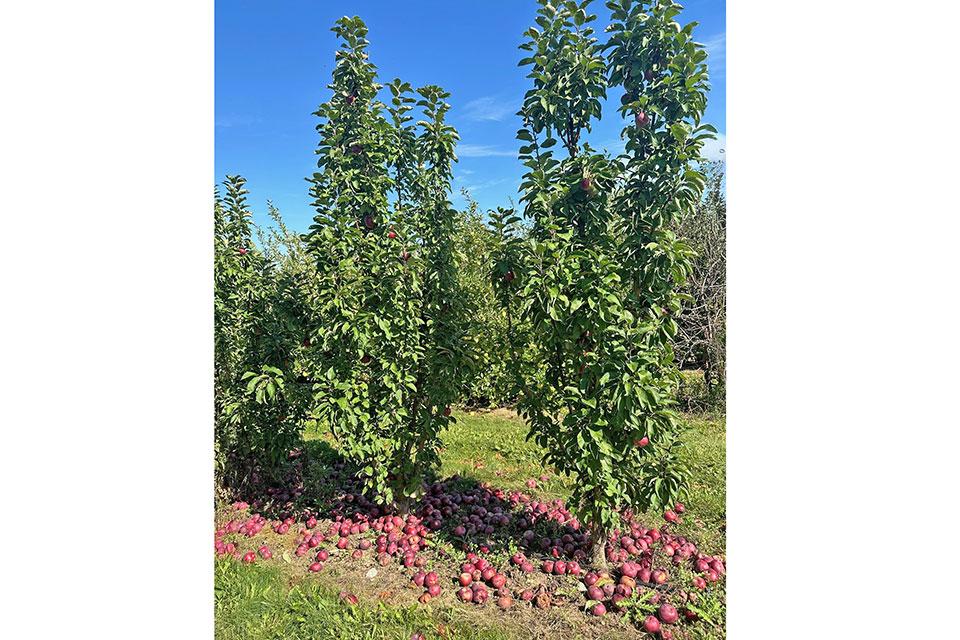
Transposase-assisted target-site integration (TATSI) converts existing apple cultivars into columnar trees to reduce orchard management costs.
Photo by Kenong Xu
Ever since the development of CRISPR/CAS-based gene editing in 2012, the technology has been increasingly adapted in agriculture for genetic improvement of food products from animals and plants, such as apples and grapes. However, one of the important limitations of the current CRISPR/CAS-based gene editing technology is its inability to allow accurate genome insertion of a desired DNA longer than 40 base-pairs (bp), which is way below the size of a gene that usually exceeds hundreds or thousands of base-pairs. To overcome the limitation, the functionality of the current CRISPR/CAS system must be expanded. Fortunately, a recent study, titled “Transposase-assisted target-site integration for efficient plant genome engineering,” has addressed this important need by developing a genome engineering system called transposase-assisted target-site integration (TATSI).
The study, published by the journal Nature, was accomplished by a group of scientists led by Dr. R. Keith Slotkin, a principal investigator at the Donald Danforth Plant Science Center and a professor at the University of Missouri.
What is the transposase-assisted target-site integration (TATSI) system?
TATSI is essentially a combination of a plant transposable element (TE) and a plant transposase with the CRISPR/CAS system that can be programmed to edit a target gene in a genome.
Transposable elements (TEs), also known as “jumping genes,” are a type of diverse DNA elements highly abundant in the genome of most organisms. In the apple genome, for example, TEs may account for 57%.
Transposases are a type of protein that can seamlessly “cut and paste” or “copy and paste” a transposable element to a different site in the genome. Therefore, transposases are the primary force for why TEs “jump.” In natural settings, there is a preference for where TEs may move to.
How does the TATSI system work?
The design is to use a well-characterized transposable element as a cargo vehicle of gene(s) that are desired to be inserted into the genome at predetermined sites.
In practice, a unit of TATSI is constructed first so that the CRISPR/CAS system is costumed to target specific genome sites, and a desirable gene is included in the transposable element.
Next, the constructed TATSI unit is transformed into plants. To confirm if the TATSI unit functions as expected, the target sites are tested by DNA sequencing.
What are the cargo capacities of TATSI and how efficient is the system?
Based on the study, the TATSI system have been tested in soybean and Arabidopsis, a model plant species. The largest genes tested in soybeans are 1,110 base pairs. However, the largest genes tested in Arabidopsis are 8,600 base pairs, demonstrating the large cargo capacity of the TATSI system.
The efficiency for targeted insertion by the TATSI system varied depending on the cargo sizes. The larger the genes to be inserted, the lower the efficiency. However, compared with the existing systems, the efficiency of TATSI is increased by a fold or more.
How can apple improvement benefit from the TATSI tool?
It is expected that the TATSI system can be used in many other crop plants, including apples. One possible use of TATSI is to convert existing apple cultivars into columnar trees to reduce orchard management costs, as columnar apples feature limited branches (see photo), requiring little pruning.
‘Wijcik McIntosh’ apple, which is the original source of columnar growth habit, is a sport mutation from regular ‘McIntosh’ apple discovered in the 1960s. By co-incidence, the mutation was caused by a transposable element that jumped into a genomic region close to a gene, called Co.
It has been shown that the Co gene encodes a protein (2-oxoglutarate/Fe (II)-dependent oxygenase) of important role in plant growth. In standard apple cultivars, the Co gene is expressed in roots but not in shoots. Although the transposable element did not interrupt the Co gene, it induces the expression of the gene in shoots, leading to columnar growth.
Given the aforementioned facts, the TATSI system would be particularly useful in this case. The idea is to use TATSI to precisely insert the same transposable element into the same or nearly same location in standard apple cultivars, such as ‘Gala’ and ‘Honeycrisp’.
Another possible application of the system is to insert an apple disease (e.g., fire blight, apple scab) resistance gene into a selected site in the genome to make existing apple cultivars more resistant to diseases. Since most disease resistance genes are found in wild apple species of poor fruit quality attributes and small fruit sizes, this approach likely represents the fastest way to make use of such genes.
Subscribe Today For
