



Integrated Pest Management an Important Component of Food Safety Certifications
 December 16, 2024
 Integrated Pest Management, or IPM, is becoming a prominent component of primary production 3rd party food safety certifications for fruit and vegetable growers. IPM is a sustainable approach to pest and disease management that combines biological, cultural, and chemical tools to keep pests below relevant damage thresholds while minimizing environmental, human health, and economic risks. Certification schemes such as GLOBALG.A.P., PrimusGFS, and SQF, have long addressed chemical applications, but recent versions/ modules/ addendums of these standards call out IPM practices specifically as requirements.
- GLOBALG.A.P. IFA version 6-GFS, due to be implemented later this year, includes an IPM section with eight specific principles, consisting of both Minor- and Major-level criteria.
- PrimusGFS v3.2 Module 9-IPM, released near the end of 2023, is a five-question module optional add-on already being required by many large retailers.
- SQF Sustainability Addendum for Primary Plant Production was recently released and is just beginning to be implemented by growers. This eight-item addendum includes IPM as an important component of comprehensive sustainability efforts by growers.
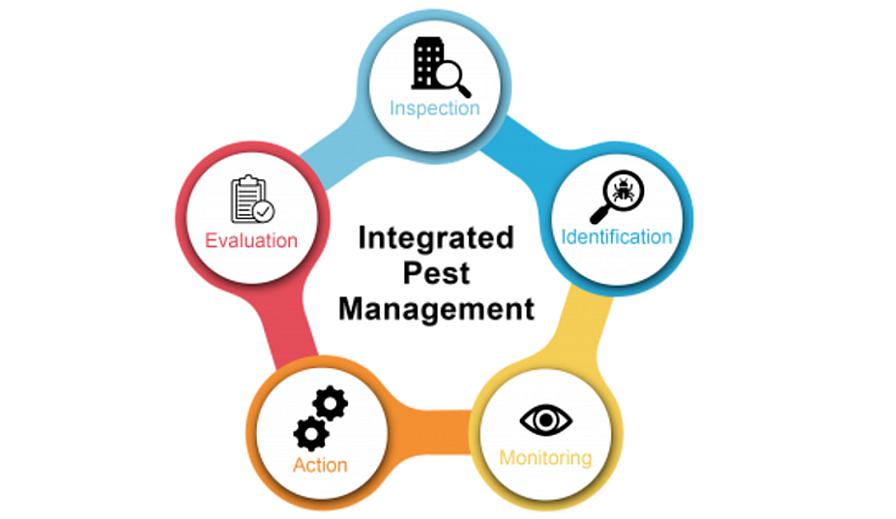
Illustration courtesy of EPA
Shared IPM Requirements:
All schemes of food safety certifications listed above require Integrated Pest Management practices. PrimusGFS Module 9 requires that a documented IPM plan be in place. SQF SAPPP requires that at least two IPM practices be demonstrably implemented. GLOBALG.A.P. IFA v6-GFS also requires an IPM plan and a “stepwise approach” to managing relevant pest and disease pressures.
A primary component of IPM, which all three certification schemes require, is the identification of relevant pests, diseases, and weeds that threaten an operation’s crops. Each of the schemes requires that qualified persons inform or make the decisions of which methods an operation uses to address these threats.
Determining a threshold for action is another key component of IMP which is specifically spelled out by these certification schemes. These can be “action thresholds” and/or “economic injury thresholds”.
Monitoring, which may include common practices such as scouting, is a core component of IPM, and is required by all three schemes as well. It is the monitoring for the identified threats which informs when a threshold has been reached and action is required.
IPM requires consideration of biological control and cultural non-chemical practices prior to use of chemical interventions, and this is specifically stated by these certification schemes as well.
Another goal of IPM that is embraced within the schemes is managing pesticide resistance. Following anti-resistance recommendations as well as practices to delay and manage pesticide resistance are incorporated into the requirements.
Protection of biodiversity is another key component of IPM. GLOBALG.A.P IFA v6-GFS requires a Biodiversity Plan, with IPM as an example practice in this effort. PrimusGFS v3.2 Module 9 specifically requires that pollinators be protected, and beneficial insects be attracted. SQF SAPPP requires an assessment of the risks farm practices may present to pollinators and other non-target organisms.
Considering the risk that pesticide use presents to humans is another component of IPM, and IPM and is included in all three schemes.
Finally, a robust IPM plan includes an evaluation step to assess the effectiveness of the IPM plan and to adjust accordingly. This evaluation step is specifically required by GLOBALG.A.P. IFA v6-GFS. It directs growers to use the results of their evaluation to improve their program, which must be evaluated on a yearly basis.
Industry-Led:
Like many 3rd party certification components, industry requirements lead the development of these additional criteria. The U.S.’s largest grocer declared, “In an effort to protect and restore natural resources involved in the production of the produce we sell, Walmart U.S. and Sam’s Club have committed to sourcing 100% of the fresh produce and floral we sell in our in-store Produce department from suppliers that adopt integrated pest management practices, as verified by a third-party, by 2025.” Other large retailers have similar requirements.
For growers of fruits and vegetables, Integrated Pest Management is becoming a component of their food safety efforts. Many growers are already implementing IPM practices within their operations, to varying degrees, and now need to formalize these as components of an IPM plan.
Subscribe Today For
