



Tap Into FieldClock, a New Farm Labor Management App
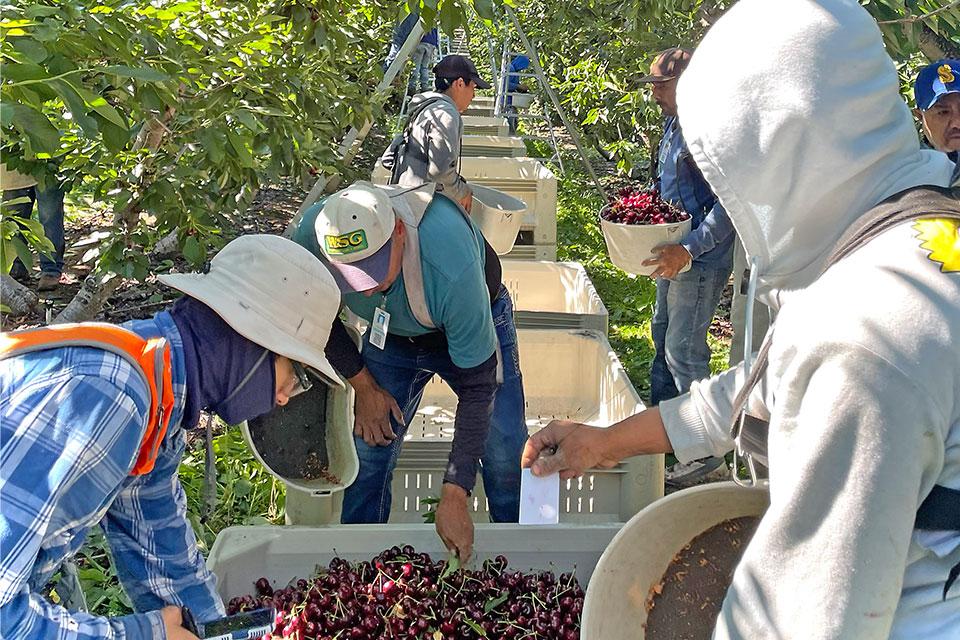
The FieldClock app records hours worked and row-by-row productivity metrics by scanning QR codes on employee badges.
Photo courtesy of FieldClock

Farmers face significant challenges with tracking worker hours, from unwieldy paper time sheets to complicated labor regulations. Solving industry-specific problems requires a technology “built by farmers, for farmers.” Enter FieldClock, a field-to-office farm management app that records all labor and production data in real time. Users can monitor employee hours and piece-rate work with precision, thanks to geostamp technology that records daily labor down to individual fruit picks, notes FieldClock Marketing Director Nico Cabral.
In early November, FieldClock partnered with the American Farm Bureau Federation, enabling the company to deliver its labor tracking and management platform to a broader audience of farmers. Future iterations of the app will encompass improved analytics, customizable reports, and expanded integration with payroll and HR systems.
“FieldClock listens to its users and encourages feedback we can share with our product team, ensuring the app stays relevant and valuable,” Cabral says. “The Farm Bureau partnership is another way to advocate for the needs of farmers and meshes well with our system.”
ADIOS, CHICKEN SCRATCH
FieldClock was established in 2015 to save farmers time and money through the power of digital labor tracking. Tired of arduous manual workforce management processes, Washington state farmer Ryan Vickery enlisted a tech-savvy friend to develop a timekeeping app allowing managers to log employee hours with a smartphone or tablet. The app’s efficiency and user-friendliness spread quickly through word-of-mouth. Nearly a decade later, FieldClock has evolved into a platform that supports over 60,000 employees and $650 million in annual payroll.
Before FieldClock, farmers used generic software tools built for retail, manufacturing, and other standard industries. Many growers still rely on the pen-and-paper practices of generations past, literally transferring labor information from a notebook to Quickbooks or similar solution, Cabral says.
“Coming off the field and entering chicken scratch into a spreadsheet is an hours-long process,” he says. “And trying to customize these (non-industry) software solutions to address the unique needs of farmers was like fitting a square peg in a round hole. Often, it caused more problems than the ‘solution’ was designed to solve. Farmers trust the FieldClock tool because it was created by people who understand their day-to-day realities.”
BLOCK-TO-BLOCK OVERSIGHT
Built with the ag community in mind, the mobile-based app is intuitive and requires minimal training, adds Cabral, himself raised on a California dairy farm. Crew leaders simply scan employee badges containing a QR code, with FieldClock recording both hours worked as well as row-by-row productivity metrics. The plug-and-play nature of the software further allows growers to stay compliant with stringent employment laws while optimizing labor allocation and efficiency, says Cabral. “It’s useful for farmers when moving crews to a different block,” Cabral says.
“It’s also good postharvest to see the productivity of employees per block. Typically, a tool with this level of reporting granularity was only available to large, enterprise farm operations. FieldClock bridges that gap and lets smaller operations benefit from the advantages of digitization.”
App adopters report reduced time spent on administrative tasks such as payroll and compliance reporting. Pinpoint-accurate records also facilitate compliance with labor laws and regulations, streamlining the auditing process.
FieldClock pricing is based on the number of employees being tracked, with three tiers supporting small farms up to larger operations. Farmers only pay for what they use, meaning they can scale up or down a pace with seasonality or fluctuations in business. The company also provides live demonstrations of app features, including importing worker data and configuring payroll settings.
Additionally, the software integrates with established payroll systems, such as Quickbooks and Paychex. Meanwhile, farmers concerned about limited cellular connectivity in remote field locations need not worry, Cabral says.
“We offer an offline sync mode,” he says. “The app records all data, and once a network connection is reestablished, it syncs directly with your admin account.” Fear of technology is an obstacle for farmers who have been relying on manual methods for decades. FieldClock’s user-friendly interface, affordable pricing plans, and strong data security measures usually alleviate those concerns, says Cabral.
“These are guys in their 50s and old school, so when they see a tech solution on a mobile device, it raises a red flag,” Cabral says. “They don’t want to learn a new system when pen and paper has been working. So, we explain the inefficiency of pen and paper and let them know they’ll be saving money even when paying for FieldClock.”
Subscribe Today For
