


How Important Is Flowering in Potato Crops?
 January 30, 2025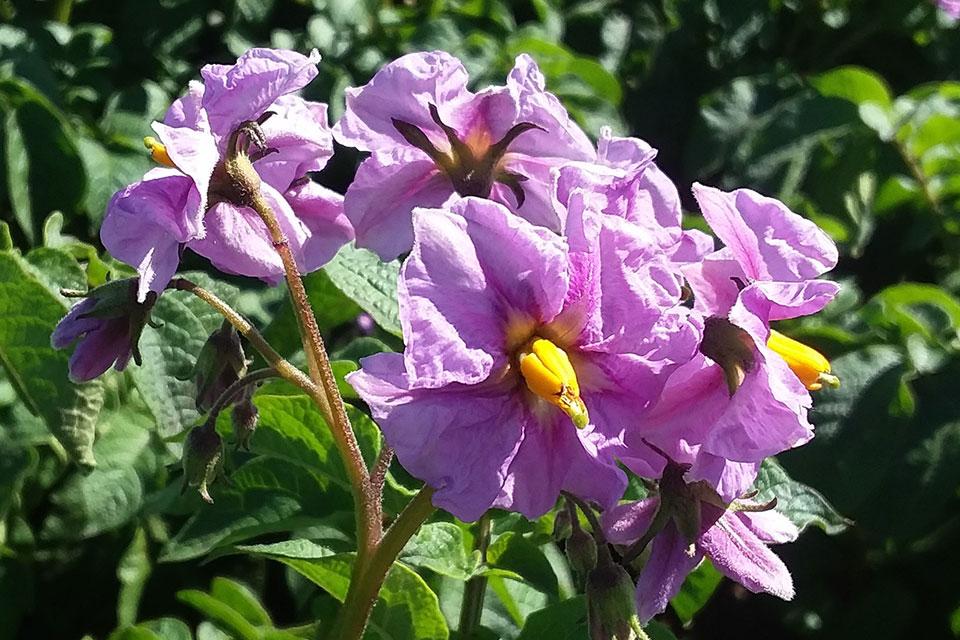
These potato plants are in bloom. Is flowering important for tuber crops like potatoes?
Photo by Carrie Wohleb
A potato grower asked me an interesting question. He wanted to know how flowering affects tuber yield and whether it even matters. He asked because his Yukon Gold potatoes produced a “bumper” crop with many tubers last year following an exceptionally prolific bloom.
Flowering Is Not Important for Potato Production, Per Se
Tuber initiation and the first appearance of flowers tend to occur around the same time, which raises the question of whether the processes are linked. They are associated with similar environmental cues, which signal some common regulatory pathways in the plant—that’s why they usually happen in sync. However, tuberization does not depend on flowering, and vice versa—one can occur without the other.
Is flowering a sign of good health? Not always.
Potatoes will sometimes flower when stressed. Stress-induced flowering (and subsequent seed production) is a common plant adaptation to ensure a species’ survival when individuals experience unfavorable conditions. The plant prioritizes seed production over vegetative growth when an early death is imminent. Since the desired component of a potato plant is vegetative, i.e., the tuber, stress-induced flowering is not good for productivity.
It is sometimes suggested that cutting off flowers can increase tuber yields by redirecting resources to vegetative growth. A few studies have supported this idea, particularly for the few potato cultivars that bloom a lot and set many fruits (green berries that resemble small, unripe tomatoes). However, most studies have shown marginal benefits and inconsistent results. Consequently, developing a cost-effective method for flower removal for commercial potato production has never been thought worthwhile.
The concern about competition between fruits and tubers is irrelevant in many cases. Most potato cultivars produce few flowers or mostly sterile flowers (usually sterile pollen) that will never produce fruits. This explains why we don’t find many berries on most potato plants — usually just a few here and there. Unfertilized flowers drop off the plant of their own accord, so cutting them off is probably a waste of time and effort.
Flowering Can Be a Sign of What’s Happening Below
So, why did the Yukon Gold grower associate a bumper crop of tubers with flowering? I suspect the abundant bloom was a sign that he used physiologically aged seed to grow the crop.
Physiological age refers to the internal age of a tuber, which differs from chronological age (the days since tuber initiation) and is determined by biochemical changes within. Like chronological aging, it advances with time but can also be influenced by genetics (e.g., cultivar traits) and accelerated by stress.
Young seed tubers express apical dominance, where one dominant bud suppresses the sprouting of the other buds on the tuber. This results in a plant with one stem and a few tubers. However, as seed tubers age, apical dominance decreases. Thus, older seed tubers produce more sprouts, which result in more stems and tubers. The tubers usually end up being smaller because they have to divvy up more of the carbohydrates produced by the leaves. Older seed tubers also sprout earlier, tend to grow plants with less foliage, and reach maturity earlier than plants generated from young seed tubers.
What does this have to do with flowering? Older seed tubers produce plants with more flowers since there are more stems per plant to end in a flower (potatoes produce one flower cluster per mainstem). So, prolific flowering is a good sign if you want to grow many small-sized tubers. But it can also be a bad sign if you want to produce large tubers.
Yukon Gold tends to age more slowly than many other cultivars. It has a strong tendency for apical dominance, producing few sprouts per seed, few stems, and few tubers per plant. This can result in larger tubers than desired, especially for specialty markets where small-sized tubers are valued and sell for a premium. Yukon Gold is often planted at a closer spacing to counter this effect; it doesn’t change the number of sprouts, stems, or tubers, but crowding limits tuber size. Another approach is to plant physiologically aged seed tubers. And, when they sprout up quickly with lots of stems and then lots of flowers, you will know to expect a bumper crop of tubers below — provided that nothing happens to stop them.
Read “Why Physiological Age of Potato Seed Tubers Counts” for more information.
Subscribe Today For
