



Investing in Your Soil Matters for Healthy Almond Crops
 February 17, 2025
 Healthy soil is the foundation for robust trees. If tree nut orchards are not getting the nutrients they need through the soil, it can limit tree growth and affect overall plant health and productivity. Unlike row crops, permanent crops cannot support healthy soil through annual rotation, so maintaining soil health is key to promoting a long tree lifespan, maximizing yield potential and ensuring long-term economic sustainability.
According to the American Farmland Trust, almond growers who implemented soil health maintenance practices saw a yield increase valued at $46 to $968 per acre based on California average almond prices. The same study found that California almond growers who adopted soil health practices saw an increase in annual net income ranging from $99 to $1,502 per acre per year.
Not only does healthy soil improve yields and annual income, but it can also boost your return on investment by reducing input costs such as fertilizers, machinery, and fuel. Conversely, unhealthy soil can have the opposite effect. For example, if the soil is too compact, it may struggle to drain, negatively affecting the return on investment by requiring more inputs for the trees to receive the same fertilization.
WATER AND NUTRIENT UPTAKE
For permanent crops to absorb nutrients and adequate water, soil health needs to be prioritized. A difficult environment makes it hard for the tree to access nutrients it needs and creates stress. As a result, instead of focusing on nut or fruit production for increased yields, the tree is focused on managing stressors.
Soil health also impacts the orchards’ resilience to pests. When trees are stressed from nutrient deficient soil, it produces an environment that could potentially kill off beneficial microorganisms, which would typically exchange nutrients with the tree and support plant health. However, when these beneficial microorganisms are given an environment to thrive, they facilitate feeder root growth, nutrient uptake, and inhibit many soilborne pathogens.
Additionally, poor soil health can create an environment for disease pathogens to thrive. For example, if the orchard is in a humid region or if it frequently floods, it can create a breeding ground for unwanted disease pathogens. Periods of 24 hours or more of saturated soil favor Phytophthora infections.
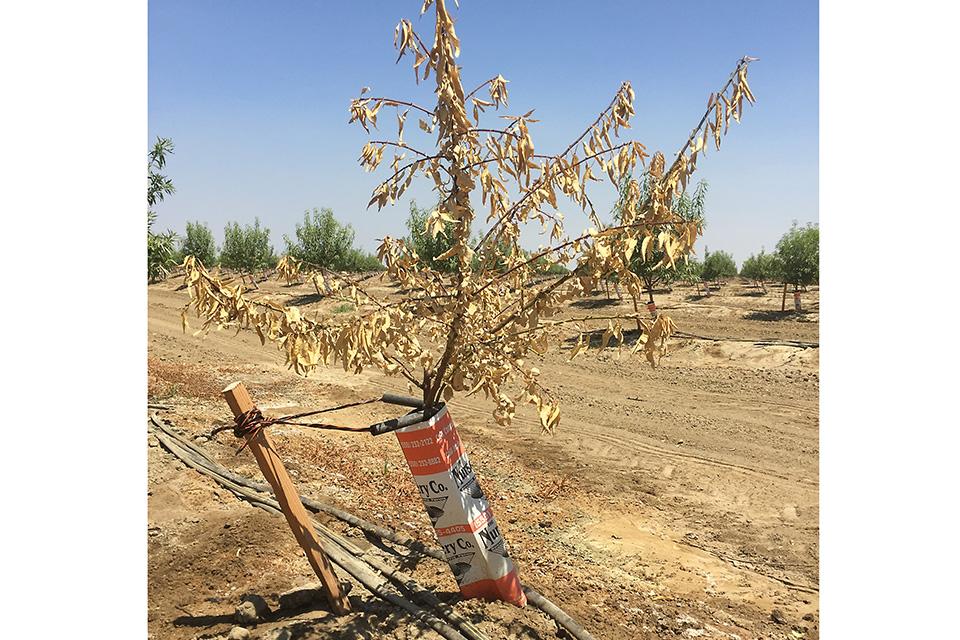
Phytophthora infected almond tree.
Photo courtesy of Syngenta
BEST PRACTICES
Determining what your soil needs is a great first step, but it does not stop there. Follow these practices to help you maximize your tree nut production through proper soil health management:
Assess your soil profile: Start by probing your soil near the root line and evaluating your tree root health to determine what nutrients are needed. Once you have a good idea of the soil profile and the health of the root system, you can add specific amendments to break up the soil for proper water retention and supplement missing nutrients as needed.
Plant cover crops: Planting cover crops between tree rows during the off-season can help with orchard water retention and biodiversity. Their roots help improve soil structure, increasing porosity and promoting better water infiltration and drainage. Cover crops also support beneficial soil organisms, which help break down the soil and enhance nutrient cycling.
Consider mulching: Mulching is an effective practice for improving soil health by enhancing water retention and regulating soil temperature. Mulch helps to maintain consistent moisture levels in the soil, reducing the need for frequent irrigation. It also acts as an insulating layer, keeping the soil cooler in the summer and warmer in the winter, benefiting root health and reducing stress on the trees.
Apply a proper fungicide: Applying a robust fungicide that protects against pathogens and supports overall plant health is a must to maximize tree nut production. Orondis fungicide (oxathiapiprolin) significantly reduces Phytophthora propagule counts and inoculum potential, while also improving root health, which is especially important for young trees with developing root systems that are more susceptible to disease.
Maintaining healthy soil is crucial to unlocking consistent profitability and orchard longevity. For more information about Orondis fungicide, click here.
Subscribe Today For
