



Smart Tech
Blackberry Harvest Challenge — Gotta Hand It to the Robots
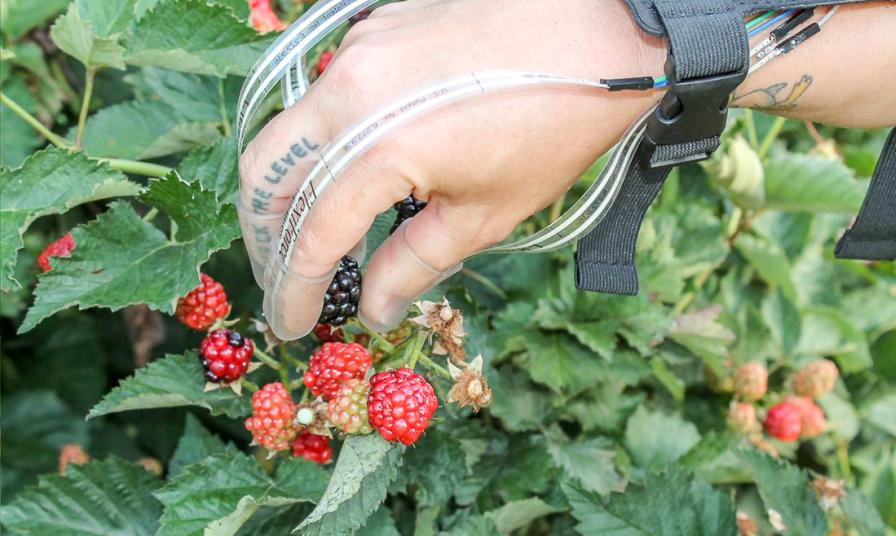
A new method for your blackberry harvest? University of Arkansas researchers measured the force needed to pick blackberries without damage. (Photo by Anthony Gunderman, University of Arkansas and University of Arkansas System Division of Agriculture)

A new berry-picking robot gripper developed at the University of Arkansas could give growers a high-tech replacement for limited labor availability. The U.S patent was issued in April to the University of Arkansas for the invention “Soft Robotic Gripper for Berry Harvesting.” Technology Ventures, part of the Division of Research and Innovation, secured the patent.

The device was developed by Anthony Gunderman, at the time a Ph.D. student and now an Assistant Professor in U of A’s Department of Mechanical Engineering, with Yue Chen, a former U of A Professor now at Georgia Tech, and Jeremy Collins, then a U of A undergraduate engineering student.
The robotic gripper has three “fingers,” each made of a soft, pliable material. When a “tendon” — in this case a guitar string — is pulled, the fingers retract.
“I was inspired by the way a tulip flower opens and closes when the sunlight hits it,” Gunderman says.
On the tip of each finger is a force sensor, which makes sure the gripper can pluck the berry without crushing it. Roughly handled blackberries can be damaged at harvest or turn red after harvest, a condition called red drupelet reversion. Both are undesirable attributes for consumers. USDA will also reject fresh blackberries with too much damage or too many red drupelets.
The research team attached sensors to the fingertips of experienced blackberry pickers and measured how much force they applied while harvesting a berry. This was to determine the force needed to pick blackberries without damage.
Before the robot can be deployed on farms, the computer vision and positioning technologies that would let it find and reach for berries on the plant still need to be developed.
The human hand can adapt to many tasks. But Gunderman thinks one day the robotic hand could be better at picking blackberries.
“When we’re talking about one specific task, it is certainly the case that you could design something that is better than the human hand for that one specific task,” he says.
For more, continue reading at news.uark.edu.

For more Smart Tech topics, click here.
Subscribe Today For
