



How Wild Bees Could Play Big Factor In Blueberry Pollination
 August 27, 2025
 Honey bees provide the bulk of pollination services in blueberry fields. We know this based on the scientific literature, and their contributions to our food system cannot be understated. However, wild bees are also known to visit blueberry flowers. Many of these wild species are excellent pollinators of blueberry. Yet knowledge of wild bee species in Washington state, which leads in national blueberry production, is obscure. New research is stepping in to fill this gap and will hopefully pave the way to eventually bolster wild bee pollination in blueberry fields through an improved understanding of their contributions.
First, it’s important to clarify why learning about wild bee pollination matters, especially when honey bees can get the job done. The reasons are many.
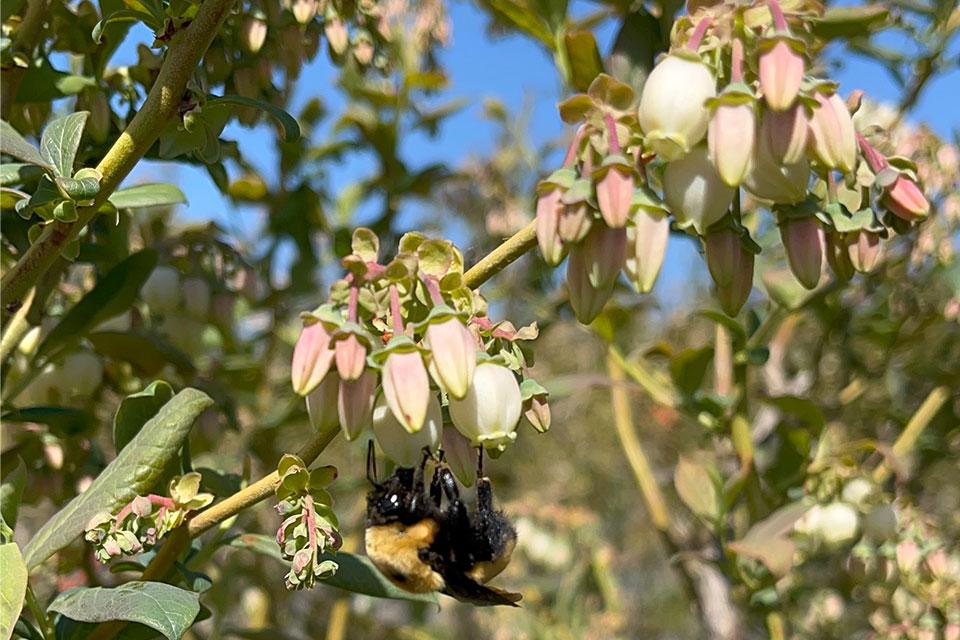
Wild bees like this Bombus nevadensi contribute to the pollination of blueberry plants more than you think.
Photo by Salena Helmreich
MATCH MEANT TO ‘BEE’
One reason is that many wild bee species are more efficient pollinators of blueberry, meaning they can visit a flower fewer times than a honey bee and deposit the amount of pollen needed to maximize berry development. Honey bees can struggle to pollinate blueberry flowers, with some cultivars being more challenging than others due to differences in flower shape and size. This is attributed to honey bees not being physically well adapted to pollinate blueberry flowers.
Many wild bees, in contrast, have adaptations they’ve developed over time to pollinate blueberry flowers. An example of this includes long tongues to probe and gather nectar and buzz pollination, which triggers pollen release. Honey bees are also not particularly attracted to blueberry flowers. Many growers can attest that honey bees will preferentially fly to other blooming plants (such as maple!) and skip over their blueberries.
Additionally, certain wild bees fly and pollinate under cooler temperatures that would otherwise be limiting for honey bees. Honey bees begin foraging under partial-to-full sun conditions and at temperatures 55° F and above. These conditions may be rare during some years and translate into poor pollination unless wild bees are there to supplement.
The biggest recent driver to revisit wild bees is the challenges some growers face with renting honey bee hives. For reasons still being explored, there is a reputation that honey bee colonies experience higher mortality levels after blueberry pollination relative to other crops. This has resulted in higher rental prices and, in a few cases, beekeepers refusing to place their honey bees in blueberry fields.
Research characterizing the contributions of wild bees to blueberry pollination in Washington is ongoing. However, the preliminary results have been pleasantly surprising.
In 2024 we sampled from Washington blueberry fields that ranged from high to low amounts of natural habitat. We captured a total of 70 different bee species, more than what we expected! Our results show more wild bees were present on the edges of blueberry fields vs. the interior. This is not surprising, and increasing pollination along the edges can still be economically advantageous, according to studies done in other crops.
We also found evidence of some wild bees nesting within blueberry fields — another finding we did not expect and suggests opportunities to manage populations both within and around fields. This work is being repeated in 2025, and the economic contribution of wild bees to blueberry pollination will also be determined.
CALL TO ACTION
If you are interested in supporting wild bees, there are a few simple things you can do. The first is to establish habitat that can provide food (i.e., pollen and nectar). Habitat also provides nesting sites. Minimize disturbances in habitat, as many wild bees nest in the ground. Aim to use native plants with a long bloom time but minimize bloom overlap with your blueberry to avoid competition. Local crop consultants can aid you with the selection of plant species to establish. Nonprofits like Pollinator Partnership and Xerces Society also have a wealth of resources. Also check out for possible cost-sharing programs with the Natural Resource Conservation Service (NRCS). Historically, NRCS has provided support for habitat enhancement and restoration. Reducing pesticide use or applying pesticides at night is also advised.
Relying on a single tool increases risk. Similarly, just relying on honey bees can be risky. While honey bees are vastly important pollinators of blueberry and other crops, efforts to look beyond honey bees and encourage wild pollinators will ultimately build resilience in growers’ pollination portfolio.
(Funding: This work is supported by the Washington State Dept. of Agriculture Specialty Crop Block Grant Program.)
Subscribe Today For
