
How This Apple Grower of the Year Is Leading the Way to New Heights
 September 20, 2025
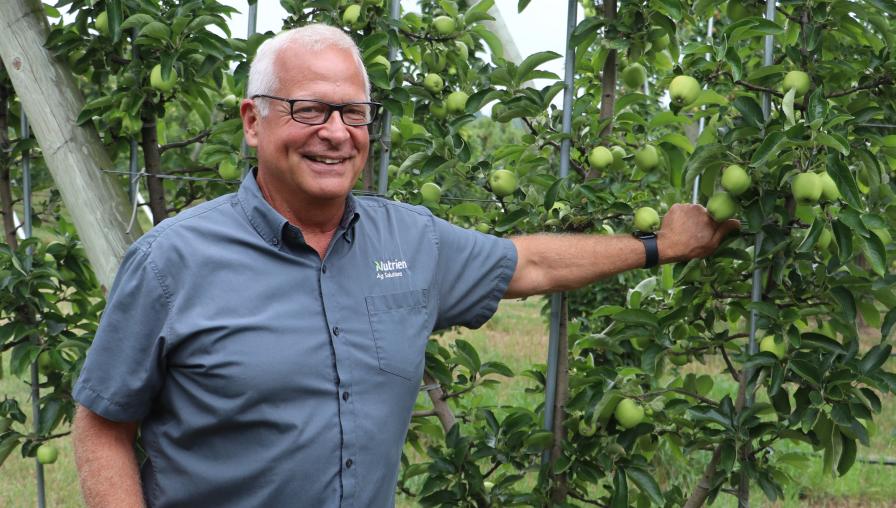
 Always prepared, measured, and confident, Jim Engelsma takes multileader systems, cidermaking, and mentorship to another level in Michigan.
View all
For a moment or two in the early 1980s, a 17-year-old Jim Engelsma gave his family reason to think it might never make that leap from second-generation farmers to third-generation farmers. Successful ones, at least.
Michigan teenagers back in the day were known to do some crazy stuff. Growing up in the Great Lakes State — as native son Kid Rock would tell us decades later — was all about “trying different things” when “caught somewhere between a boy and man.”
In this case, the teenage Engelsma was trying something that, in 1983, would be considered REALLY different to most Michigan growers, particularly his dad, Jim Sr., the old-school, blue-collar apple guy. One by one in the family’s orchard, he was planting Red Chief Red Delicious trees just 6 feet by 14 feet apart in a high-density production system.
Six by 14? High density? Say what, son?
“To my father’s dismay, I planted trees very close and even put irrigation on them,” Engelsma recalls. “My dad was very skeptical of high density. My dad was a tonnage man.”
His son, on the other hand, was, unbeknownst at the time, the fledgling new-world man of southwest Michigan’s vaunted Fruit Ridge. Versed on high-density systems despite his youth, and well before the technology would become commonplace across the region in the late 1990s, Engelsma Jr. displayed pride — and uncertainty, too — over his equally unproven Red Chiefs. At one point he revealed his work to John den Hoed, a pioneer of high-density systems who was visiting from Washington state.
“He was a big grower, and he came to our little farm. I had to go show him my little trial plot of high density with drip irrigation,” Engelsma says. “Looking back, it was men like him that encouraged me because he thought it was the neatest thing in the world that I was doing this, even though he was doing it big-time in Washington. He actually lifted me up and said, ‘Hey, this is possible. This is the way of the future.’”
Those juvenile Red Chiefs, like their cultivator, eventually came of age. In fact, they soon produced the nicest fruit on the farm, according to Engelsma, noting that they were the appropriate variety at that time. “It was my first foray,” he says, “and we went from there.”
Better yet, Dad wound up coming along for the ride.
“Yes, he was a skeptic all the way,” Engelsma says, “but as soon as we had successful plantings of high density, I remember him riding down the path with two of his friends in the front seat of his pickup, and I could hear him say as he rode by, ‘Look at what WE’RE doing here.’ He had adopted it as his, right alongside me — WE are doing this.”
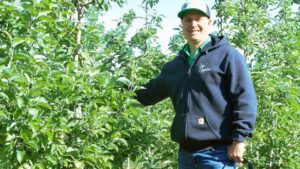
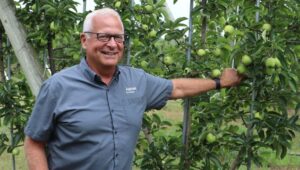
Four decades later a lot more Michigan growers are doing high density, many of whom have Engelsma — the American Fruit GrowerSM 2025 Apple Grower of the Year — to thank for their success.
TAKING CHARGE
Engelsma, now 60, would never trade in his youthful years on the family’s farm in Walker, MI, just over 4 miles west of downtown Grand Rapids. He misses his mom (and biggest influence), Marie, who passed away in 2007. He checks in frequently with his dad, who, at age 93, still lives on the property.
“I have very fond memories of growing up on a large processing, small fresh market farm,” he says. “But I was very determined to change that and move toward the fresh market.”
To accomplish that transition, the operation — J Engelsma Orchard — would need to purge its traditional blocks. In their place, high-density systems, with more trees per acre, would allow for greater yields and potentially higher-quality fruit, necessary attributes to thrive in the fresh-market arena.
With Jim Sr. retiring in 1985, the time was right for his son to take over the farm while simultaneously starting a seven-year transition plan. In what was an early indicator of his agricultural and entrepreneurial prowess, Engelsma needed only six years to complete the plan.
“The only thing we haven’t transitioned is the 10-acre cider block, which is medium-density trees,” Engelsma says. Smiling, he adds, “We thought we were doing a great thing with the medium density when we started planting trees 18 feet in a row and 10 feet apart. We really thought that was pretty high-density stuff.”
Not anymore. Not even close.
PUSHING THE LIMITS
Nowadays in Engelsma’s high-density heaven there is essentially no room for wasted space. Plantings range from 8 feet by 3 feet (dual-leader Honeycrisp) to 12 feet by 3 feet (triple-leader Ambrosia and single-leader Gala). The prevalent rootstock is Budagovsky 9.
“The farm is fully planted now. If we want to get better at what we’re doing, we’ll need to take out some plantings that were planted in 2007,” Engelsma says. “But right now we’re fully planted and in full production and are enjoying that.”
Engelsma especially favors his block of dual-leader Firestorm Honeycrisp, which he highlighted in 2023 during the winter tour of the International Fruit Tree Association. Planted in 2020 and spaced 8 feet by 1.5 feet per leader, expectations are high this season, its second cropping year.
“I’ve always wanted to break the 2,000-bushel (per acre) mark. And with the Honeycrisp 8 by 3 with a double-leader, there are enough tree leaders there for a 2,000-bushel crop,” Engelsma says. “I’m really looking forward to this fall because, when I do the math, the increase in production is exponential with the number of fruit per tree. We have it dialed in very closely. We know what amount of fruit is on there per acre, and if that bushels up like it’s supposed to, it will be records for our farm.”
RELATED CONTENT: What People Are Saying About the Latest Apple Grower of the Year
Engelsma’s crew hand-planted each Firestorm Honeycrisp in an Ellepot membrane. The trellising had already been constructed, and irrigation went in directly behind the plantings. “The water went on, and the trees took off,” Engelsma says. The trees were then cut to 18 inches and trained to a dual-leader system. “The second leaf we had substantial growth and have really never looked back.”
Lack of uniformity — the frequent caveat of multileader systems when one leader decides to dominate — has never materialized, according to Engelsma.
“Originally there was quite a bit of concern that we wouldn’t be able to fill our space with a dual-leader on Bud.9, but we’ve been able to do that,” he says. “We’ve micro-managed nutrition going in here, and we’ve used variable-rate ground-applied fertilizers. We apply fertilizer in the springtime, according to the needs, and then supplement that with fertigation but also with foliar nutrition. We’ve continued to fill the space and feel like this is going to be a good producing orchard.”
Why take the risk posed by a multileader system?
“Every day we need to look at our operations and really try to sharpen the edge,” Engelsma says. “If a grower wants to be profitable, we have to do everything right. I’m constantly trying to push that envelope on my own farm with planting densities. The quicker we can grow a tree, the more profitable an orchard is. We can’t take our time growing a tree. The economics are not there. We have to be very aggressive.”
DRINKING IT ALL IN
As successful as Engelsma has been with his high-density apples, his cider work has garnered even more accolades — in less time.
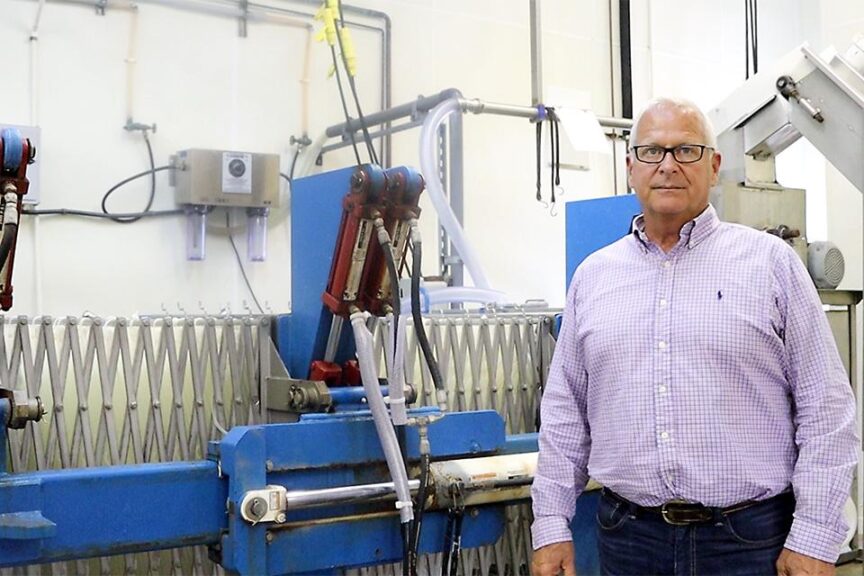
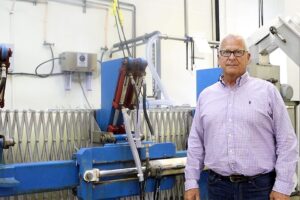
Long intrigued by the production of fresh, high-quality cider, Engelsma launched an on-farm wholesale cider operation — Engelsma’s Apple Barn — in 2004. In just its second year of production, the business won the annual Michigan Apple Cider Contest. Totaled, it has finished first a record seven times over the first 26 years of the competition.
“We made sure all of the I’s were dotted and T’s were crossed. Cleanliness was a top priority, and we focused on all tree-picked apples to start making our first batches of cider,” Engelsma says.
Gala lends itself to the cider’s base, while other staple varieties include Golden Delicious, Jonathan, and Jonagold. “Really, it’s your old standards that produce a lot of the juice,” Engelsma says. “We do have our favorite apples for cider. It varies with season. Some of the earlier cider is harder to make. We’ll include MacIntosh in there. It’s a balance, but we do have up to seven varieties in almost every pressing.”
EMPOWERING THE FUTURE
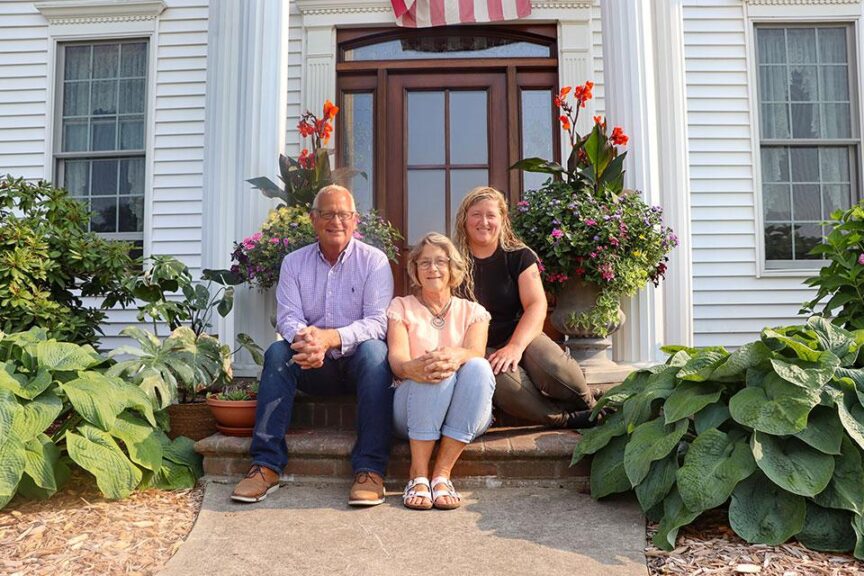
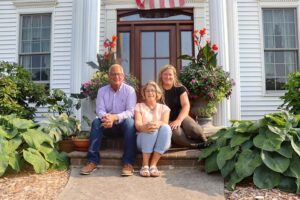
Speaking of balance, another Engelsma family member — already validated as generation No. 4 in the farming arena — bears full responsibility for the cider business, which operates September through December. In fact, Jim and wife Becky’s daughter, Bridget, 37, has served as Farm Manager across the entire operation since Jim began working full-time for Nutrien Ag Solutions in 2013.
“Bridget does all the (cider) work, so she really gets the credit for doing a phenomenal job in there,” her dad says. “She is very good at food safety, she takes it very seriously, and she really owns that business. I’m very proud of her. She also manages the day-to-day farm operations for us. She’s a very key, integral part of our operation.”
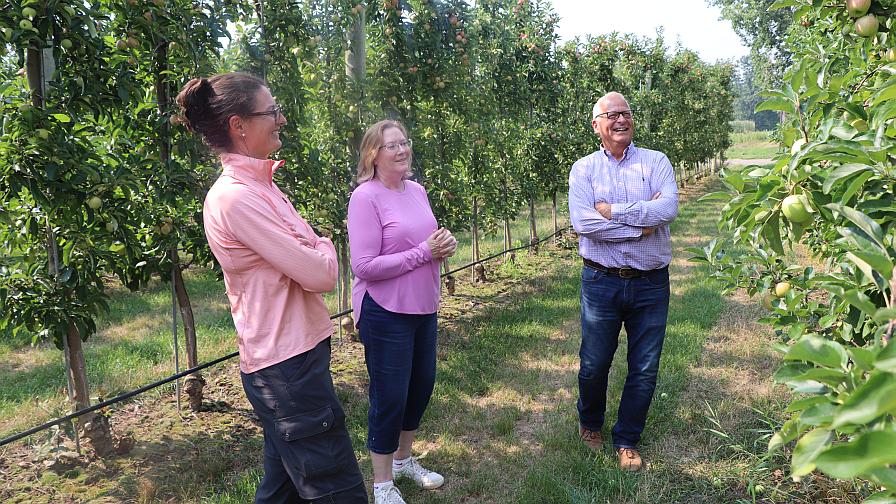
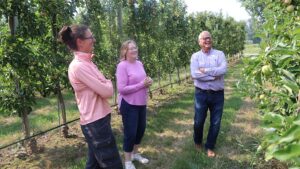
Mentoring young growers comes inherently to Engelsma, relation or not. His networking circle as a specialty crop consultant with Nutrien Ag Solutions continually expands from one Fruit Ridge orchard to another. He might miss being on his own farm were it not for his daily visits and interactions with other growers.
“My experiences on my own farm have really lent toward helping growers get better on their own farms,” Engelsma says. “That gives me a lot of joy to see a grower who might be afraid of moving in a direction and to see them take baby steps and move all the way into that high-density mindset.”
Forty-plus years ago, that same reluctant young grower was Jim Engelsma. Inspired himself by a pioneer, he found his destiny in high-density, and all was good with the apple industry in Michigan.
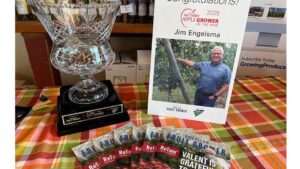
Jim Engelsma will formally receive the 2025 Apple Grower of the Year Award, sponsored by Valent U.S.A., this fall at a celebration in the Grand Rapids area.
Subscribe Today For