

Spotted Lanternfly Update: The Good, Bad, and the Bugly
 September 30, 2025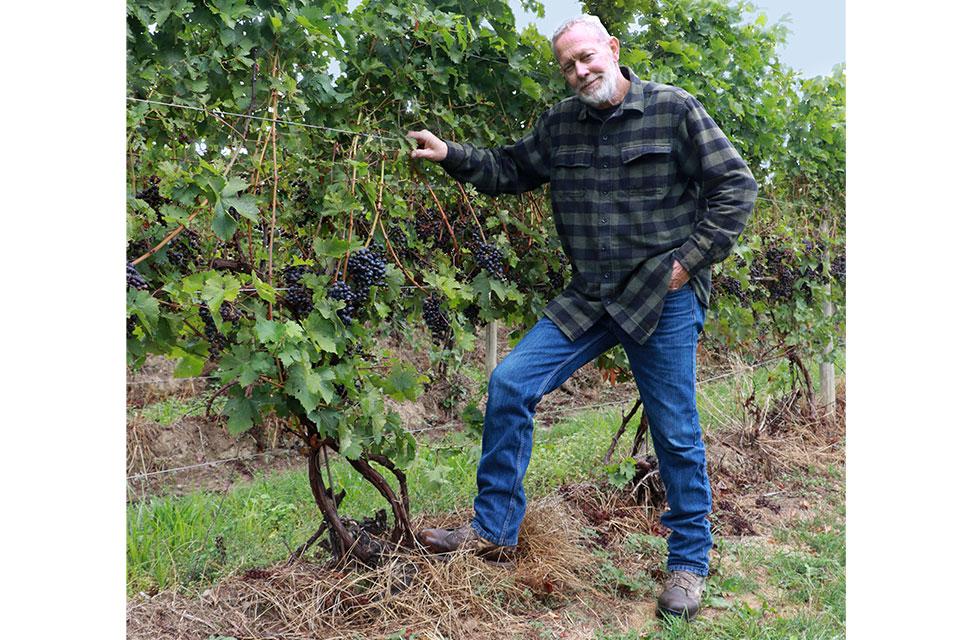
Now in his 32nd year, vineyard manager Gene Sigel oversees 160 acres at Debonné Vineyards and another 50 at his own winery, South River Vineyard (shown here).
Photo by Thomas Skernivitz
Typically, no news is good news with agricultural pests. With spotted lanternfly, U.S. grape growers are OK if the bug du jour remains in the headlines, as long as it stays out of their vineyards.
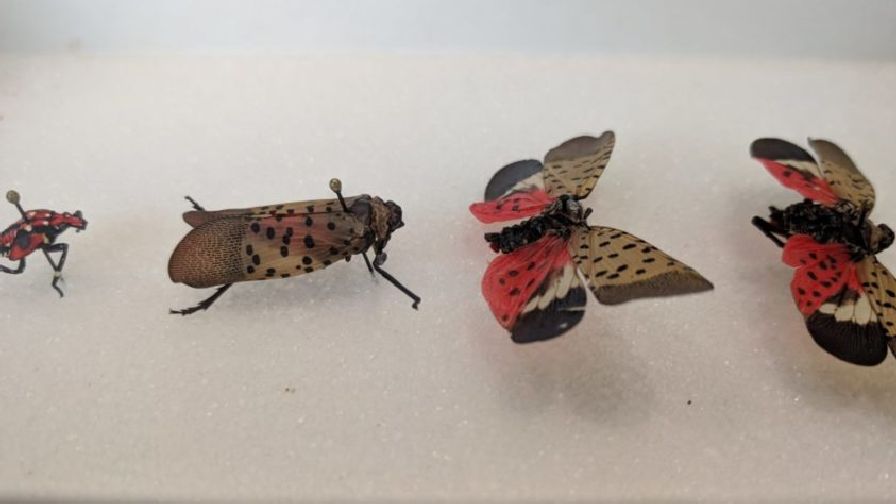
View all
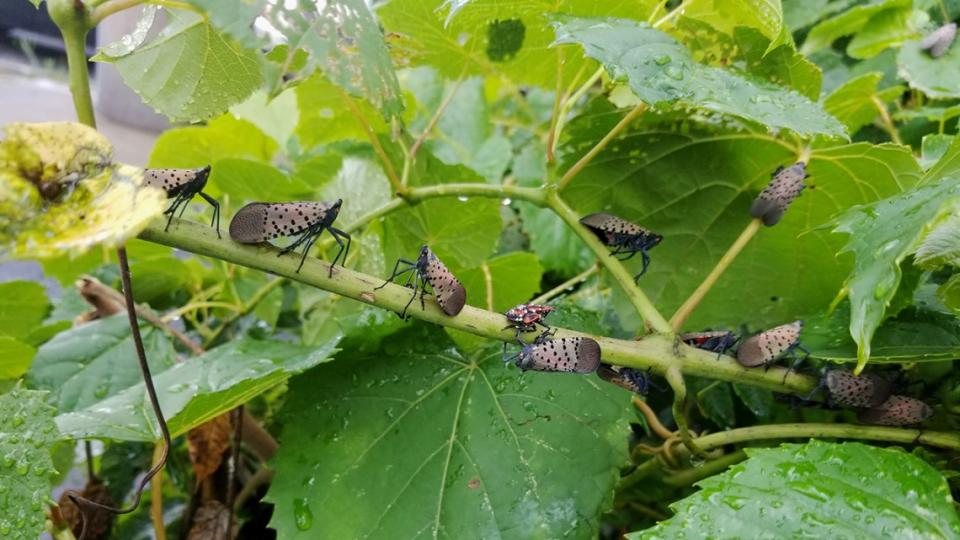
Excluding, maybe, the “murder hornet” (which USDA declared eradicated in the U.S. last December), no insect in recent memory has grabbed the attention of the mainstream media like spotted lanternfly (SLF) has the last five years.
The New Yorker declared 2022 to be “The Year of the Spotted Lanternfly.” The New York Times has written about the insect dozens of times, most recently the July 2 op/ed, “A Plague of Pests Is Coming for California. Here’s How to Stop It.”
Gene Sigel is too busy to notice such articles. But as the vineyard manager of Ohio’s largest estate winery, Debonné Vineyards, and the owner of South River Vineyard, he is anything but oblivious to SLF.
“What we grow here is grapes, and we sell wine. With a pest like this, we take it very seriously, the health of our vineyards and everything,” Sigel says. “There is no specific predator for this, and spraying chemicals really is not a viable long-term solution throughout a whole giant grape-growing region in the way they are suggesting to get it under control. So, there really is no specific answer.”
Whether grape growers will ever need such an answer is a question itself. For all of the banner news about SLF, the coverage rarely cites resulting crop damage — at least, not since the original outbreak of SLF in southeastern Pennsylvania in 2014.
“Something is causing these invasive pests not to be spiking,” Sigel says. “When you look at all the curves from each state, they tend to jump, and then they flatten.”
RUDE AWAKENING
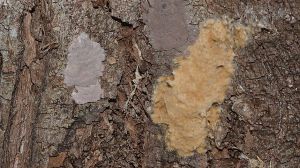
Sigel remembers being “horrified” upon first hearing about SLF at the Eastern Winery Exposition a year or two after the first U.S. infestation had been officially identified in September of 2014 in a wooded area of Berks County, PA, northwest of Philadelphia. The invasive planthopper from Asia had likely arrived in 2012 as egg masses attached to a shipment of stone.
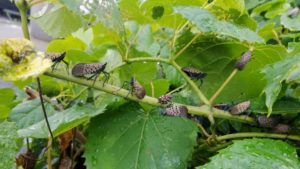
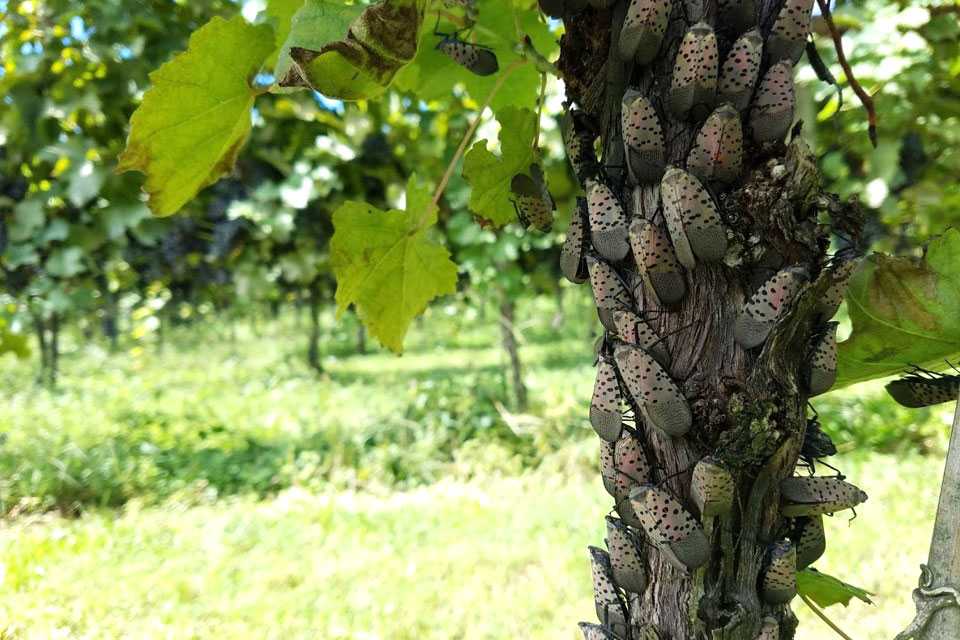
“When I went to the meeting, it was like something out of Alfred Hitchcock’s ‘The Birds,’ in terms of seeing these slides with vines just covered and coated with lanternflies,” Sigel says. “It was very startling to think, ‘Well, this is the next outbreak that’s coming.”
By 2019, Penn State University had estimated annual statewide costs of the original SLF infestation to be $99 million in agricultural losses and $236 million to the forestry industry.
The pandemic then came and went, and Sigel began attending fruit trade shows once again, in this case the 2023 Ontario Fruit and Vegetable Conference, where SLF was the subject of several presentations.
“Nobody really said, ‘Yeah, Joe down the road had 20 acres lost to it,’ and yet they were really worried,” Sigel says. “There was a quarantine on the border. They had a picture of dead lanternflies that had been shrink-wrapped onto the pallets coming in from the U.S. We talked about insecticide regimes: When you should spray them. Or, if you find spotted lanternfly in the vineyard, then you’re going to have to spray a lot more through harvest and even after harvest to try to get them under control before winter.”
But, according to Sigel, who admits it may be due to his own ignorance, “I haven’t really encountered any grower that’s been in that situation.”
Not yet, at least. Himself included.
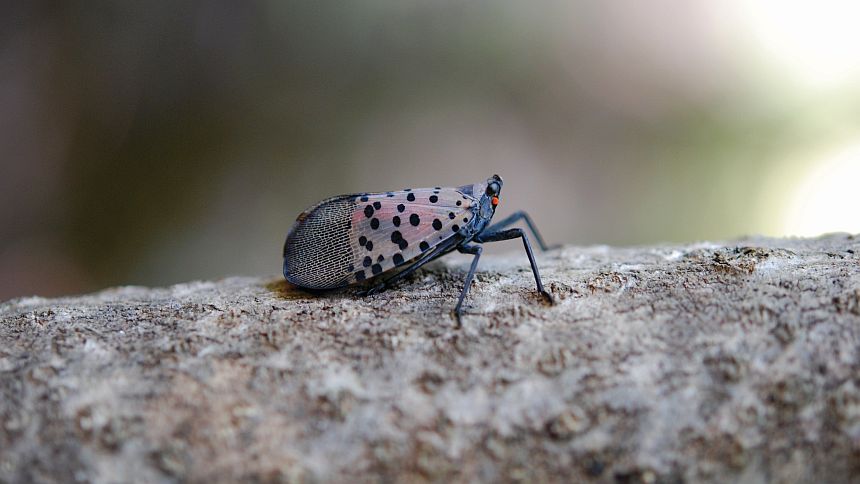
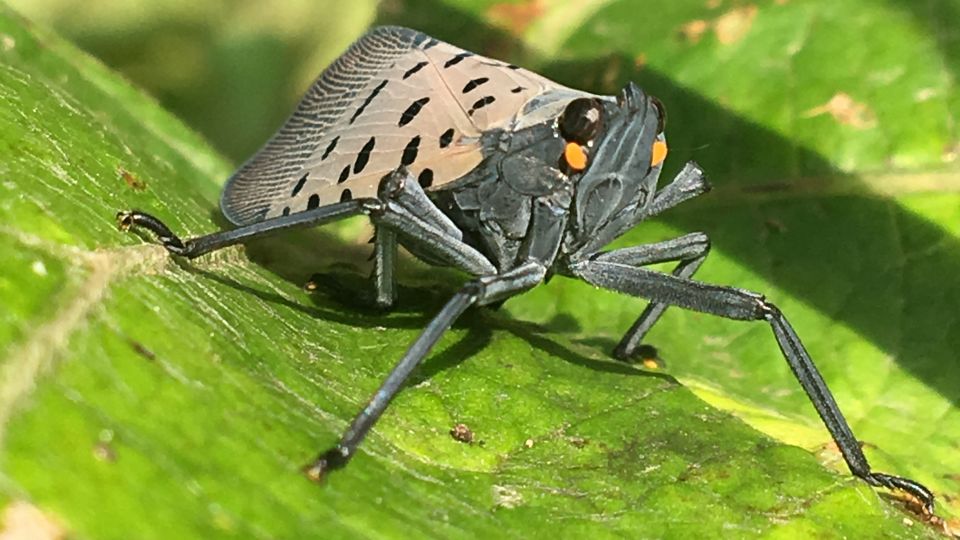
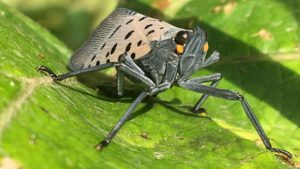
Adult spotted lanternfly. (Photo credit: Dana Rhodes Pennsylvania Department of Agriculture)
FALSE ALARM
While SLF has made its presence known this year in northeast Ohio like never before, Sigel and his peers in Lake and Ashtabula counties still have not witnessed the insect in their vineyards. Neither county, situated along Lake Erie between Cleveland and the Pennsylvania border, is one of the 18 in Ohio under state-imposed quarantine.
Nevertheless, Sigel nervously entered this season after the 2024 discovery of SLF DNA in tree canopies adjacent to nearby vineyards and their parking lots. Researchers from Ohio State University had visited the area several times during the growing season and used “these big paint rollers with a nappy heads on them,” he says, to collect environmental DNA for monitoring purposes.
“They went through garbage bags full of these paint rollers, and in the spring (Ohio State) got in touch and said, ‘You know, we found some positive DNA smears on those rollers’ — not in the vineyards but along the woods on the tree canopies that they were indexing along the parking lot perimeters of the wineries.
“That was last year, so I guess I expected, ‘Well, it’s probably going to hit this year,’” Sigel says. “For a number of years, I’ve kept thinking, ‘When this hits, that’s it. Are we going to keep growing grapes? I don’t know.’ But this year I came to the reality that we aren’t seeing (spotted lanternfly). … We all talk directly to the (Ohio) Dept. of Agriculture and the Ohio Wine Producers Association, so when something happens to one of us, it’s immediately spread to everybody. But, no, nobody in Ohio.”
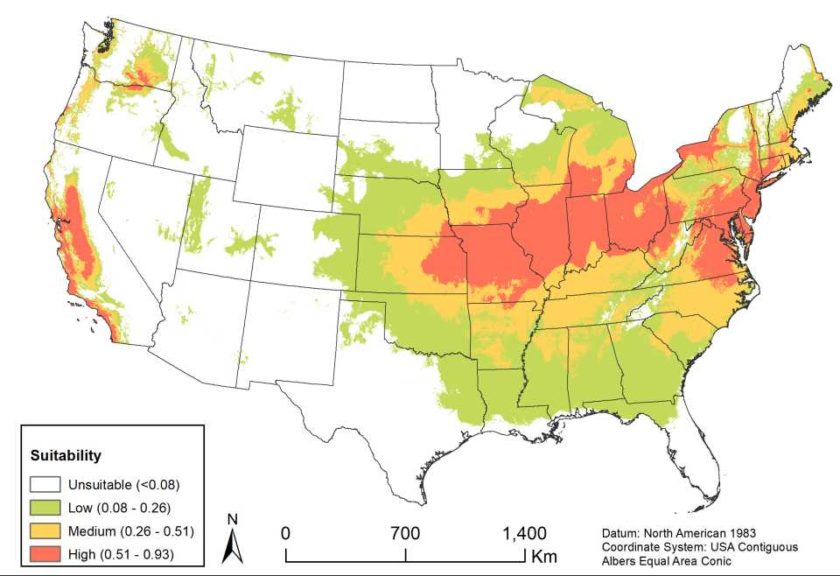
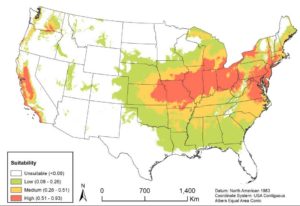
Nonetheless, the insect, as of August, has been detected in 21 states — all east of the Mississippi River — and the District of Columbia. The potential for a 2014 repeat is everpresent.
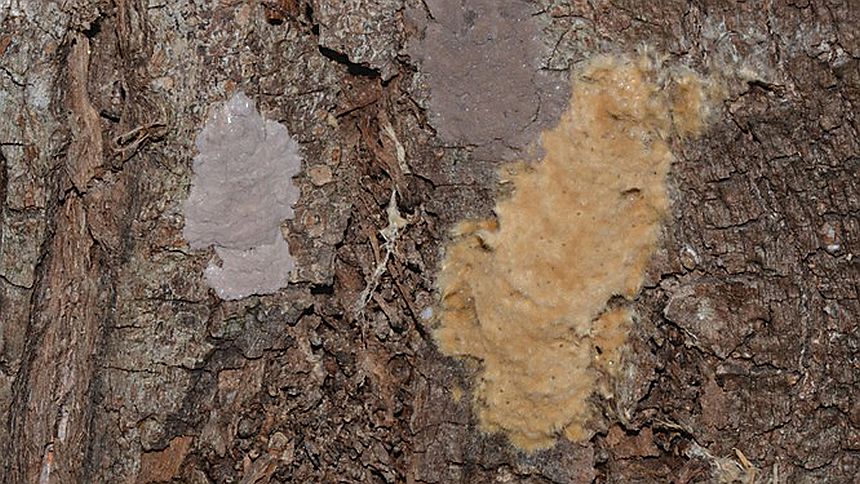
“They definitely are entrenched in urban areas, whether it’s Cleveland or New York City,” Sigel says. “It’s made me realize that what happened in Berks County in 2014 was unique. It was a barge of gravel ballast — at least that’s what the guy said — and it had masses of eggs. It wasn’t live insects moving en masse. It was an unknown quantity of egg masses that had been laid in the gravel. It created the conditions for a tremendous outburst. We don’t know how many eggs were there, but it could have been a lot in one concentrated area. Are we having that kind of egg massing now? Had it been some other planting and density, the whole story may have been different, but because it encountered a vineyard with its first immediate effect, that’s what was documented.”
In a September 2021 story on SLF, published by Farm and Dairy magazine, Sigel was quoted as saying: “I don’t know how this is going to work out. We have not seen it here, but it’s starting to almost surround us. There’s really nothing we can do particularly. It’s sort of like watching a train wreck at slow speeds.”
What are his sentiments four years later? “Nothing has changed at all about that,” he says. “If anything, the train has slowed down.”
Still, Sigel remains vigilant.
“We’re not cavalier about it or thinking, ‘Well, it’s not going to happen.’ We’re just not seeing the kind of massing in the vineyard areas that might be expected if this was really a heavy presence,” Sigel says. “If you’re old enough to remember ‘Sanford and Son,’ Fred Sanford is always going to have that ‘big one.’ It’s kind of like Fred Sanford’s heart attack. It just hasn’t happened yet.”
Subscribe Today For