



Smart Tech
What’s Trending in the Next Wave of Farm Robotics
 December 15, 2025
As labor shortages persist and production costs climb, automation is no longer a futuristic concept; it is a working solution. That message came through clearly at FIRA USA 2025, held recently in Woodland, CA, where growers, manufacturers, and ag tech innovators gathered to see the latest farm robotics and autonomous systems operating in real-world conditions. FIRA stands for International Forum for Agricultural Robotics.
The 4th annual event brought together more than 80 exhibitors and thousands of participants, highlighting how quickly automation has moved from prototype to practice across specialty crops. Here are five ag tech trends I noticed.
Trend #1: Autonomous Machinery Moves into Production
A defining takeaway from this year’s event was that autonomy has entered the production phase.
John Deere’s 5ML Autonomous Orchard Tractor, making its first live agricultural trade show debut, drew significant attention for its autonomous navigation and precision air-blast spraying. Paired with the Smart Apply Intelligent Spray Control System, the tractor demonstrated how machine learning and LiDAR-based canopy sensing can reduce water and chemical use by up to 50% while maintaining spray accuracy and improving sustainability outcomes. John Deere also highlighted its GUSS lineup of autonomous sprayers, managed by a single operator overseeing multiple machines simultaneously.
New Holland reinforced the shift toward fully integrated autonomy, showcasing its Precision Fan Sprayer and guidance systems for the T4.120F specialty tractor. These demonstrations signaled that major equipment manufacturers are transitioning from incremental upgrades to comprehensive automation ecosystems, designed to deliver measurable efficiency in orchards and vineyards.
Industry attendees noted that autonomous machines are now being tested under real production conditions and proving reliable. Many agreed that “automation is not just an option anymore; it’s an operational tool that’s here to stay.”
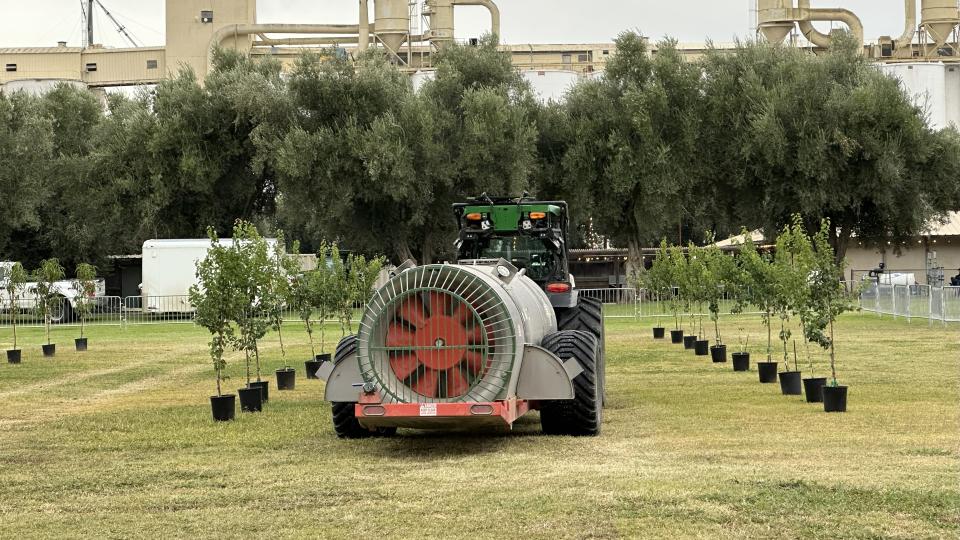
John Deere air-blast sprayer demo at FIRA USA 2025.
Photo by Melinda Taschetta-Millane
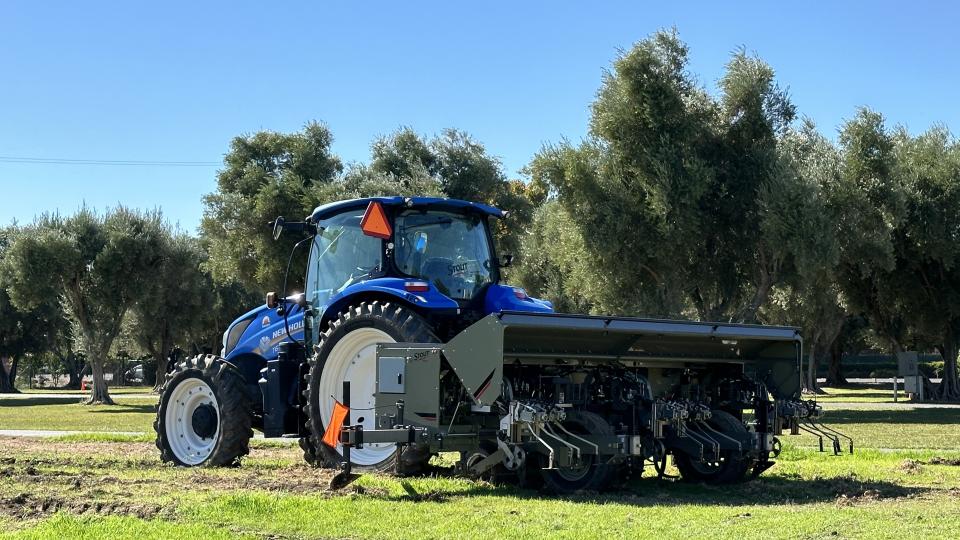
New Holland highlighted a T4.120F specialty tractor with a precision sprayer and the XPower XPR concept electric weeder.
Photo by Melinda Taschetta-Millane
Trend #2: Smarter, Scalable Robotics
For smaller and mid-sized operations, scalability and ROI are central concerns, and FIRA 2025 reflected that reality.
Bonsai Robotics, following its acquisition of Farm-NG, presented expanded capabilities in orchard and vineyard automation. Companies such as LJ Tech and Autogenbot showcased autonomous sprayers with shorter payback periods, while FJDynamics introduced new autosteer kits and sprayer controllers that simplify retrofitting for existing fleets.
Emerging AI-driven firms like NIQO Robotics and Tensorfield Agriculture displayed precision weeding and targeted spraying systems capable of identifying and treating individual plants. This new wave of robotic tools is built around modularity and data integration, making it easier for growers to adapt the technology across multiple crops and production systems.
Another highlight came from Ecorobotix, whose ARA precision sprayer uses high-resolution cameras and AI-driven weed recognition to deliver sub-inch accuracy in herbicide application. Designed for flexibility across row crops, orchards, and vineyards, the system can reduce chemical use by as much as 95% while maintaining treatment efficacy. Its modular design and data collection capabilities align closely with growers’ increasing focus on sustainability and traceability.
Growers who attended the demos remarked that having “systems that scale to smaller acreages or diversified farms” represents a major step forward in accessibility and cost-effectiveness.
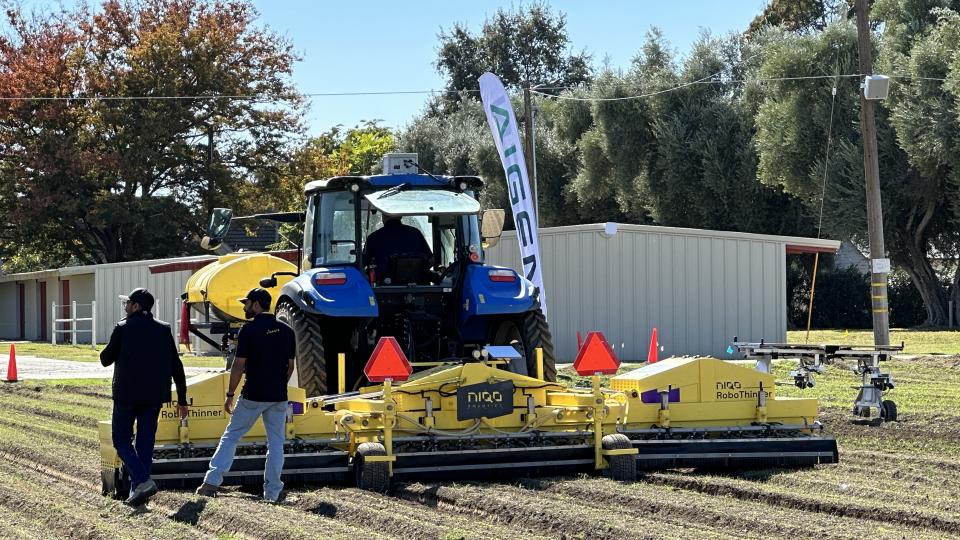
The Niqo Robo Thinner in action at FIRA USA 2025.
Photo by Melinda Taschetta-Millane
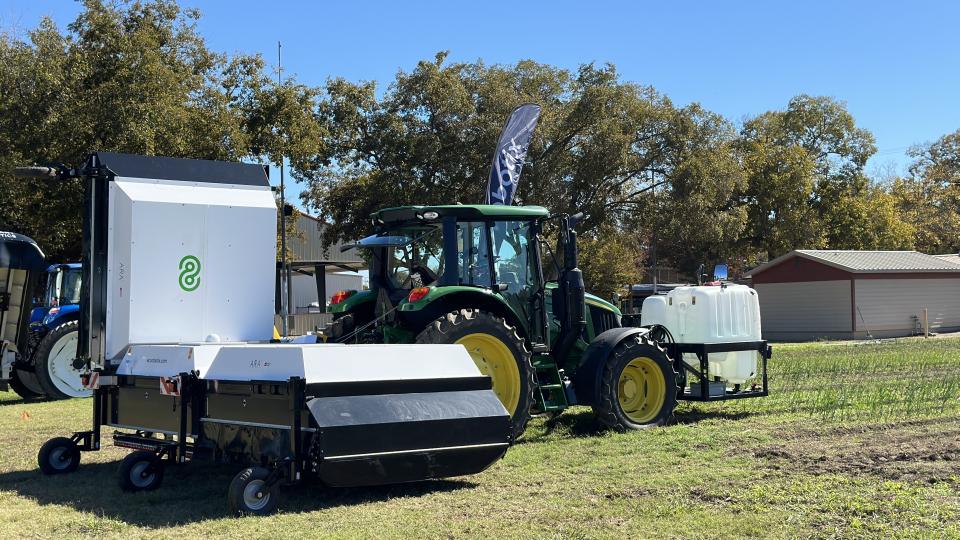
Originally founded a decade ago to develop autonomous sprayers, EcoRobotix pivoted to tractor-compatible systems that integrate easily into existing farm operations. Shown here is the ARA.
Photo by Melinda Taschetta-Millane
Trend #3: Field-Ready Demos and Real-World Validation
The hallmark of FIRA — its live field demonstrations — expanded in 2025 to include cotton and tomato plots alongside orchard, vineyard, and vegetable systems. The broader crop mix allowed growers to evaluate automation under different canopy structures, soil types, and crop cycles.
In orchard settings, John Deere, GUSS, Bonsai Robotics, and Agtonomy demonstrated mowing, spraying, and mapping functions with impressive precision. Vineyard demos by Burro and MQ Autonomous Agritech showcased advancements in fleet coordination and obstacle detection.
The vegetable and open-field demonstrations highlighted solutions from Verdant Robotics, Solinftec, and Stout Industrial Technology, emphasizing how artificial intelligence is improving in-field decision-making. These demos helped confirm that many of today’s autonomous platforms are ready for commercial deployment, not just pilot testing.
Several growers noted that “seeing machines run in real field conditions, not just videos or prototypes, makes a huge difference in evaluating what’s ready to bring home.”
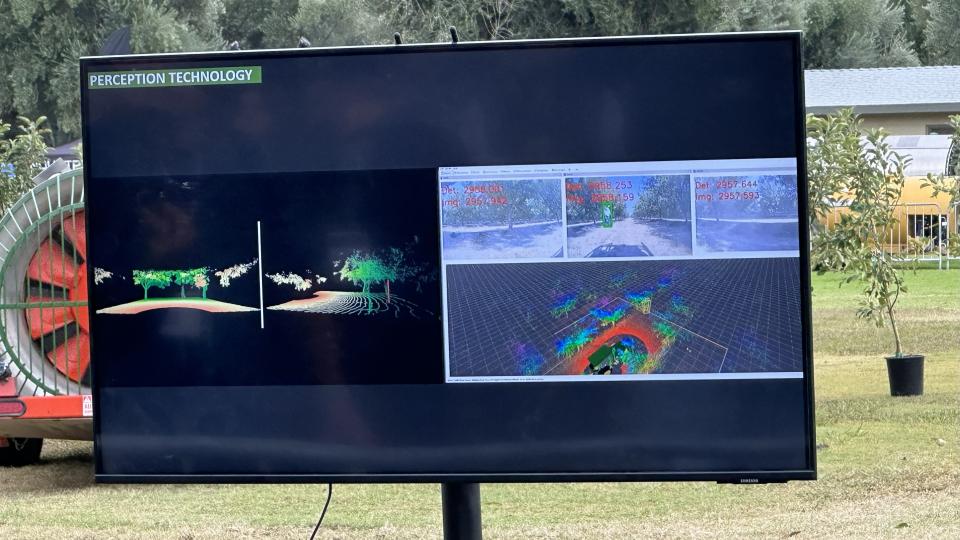
Using perception technology, this field is mapped with an autonomy-capable boundary and a headland boundary.
Photo by Melinda Taschetta-Millane
Trend #4: Collaboration Fuels Innovation
Two major announcements underscored the growing emphasis on collaboration across California’s ag tech ecosystem.
The California AgTech Alliance officially launched during the event, supported by a $15 million state investment. Led by the California Department of Food and Agriculture (CDFA) in partnership with UC Agriculture and Natural Resources and Western Growers, the Alliance aims to accelerate adoption of climate-smart and automation technologies through regional innovation hubs and workforce training.
In another development, RESERVOIR Farms introduced RESERVOIR St., a private investment marketplace connecting ag tech startups with capital partners, and RESERVOIR Jobs, a recruitment platform dedicated to the automation workforce. The initiative was described by organizers as a “collaborative village” designed to connect innovators, growers, and investors on active working farms.
Observers agreed that these partnerships mark an important step toward building the infrastructure needed for sustainable technology adoption, not just product innovation.
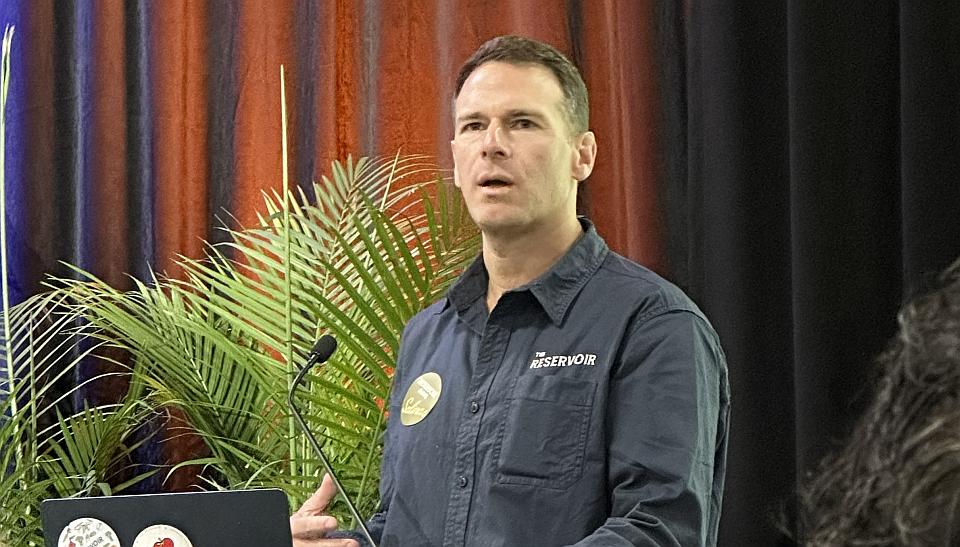
Danny Bernstein, CEO and Managing Partner at The Reservoir, discussed the progress and vision of Reservoir Farms, an ag tech incubator focused on specialty crops.
Photo by Melinda Taschetta-Millane
Trend #5: From Pilots to Production
Perhaps the strongest signal from FIRA 2025 was the widespread shift from pilot projects to full-scale commercial use.
Companies like Agtonomy demonstrated how embedded AI and remote fleet management can enable autonomy through trusted OEM platforms such as Kubota and Solinftec’s Solix Robotics system, now featuring Starlink connectivity and “Discovery Mode” navigation, illustrated how communication and intelligence are converging to deliver truly autonomous, connected fleets.
Several presenters emphasized that growers are no longer being asked to “try” automation; they are being offered turnkey systems that deliver value immediately. Attendees echoed that sentiment, noting that the conversation has shifted from if to how fast automation can scale across the industry.
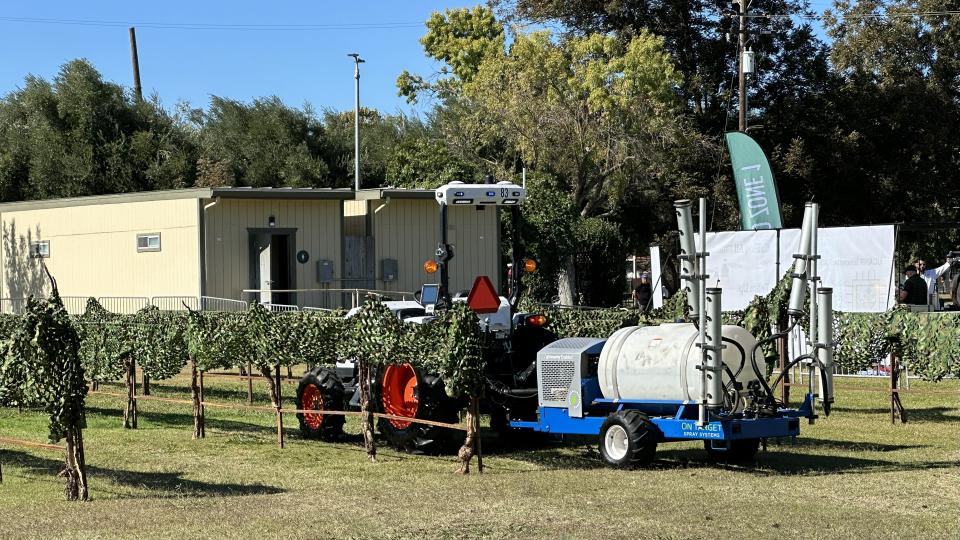
OnTarget electrostatic sprayer attached to a tractor in a simulated vineyard. OnTarget electrostatic sprayer technology is designed to provide better coverage and reduce the amount of water and chemicals needed.
Photo by Melinda Taschetta-Millane
FIRA USA 2025 confirmed that agricultural automation has entered a new era, one that is practical, connected, and grower driven.
Across all sectors, from fruit and nut orchards to vineyards and vegetable fields, this year’s innovations reflected a maturing market focused on operational efficiency and environmental sustainability. The message was consistent: automation is not about replacing people; it is about empowering them with better tools and data to make smarter, more efficient decisions.
For growers and operations managers, the takeaway was clear: The future of farming is not years away; it is already running in the rows.
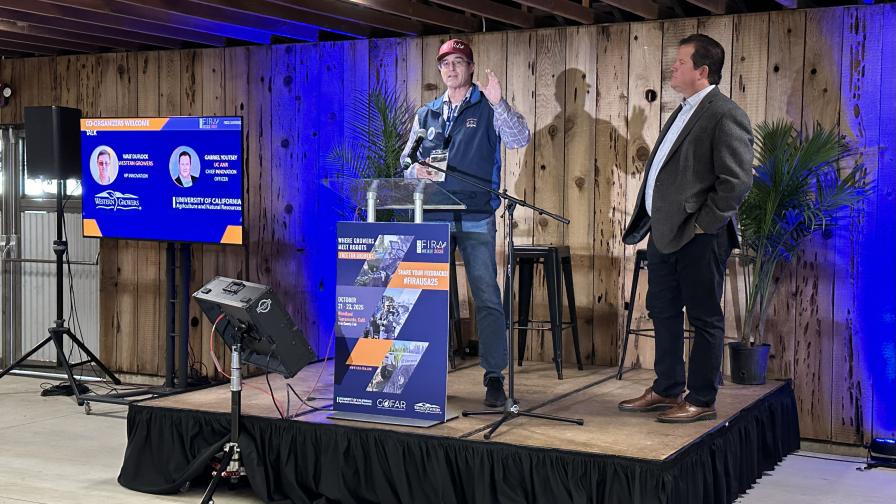
Walt Duflock of Western Growers and Gabe Youtsey, Chief Innovation Officer at UC Agriculture and Natural Resources (UC ANR), welcomed attendees of FIRA USA 2025 and emphasized California’s pivotal role in advancing ag robotics and ag tech adoption.
Photo by Melinda Taschetta-Millane
The Human Side of Automation
At FIRA USA 2025, one message echoed through every session: the future of farm automation depends as much on people as on machines.
“Growers are the ultimate innovators,” said Walt Duflock, Vice President of Innovation at Western Growers. “They’re willing to adopt new tools when it solves a real problem in the field, but the technology has to work, it has to pencil out, and it has to fit into existing operations.”
For Gabe Youtsey, Chief Innovation Officer at UC Agriculture and Natural Resources (UC ANR), collaboration is key. “We cannot advance automation in isolation. It takes universities, startups, and growers working together — testing, validating, and training the next generation of the ag workforce.”
Speakers across multiple panels reinforced that human-centered design will determine how quickly robotics scale in specialty crops. “It’s not about replacing people,” one panelist noted. “It’s about giving them better tools — and better opportunities — to keep our farms viable.”
As growers and innovators left FIRA USA to return to their own fields, that theme lingered: automation may be powered by AI, but its success will always depend on human insight and collaboration.

For more Smart Tech topics, click here.
Subscribe Today For
