



How a Soil Nitrate Quick Test Can Save on Fertilizer Costs
 April 8, 2026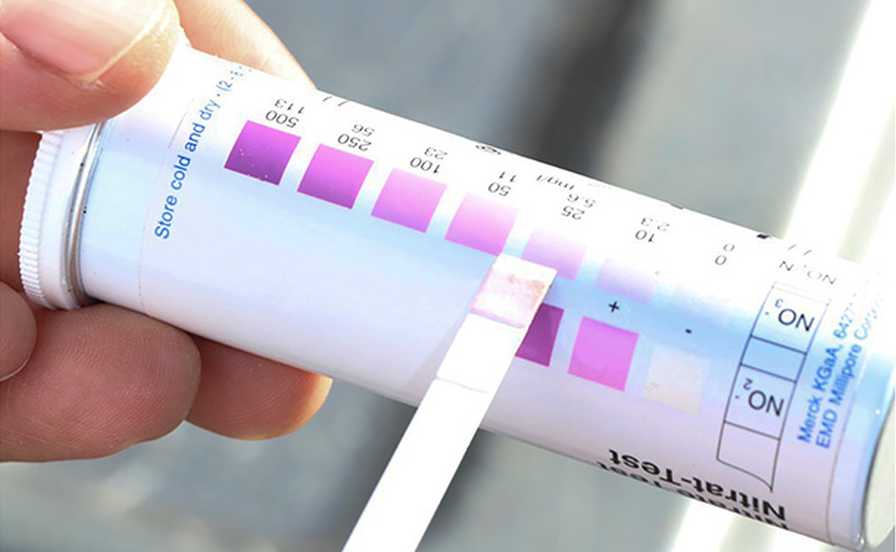
The soil nitrate quick test can be used to determine if nitrogen fertilizer is needed. he test strips can be used to measure the concentration of nitrate in soil by dipping the strip into the soil extract and comparing the strip color with the pallet key on the side of the container.
Photo by Michael Cahn
The growing season has started with a spike in nitrogen fertilizer prices, now higher than last year and the highest since 2022. Although nitrogen fertilizer represents a relatively small share of total vegetable production costs, avoiding unnecessary applications can reduce expenses and help protect water quality by minimizing nitrate losses to ground and surface water.
Often after the first crop of the season, sufficient nitrogen remains in the soil and irrigation water to reduce fertilizer needs for a second crop. One of the most effective tools for managing nitrogen more efficiently is nitrate-sensitive test strips. These strips can be used to estimate plant-available nitrogen in soil and measure nitrate concentration in irrigation water. Both can supply nitrogen that substitutes for a portion of fertilizer applications.
Another advantage of the quick test is speed. Results are available the same day, whether the test is conducted in the field or shortly after returning to the office. This allows timely decisions on fertilizer applications without waiting for laboratory analysis.
Measuring Nitrate in Soil
Several instructional bulletins and online videos explain how to conduct the soil nitrate quick test using nitrate test strips. I recommend reviewing the materials provided by the California Department of Food and Agriculture Fertilizer Research and Education Program (CDFA FREP).
The basic procedure involves:
- Collecting a representative soil sample
- Adding a measured volume of soil to a centrifuge tube containing a weak calcium chloride extractant at a 1:3 ratio
- Shaking the capped tube thoroughly and allowing soil particles to settle
- Dipping the test strip into the clear supernatant and comparing the color to the reference chart after the recommended reaction time
The resulting value must then be converted to pounds of nitrogen per acre using standard conversion factors. Detailed instructions, including materials, procedures, and conversion tables, are available in the online resources referenced above.
Although the procedure is straightforward, attention to a few details will improve accuracy.
Collect Representative Soil Samples
Use a sturdy probe to collect soil cores and combine samples from 10 to 12 locations within a field. Sampling only a few spots can bias results. Following a “W” or diagonal pattern across the field helps ensure a representative sample.
Sample depths should reflect the crop’s rooting zone. For young crops, sample the top 12 inches. For more mature crops, sample both the 0–12-inch and 12–24-inch depths. Discard the surface inch, where nitrate can accumulate due to evaporation and may not reflect the overall profile. Avoid sampling near fertilizer bands.
Handle Samples Carefully
If samples are not analyzed immediately, place them in sealed bags and keep them cool to prevent moisture loss and changes in nitrate concentration.
Combine cores thoroughly before subsampling. For loam and sandy soils, passing soil through a 2- to 4-millimeter sieve works well. For heavier soils, mixing small portions from multiple cores can provide a representative sample.
Use Proper Technique
Maintain the correct soil-to-extractant ratio (1:3). Using 50 mL centrifuge tubes marked in increments can help ensure consistency.
After dipping the strip, read it at the specified development time, typically 30 or 60 seconds. Reading too early or too late can lead to inaccurate results.
Store test strips in a cool environment, preferably refrigerated, and transport them in a cooler when working in the field. Periodically check strip accuracy using standard nitrate solutions.
Measuring Nitrate in Irrigation Water
The same strips can be used to measure nitrate concentration in irrigation water. Dip the strip into the sample, shake off excess water, and read it after the recommended development time.
If the strip is calibrated in ppm nitrate (NO₃), divide the value by 4.43 to convert to ppm nitrate-N.
To estimate how much nitrogen is applied through irrigation, use the following equation:
lbs N/acre = ppm nitrate-N × inches of water applied × 0.227
For example, applying 2 inches of water with a nitrate-N concentration of 20 ppm provides approximately 9 pounds of nitrogen per acre:
20 × 2 × 0.227 = 9.1 lbs N/acre
Not all applied water remains in the root zone, so some nitrogen may be lost through drainage. A practical approach is to estimate the portion of irrigation water that meets crop evapotranspiration needs between fertilizer applications and credit only that fraction as plant-available nitrogen.
Interpreting Results
Once soil and water nitrate levels are known, the next step is determining how much fertilizer to apply. Crop growth stage is an important factor. During early growth, most vegetable crops take up less than 30 pounds of nitrogen per acre. Later in the season, uptake can reach 3 to 5 pounds per acre per day. Under weekly fertigation, this may translate to 20 to 35 pounds per acre per week during peak growth.
Another key decision is how much of the measured soil nitrogen to credit. Because some nitrogen may be lost to leaching and a baseline concentration is needed to sustain growth, it is often advisable to credit only a portion.
For example, a soil nitrate concentration of 20 ppm nitrate-N is roughly equivalent to 70 to 80 pounds of nitrogen per acre in the top foot of soil. Crediting half of that amount suggests that 35 to 40 pounds per acre could substitute for fertilizer nitrogen.
Conclusion
By estimating how much nitrogen is already available in the soil and supplied through irrigation water, growers can make more informed fertilizer decisions. In many cases, this approach can significantly reduce unnecessary nitrogen applications.
Across multiple fields, these adjustments can add up to meaningful cost savings over the season while also reducing environmental impact.
Subscribe Today For
