


Biofertilizers 101: What Fruit Growers Need To Know
 May 30, 2026
 Biofertilizers that combine modern approaches — such as upcycled amino acid nutrients and proteins, natural polymers, precision chemistry, and digital analytics — will define the next decade of crop nutrition, according to Trey Cutts, Vice President of Commercial Agriculture Science with Tidal Grow AgriScience.
“The next frontier isn’t just ‘biologicals vs. synthetics’ — it’s integrated nutrient intelligence,” he says. “We’re focused on making these innovations measurable, scalable, and agronomically trusted across global production systems.”
Kelly Tanaka, Chief Science Officer with HGS BioScience, assigns responsibility to academics and industry leaders to continue to improve products in the biofertilizer space and educate growers as the market evolves.
“Biofertilizers,” he says, “are an exciting and growing segment of agriculture that will continue to become more relevant.”
Representatives of eight crop nutrition manufacturers — Alltech Crop Science, BioWorks, HGS BioScience (formerly NutriAg), Kemin Crop Technologies (now part of AgroPlantae Inc.), Microbial Science Laboratories, Nutrient TECH, Redox Bio-Nutrients, and Tidal Grow AgriScience — provide a detailed look at the current state of biofertilizers:
There is no official definition of biofertilizer. What definition, if any, do you relay to grower-customers?
Tanaka (HGS BioScience): “Great question. I believe the definition is open to evolve over time, but I have always considered biofertilizers as microbial-based products that help crops grow through a number of different mechanisms. A few key ways are nitrogen (N) fixation, nutrient-use efficiency, and abiotic stress mitigation.”

Kevin Johnson
Kevin Johnson (Owner, Microbial Science Laboratories): “I would say a biofertilizer is a fertilizer which contains beneficial soil microbes.”
Where are we at in terms of growers understanding the differences between biofertilizers, biostimulants, and organic fertilizers?
Tanaka (HGS): “Growers have an accelerated and better understanding of the overall ‘biological’ segment than we may give them credit for. They may not think about the products in specific categories, but over time that will happen. The lack of clear definitions is a contributing factor. Until biofertilizers, biostimulants, and organic fertilizers are well defined at the regulatory level, it will be difficult to have a concise message to the grower. However, growers do have a strong appetite for products that address soil health, plant health, and efficiency/fertilizer utilization. They know that to get to the next level of yield, products that improve soils, improve plant health, and stimulate better nutrient-use efficiency are the keys to unlocking greater returns compared to traditional methods.”
Steven Borst (Vice President, Alltech Crop Science): “As far as biological technologies being incorporated, there is a large group of producers that are utilizing those more and more, so it is a growing segment. We don’t get a question of, ‘OK, where does this classification fit in? The question we get is, ‘We have this problem, do you have an answer or a solution for this problem? That’s how we dictate which technology we’re going to use, when we’re going to use it. It is a very solution-driven process.”
How do you clarify when confusion arises?

Trey Cutts
Cutts (Tidal Grow): “When confusion arises, we start with the agronomic function — what the product does in the soil or plant. We use side-by-side trials, nutrient-use efficiency data, and soil health metrics to quantify differences in outcomes. Grounding the discussion in measurable outcomes, rather than marketing language, helps the various product concepts click for growers and advisors alike.”
Bridget Hatfield (Technical Services Manager, AgroPlantae Inc.): “When confusion arises, I have a face-to-face or phone call conversation to understand the basis of the confusion and then answer the grower’s questions honestly and with data.”
If a grower could pick only one of the three, which would you recommend — and why?

Bridget Hatfield
Hatfield (AgroPlantae): “The three categories have very different purposes! Ultimately, growers need to make sure that their crops have the appropriate nutrition available either in the soil or via foliar applications and should make their fertilizer choice based on what an individual product is providing (i.e., N, micronutrients, etc.). Biostimulants tend to be value added but can often lead to improved root development, allowing better access to existing nutrients and water in the soil. Growers should choose their products based on their needs and budget.”
Mark Freeman (Technical Services Manager for Plant Nutrition, BioWorks): “Biostimulants cause the least confusion when growers evaluate the value these products offer. Although many have nutrient value, too, the plant responses can be more easily measured and investments justified.”
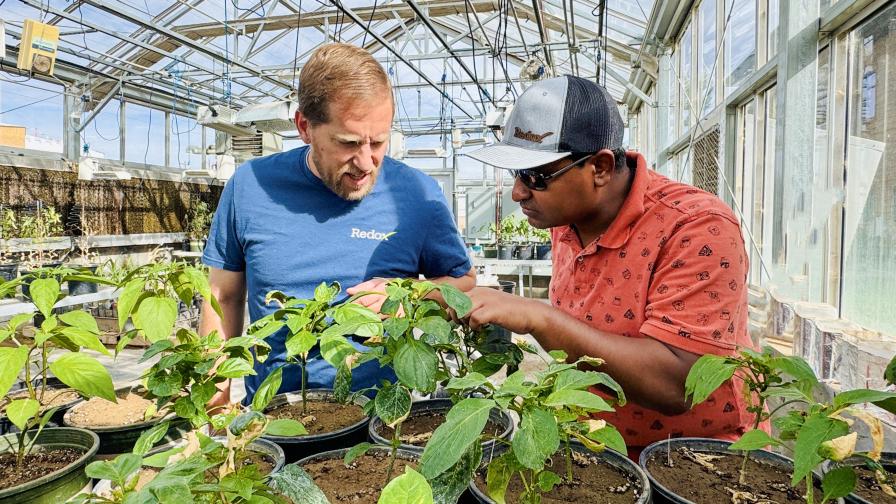
Redox Bio-Nutrients researchers Gifford Gillette (left) and Debatosh Das.
Photo: Redox Bio-Nutrients
Gifford Gillette and Debatosh Das (Lead Researchers, Redox Bio-Nutrients): “The most broadly effective and practical choice in modern production systems would be biostimulants layered into bio-nutrient platforms. Most growers we work with strive to manage nutrients efficiently and understand the value of organic matter and native microbial activity. Choosing biostimulant-driven bio-nutrients provides the greatest return because they influence how effectively plants take up, move, and use nutrients all season. In other words, they amplify the performance of what a grower is already doing. This makes them the most reliable single choice across diverse growing environments.”
How frequently do growers integrate two or all three of these products?

Mark Freeman
Freeman (BioWorks): “It is rare to find a grower that is not using at least two of these product groups. Many use organic nutrient sources for soil management/improvements as a standard practice.”
Tanaka (HGS): “Organic growers are more likely to integrate all three product types, but conventional growers are more likely to use one or two types. However, this is changing quickly, too.”
Cutts (Tidal Grow): “We see a growing number of progressive operations layering all three — an organic base for soil carbon, a biofertilizer for nutrient efficiency, and a biostimulant for stress resilience. On high-value specialty crops and irrigated row crops, this combination is becoming more broadly adopted. Integration often follows proof from side-by-side field trials showing ROI and yield consistency.”
Cameron Gerecke (Product Development Specialist, Nutrient TECH): “It is a challenge to get growers to use more than one of these products unless they are a committed organic producer. The greatest success that I have had with growers using both a biofertilizer and a biostimulant is with regenerative wine grape growers. Organic growers will often use an organic fertilizer and an organic biostimulant.”
To what degree are these products replacing synthetic inputs?
Cutts (Tidal Grow): “Most growers are pursuing partial substitution, not full replacement. Typically, biofertilizers replace 15-30% of synthetic N or phosphorus inputs, depending on soil health and crop demand. The key is precision — maintaining yield while reducing input intensity and improving nutrient recovery efficiency.”

Kelly Tanaka
Tanaka (HGS): “In the organic fruit and nut crop acres, there is better adoption since those growers don’t have the same synthetic input options. There has been significant adoption as regulations mandate. For the conventional acre, the focus is more about supplement rather than replacement except for those using nitrogen-fixing bacteria, where the amount of applied conventional N would be decreased.”
Freeman (BioWorks): “The only growers totally replacing synthetic inputs are the organic-certified operations. Most are finding economic reasons to reduce synthetic inputs based upon nutrient-use efficiencies that are realized and reduction of pest control inputs due to increased plant health.”
Gerecke (Nutrient TECH): “Biostimulants are best suited to compliment synthetic inputs rather than replace synthetic inputs. Biofertilizers can replace synthetic inputs, but calculating the number of units replaced can be complicated. An increasing use for biofertilizers is in place of an extra commercial fertilizer application. This may be to avoid an extra 30 units for corn in case there is either high yield potential or excessive rainfall that season. Organic fertilizers by definition replace synthetic inputs because synthetic inputs are not allowed in organic farming.”
Why should growers consider replacing synthetic inputs at all?
Cutts (Tidal Grow): “Reducing synthetic inputs aligns with both economic and environmental goals. Beyond lowering costs, it decreases nitrate leaching, improves soil structure, and increases input use efficiency per bushel or pound produced. Our seafood hydrolysis technology helps growers transition responsibly — maintaining yield while moving toward regenerative nutrient management.”
Freeman (BioWorks): “Greater efficiency in their production systems drives changes in raw material inputs. Overall yield improvement leads these decisions but gaining efficiency from management practices that can drive more production with less water, land, and labor inputs will lead growers to stronger businesses.”
Gerecke (Nutrient TECH): “Soil health can be improved through the application of biofertilizers. Biofertilizers have less risk of loss to the environment than commercial fertilizers.”
Subscribe Today For
