

Priceless Lessons Learned From Apple Growers of the Year
 August 13, 2026
 When Robert “Bobby” Brown III formally received the American Fruit Grower Apple Grower of the Year award last month in Lyndonville, NY, Rod Farrow and Darrel Oakes had a particularly good perspective on the moment. They had stood in Brown’s place before.
Farrow was named Apple Grower of the Year in 2017, Oakes in 2004. Another Western New York grower who loomed large in their conversation, the late George Lamont, received the honor in 1997.
Brown’s age — 42 — made the occasion particularly meaningful to Farrow.
“What was nice is the opportunity to come and have somebody recognized as young as Bobby,” Farrow says. “All too often people like me get the recognition if they’re 60, 65 years old.”
That matters in an industry that, not so long ago, worried about whether another generation would return to the farm.
“There was a huge gap 20 years ago, after the industry suffered through the ’80s and ’90s,” Farrow says. “There just wasn’t any young people coming back into the industry.
“And now, all of a sudden, there’s a real strong group.”
Brown is part of that group, but Farrow and Oakes see his success as part of something older: a Western New York apple culture built around growers learning from one another.
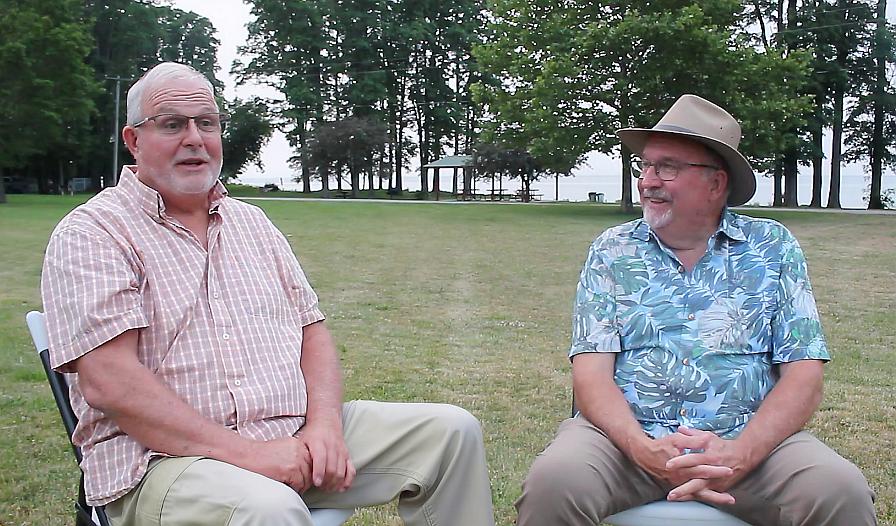
[From left] Former Apple Growers of the Year Rod Farrow (2017) and Darrel Oakes (2004) in deep conversation.
Photo: Thomas Skernivitz
BUILDING AN INDUSTRY
Oakes traces much of that spirit to Lamont, who died in 2020 at 83.
“He took the industry by the horns, literally single-handedly, on his own dime and on his own time,” Oakes says.
Over a two- to three-year period, Lamont helped bring growers and industry players together to address problems collectively.
“That is still reverberating and gives us the opportunity to talk together, to work together,” Oakes says. “That’s been the hallmark of this industry.”
Farrow worked with Lamont for 40 years. Lamont Fruit Farm became the first farm to produce two Apple Growers of the Year when Farrow won exactly 20 years after Lamont.
“It was challenging to keep up with George’s mind,” Farrow says. “He saw the big picture like probably nobody else has in our area.”
Farrow credits Lamont with helping establish Premier Apple Cooperative and bringing together marketers who previously had not been communicating.
“He was the savior,” Farrow says.
The cooperative, he says, helped growers stop working against one another and start solving problems together — sharing sales needs across New York and eventually with growers in Pennsylvania, New England, Michigan, and North Carolina.
“It was a really industry-changing moment,” Farrow says.
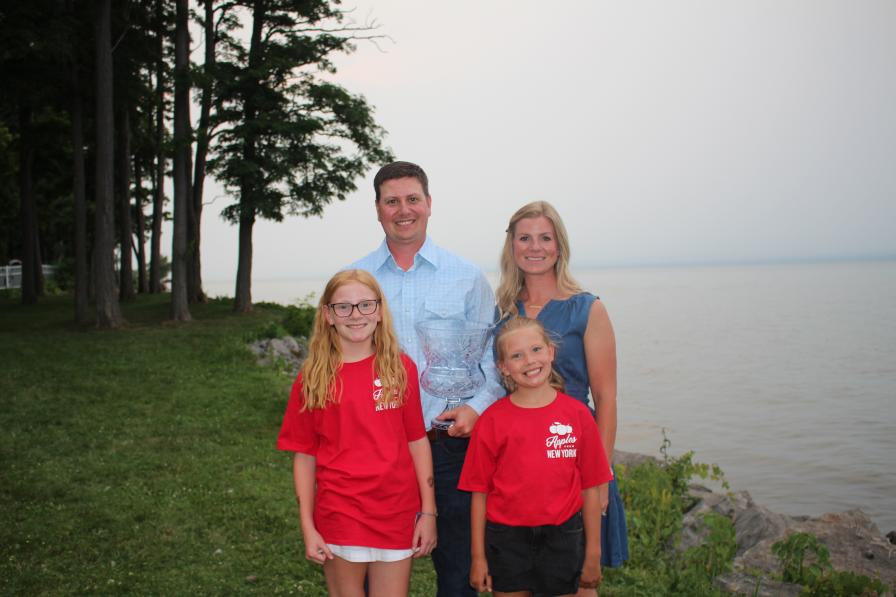
Robert “Bobby” Brown III, with wife Beth and daughters Emaline and Addison: “This will be my 20th year at our farm. I remember my dad asking me 20 years ago, ‘What do you want to do? How do you want to get involved?’ I said, ‘Well, I’d like to grow, I’d like to get more involved with our apple cider business.’ And he challenged me a little that we need to get things figured out and get our quality in order and become better growers before we expanded too much. So, I was like, ‘Well, that sounds pretty easy.’ But as we all know — we’re all in this industry together — that is extremely hard to do. And it’s taken a lot of support from our family, our employees, and everybody around us in the industry.”
Photo: Thomas Skernivitz
ROOM TO GROW
That collaborative tradition extends to the Brown family.
Farrow has known and worked with the Browns since returning to Western New York in 1986. Oakes’ relationship reaches back another generation.
“I started out as a young person, younger than Bobby, and served on a couple of different grower boards with Bob’s grandpa,” Oakes says. “He was quite a farmer.”
Oakes also remembers Brown’s parents helping develop a major direct-market operation.
“There’s been a lot of collaboration between the various families,” he says.
Farrow says he did not really get to know Brown until Brown returned from Cornell University. Since then, he has watched the operation develop into what he calls “a picturesque, beautiful farm.”
Oakes credits Brown’s father, Bob, who died last November, and uncle Eric with giving the younger grower room to make his own mark.
“They allowed Bobby to grow and institute things that made economic sense,” Oakes says. “You don’t often find that dynamic in family operations. They tend to be very hierarchical.”
BROAD SHOULDERS
That willingness to share — within families and among neighboring growers — is what Farrow and Oakes believe distinguishes Western New York.
“We’ve both been very fortunate to be in a microcosm of growers here that were willing to share and support,” Oakes says. “Whether it was machinery or mistakes — mostly mistakes.”
Farrow remembers growers meeting in orchards and gathering at a Lyndonville bar on Friday nights simply to talk apples.
“It was just like a natural network of people,” he says.
Yet cooperation does not mean Western New York growers lack strong opinions.
“I think we had our fair share of rugged individualists, regardless of the fact that we do cooperate,” Oakes says. “There’s folks with some broad shoulders.”
Brown now joins Lamont, Oakes, and Farrow as evidence that those broad shoulders have carried more than individual farms.
They have helped carry an industry — and another generation of growers — forward.
Subscribe Today For
